-

Cover Image_page-0001.jpg
-
Out 01_page-0001.jpg
-
Out 02_page-0001.jpg
-
Section 01_page-0001.jpg
-
Section 02_page-0001.jpg
-
In 02_page-0001.jpg
-
In 01_page-0001.jpg
-
Exploded ISO_page-0001.jpg
-
Double Facade_page-0001.jpg
-
Cladding Close Up_page-0001.jpg
-
Structure Close Up_page-0001.jpg
Opportune Resourcefulness
Owen Degiorgio. Corradino, Malta
-
Name of work in English
Opportune Resourcefulness
-
Name of work in original language
Reshaping the Materials Industry
Prize year
Young Talent 2025
-
Work Location
Corradino, Malta
-
Author/s
Owen Degiorgio
-
School
Faculty for the Built Environment - University of Malta.
Msida, Malta
Young Talent 2025 YT Nominees




Opportune Resourcefulness
Reshaping the Materials Industry
Program
Industrial
-
Labels
Factory · Research
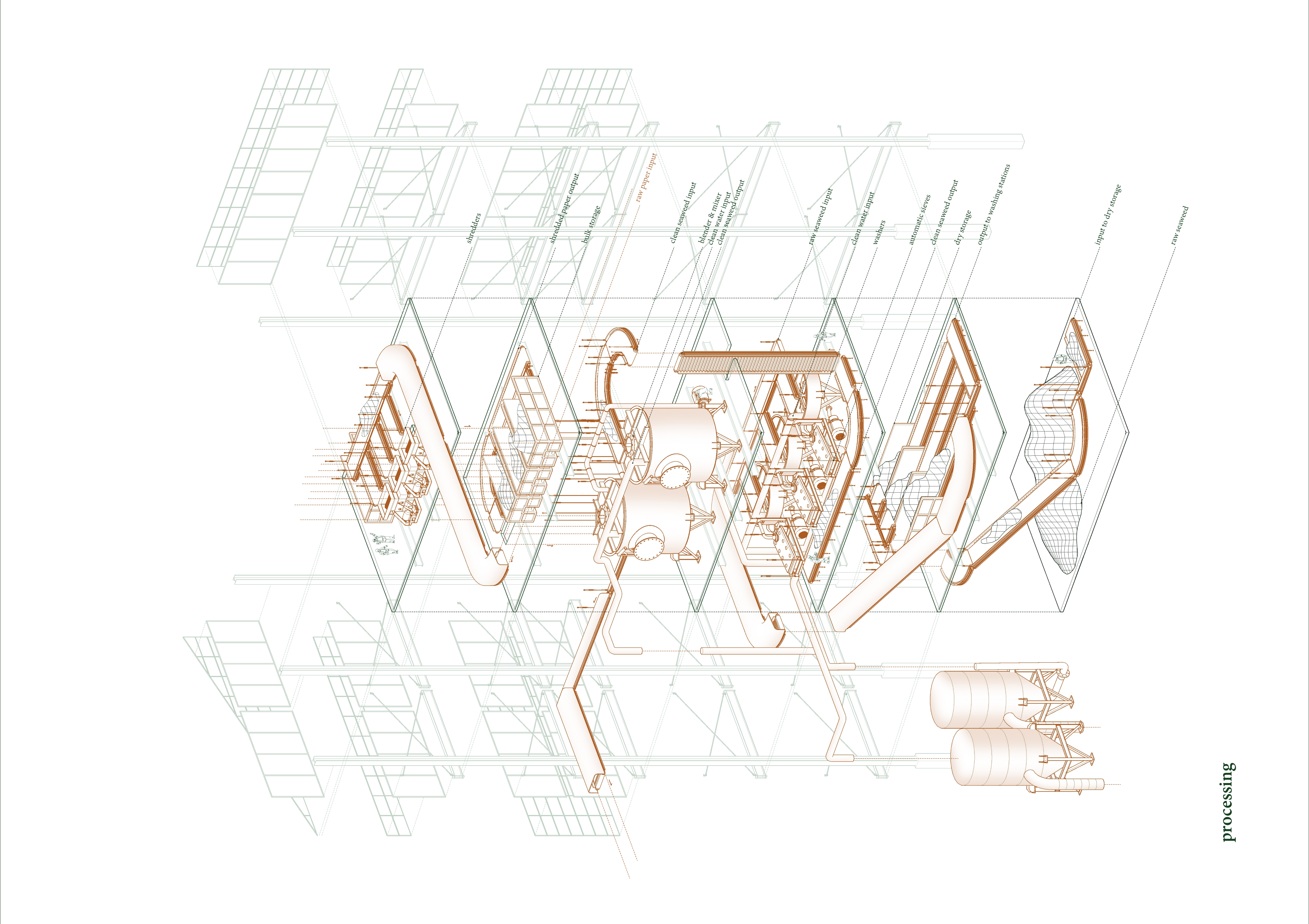
The construction industry is one of the largest contributors to global carbon emissions and material waste. Conventional building materials rely heavily on extraction and industrial processing, leading to significant environmental degradation. This project challenges existing practices by exploring the potential of Posidonia oceanica as a sustainable alternative. The aim is to establish a new material industry that utilises seagrass as a primary resource, reducing waste, promoting circular economies, and introducing an ecologically responsible approach to architecture and construction.
This project proposes the integration of a biodegradable seagrass-based composite into the construction industry to establish a closed-loop material system. The intervention takes place in Corradino, Malta, a heavily industrialised zone, and envisions a research-driven approach to sustainable material production. A fabrication process was developed using 70% seagrass pulp and 30% paper pulp, forming composite panels that exhibit fire resistance, water repellence, and insulation capabilities. These panels are biodegradable, lightweight, and adaptable for multiple applications within the built environment. The architectural proposal introduces a phased master plan, with a site-specific strategy to establish a material innovation hub. This includes a vertical processing facility for seagrass collection, treatment, and panel fabrication, integrated with research and development spaces to further material advancements. Horizontal structures accommodate research labs, administrative spaces, and exhibition areas to encourage public engagement and knowledge sharing. The project’s design is guided by a modular braced-frame system, providing flexibility for future adaptation. The material is showcased as both a structural and cladding element, reinforcing the feasibility of biodegradable construction. Additionally, environmental strategies such as seawater desalination, solar energy integration, and localised material sourcing contribute to a near net-zero operational footprint. Ultimately, this intervention redefines industrial zones as sites for ecological innovation, demonstrating how waste materials can drive architectural progress while fostering a resilient and sustainable built environment.