-

Lighting the Void
-
1. THE CITY AS A VISIBLE IDEA IS TRAPPED AT THE CROSSROADS OF URBANIZATION
-
2. STRIATIONS: STRATEGIES FOR INHABITING TIME
-
3. A PASSAGE FOR THE LIVING FLANKED BY STRUCTURES FOR THE DEAD
-
4. FROM TURBINE HALL TO CEREMONIAL NAVE
-
5. FUNERARY COMPLEX - INSCRIBING THE PERMANENCE OF DEATH
-
6. BURIAL GROUNDS - WATER ( ULTIMATE DISSOLUTION) MEETS BRICK (ARCHITECTURE AS DEATH CONFRONTING GESTURE)
-
OFF-CROSSING - PANEL
-
OFF-CROSSING
Lorenzo Uribe. Barcelona, Spain
-
Name of work in English
OFF-CROSSING
-
Name of work in original language
Death as architectural origin and end
Prize year
Young Talent 2023
-
Work Location
Barcelona, Spain
-
Author/s
Lorenzo Uribe
-
School
IE School of Architecture & Design - IE University.
Segovia, Spain
Young Talent 2023 YT Nominees


OFF-CROSSING
Death as architectural origin and end
Program
Funerary
-
Labels
Funeral Parlour · Cemetery
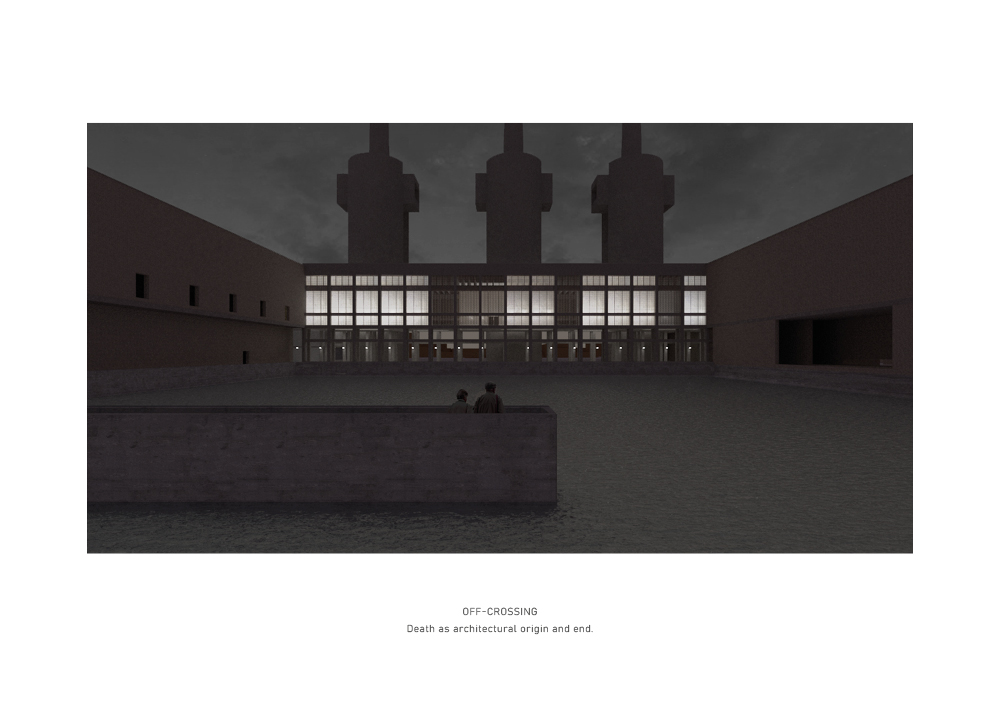
This project aims to monumentalize the presence of death as an urban experience to provide alternatives to urban development and rehabilitation. It repositions the role of the sacred as one of architecture’s principal foundations and explores the potential of the monumental to explore the opportunities of marginal terrains.
The project pays tribute to death in order to carve out a space for the living. It accepts that the historical development of Sant Adria de Besos and its encirclement by both natural and man-made boundaries is near insurmountable and irreversible, and so proposes to transform the abandoned electrical plant of Sant Adriá de Besos into a civic funerary complex and its surrounding areas into a public cemetery park. It emphasizes the undeniable fact that death will always be at a distance from the daily activities of life while it is within this distance that meaning can be found, thus creating a space for the sacred amidst the ruins of the profane. The existing turbine hall is stripped down to its concrete structure, creating a monumental skeleton with a series of chapels on its upper level (a great ceremonial nave) and a fully open lower level (a wide civic bridge) connecting to an urban passage underneath. This passage intends to run along the whole site, thus linking the beachfront of Badalona to the existing promenade along the Besos. This urban procession brings back quasi-Baroque forgotten notions of meaning and theatricality into the experience of the contemporary urban condition. The climax of this experience is placed at the feet of the turbine hall by excavating the shoreline and bringing the sea to meet the building. On the opposite side, a shallow pool mirrors the effect of the sea and creates a solemn entrance to the funerary complex. Rather than pursuing naive formulae for a 'new urban birth’, the project tries to create a space for the remembrance of death and for the reinsertion of ritual into an increasing utilitarian conception of architecture, onto which considerations of form are then subscribed. If the discussion of ‘program’ seeks ever more efficient forms, ‘ritual’ opposes it by the fixed nature of its forms. The project translates this into a series of austere volumes whose interior connects a series of private chambers to urban rooms and platforms through long meditative hallways that dramatize thresholds and embed a ceremonial sense to the whole circulation.