-

Visuals for EUMies Awards 19.2.2025.jpg
-
Visuals for EUMies Awards 19.2.20252.jpg
-
Visuals for EUMies Awards 19.2.20253.jpg
-
Visuals for EUMies Awards 19.2.20254.jpg
-
Visuals for EUMies Awards 19.2.20255.jpg
-
Visuals for EUMies Awards 19.2.20256.jpg
-
Visuals for EUMies Awards 19.2.20257.jpg
-
Visuals for EUMies Awards 19.2.20258.jpg
-
Visuals for EUMies Awards 19.2.20259.jpg
-
Visuals for EUMies Awards 19.2.202510.jpg
Observing the experience of time through the serial vision technique
Jasmiina Knaapi. Helsinki, Finland
-
Name of work in English
Observing the experience of time through the serial vision technique
Prize year
Young Talent 2025
-
Work Location
Helsinki, Finland
-
Author/s
Jasmiina Knaapi
-
School
School of Arts, Design and Architecture, Department of Architecture - Aalto University.
Espoo, Finland
Young Talent 2025 YT Nominees



Observing the experience of time through the serial vision technique
Observing the experience of time through the serial vision technique
Program
Urban planning
-
Labels
Public Space · Waterfront · Master plan · Heritage · Memorial · Redevelopment
Time is at the centre of architecture – buildings age, cities evolve, and our perception of place shifts through movement. Despite this, design rarely considers time, reducing places to static objects rather than unfolding, sequential experiences. This affects not only how places endure but how they are felt, used, cared for and remembered. This thesis explores how time is observed in architecture and how its perception shapes our connection to place. By focusing on the experience of time, this study calls for a stronger consideration for continuity and temporality in the built environment.
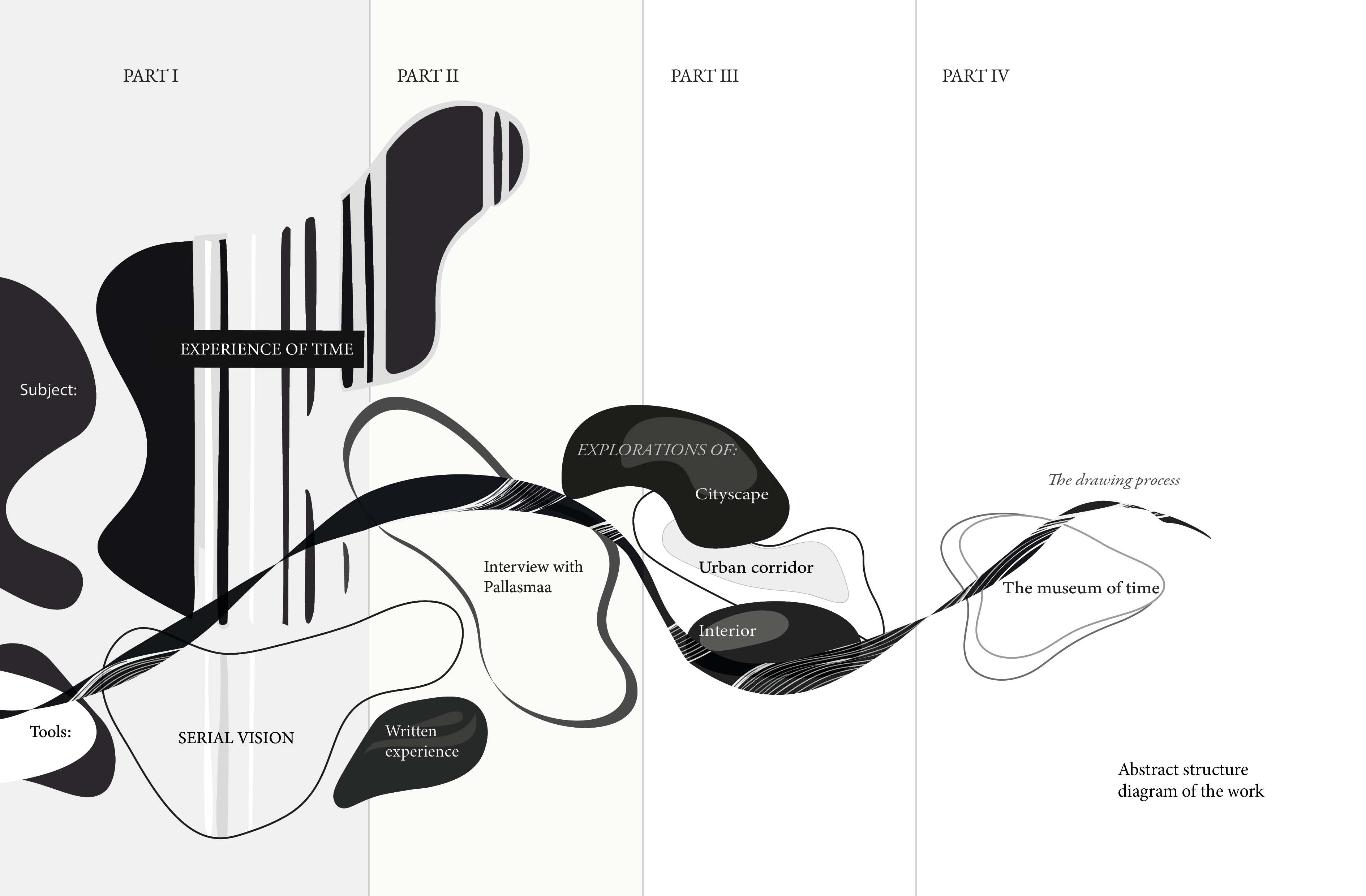
This study investigates if the experience of time can be recognised through the serial vision technique, capturing architectural sequences revealed during movement. By mapping a journey through Helsinki’s South Harbour, Eteläsatama, it explores how time is perceived at different scales and whether the tool effectively reveals this experience when transitioning from one scale to another. The process begins with a theoretical framework, first defining the serial vision technique and then continuing to the broader topic of the experience of time. The study looks at Gordon Cullen’s The Concise Townscape (1961) and Henri Bergson’s theories on time and perception, linking movement, memory, and architectural experience. To deepen this understanding, an interview with Juhani Pallasmaa further discusses how time is embedded in architecture, offering insights from both his perspective and my own thoughts. The drawn explorations consist of three linked journeys, each moving through a different scale. The first takes place in Eteläsatama, an open harbour area where vast views and historical layers reveal time’s presence. The second journey continues to an urban corridor, transitioning from the expansive harbour into the denser city. Finally, the third journey enters a church’s interior concluding the journey from macro to micro. Through the serial vision drawings the sequences offer glimpses into how time is sensed and observed in movement. The study concludes by reflecting on how serial visions can reveal architectural time and advocates for a more integrated approach to time perception in design. By reconsidering how we observe time and place this research calls for a deeper awareness of continuity, temporality, for traces of time in our lived environment and movement.