-

showcase factory - east facade
-
courtyard - place of encounter and communication
-
foyer - entrance and spatial hinge
-
open gallery - working environments
-
production hall - industry 4.0
-
landmark in the landscape
-
site Plan
-
ground floor plan
-
first floor plan
-
section
-
west elevation
New Rosink Building
Westphal Architekten BDA. Nordhorn, Germany
-
Name of work in English
New Rosink Building
-
Name of work in original language
Neubau Rosink Nordhorn
Prize year
EUmies Awards 2026
-
Work Location
Nordhorn, Germany
-
Studio
Westphal Architekten BDA
EUmies Awards 2026 Nominees

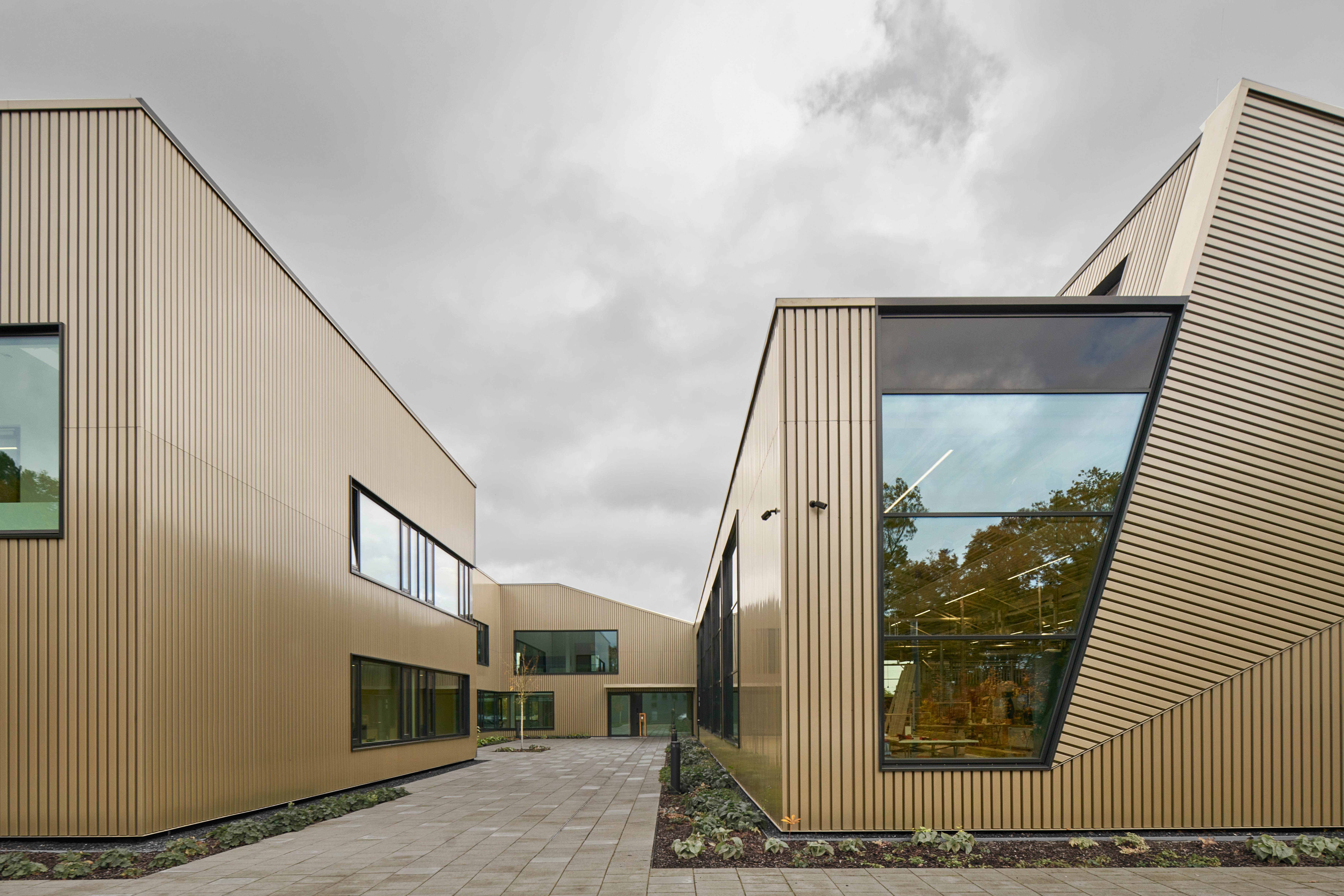


The Showcase Factory in Nordhorn establishes a contemporary identity for Rosink. A flexible synthesis of production and administration, it forms a distinctive corporate architecture where transparency, dialogue, and sustainable design create lasting value.
Collaborators
Landscape: Anke Deeken Büro für Architektur Stadt- und Freiraumplanung Lichtplanung; Construction management: Lindschulte Ingenieurgesellschaft mbH; Fire Safety and Accessibility: Böcker Ingenieure GmbH
Program
Industrial
-
Labels
Factory
Site area
31242 m²
-
Client
VR Besitz GmbH & Co.KG, Bentheim – Jan Lucas Veddeler
Total gross floor
5766 m²
The Showcase Factory in Nordhorn by Westphal Architekten BDA combines production and administration for Rosink Objekteinrichtungen in a single expressive structure. Set along the highway B213, it strengthens the company’s identity through a clear urban gesture, a shimmering anodized aluminium façade, and transparent spatial links. Sustainable systems and a flexible framework enable adaptability and reflect a contemporary industrial culture.
The new production and administration facility was designed as a powerful architectural statement that reflects the company's identity and supports its long-term operational needs. The building creates a strong visual presence along the B213 highway and serves as both a functional workplace and a symbol of the company's culture. The design strategy focused on creating a flexible, future-proof environment that fosters employee identification, improves internal collaboration, and represents the company and its woodworking production to the outside world. The floor plan connects the production hall and the two-story office wing through an open, multifunctional axis – the "Rosink" courtyard – which serves as a place for communication, exhibitions, and expansion. The dialogic spatial concept strengthens the relationships between administration and production teams through visual connections, transparent structures, and shared spaces.
A wide-span steel structure with a modular shed roof structure creates maximum flexibility for diverse production scenarios. The outer shell is made of individually folded, anodized trapezoidal aluminum sheeting, which not only creates a distinctive appearance but is also low-maintenance and durable. Sustainability is achieved through simple yet effective measures: the entire roof area is covered with photovoltaic modules, and the shed roof maximizes the use of daylight. Heating is provided, in keeping with the circular economy concept, through the energetic utilization of the building's own wood waste from production. Mechanical ventilation with heat recovery ensures efficient fresh air supply to the offices – without noise pollution from the adjacent federal highway. The project thus combines design, functionality, and ecological responsibility.