-

Architectural Island Creatures
-
[Re]staging Island Materials
-
[Re]staging Island Creatures
-
The [Dis]section Table
-
Bogland Creature 01 - The Laminator
-
Island Exhibition
-
The Concealed Crypt
-
Island Panel
-
New Non-Antropocentric Agencies
Jedda Desmond. Cork, Ireland
-
Name of work in English
New Non-Antropocentric Agencies
-
Name of work in original language
Uncanny [Re]Enchantment
Prize year
Young Talent 2023
-
Work Location
Cork, Ireland
-
Author/s
Jedda Desmond
-
School
School of Engineering and Architecture, SEFS - University College Cork & Munster Technological University.
Cork, Ireland
Young Talent 2023 YT Nominees
![[Re]staging Island Materials](https://d10ic2gxw9yhll.cloudfront.net/public/DigitalAsset/3e507923b8e3fdc04f5e09dd730aaa1e/3e507923b8e3fdc04f5e09dd730aaa1e/full/original/0/default.png)
![[Re]staging Island Creatures](https://d10ic2gxw9yhll.cloudfront.net/public/DigitalAsset/36b97abe3019a4d5060cc4950911af7c/36b97abe3019a4d5060cc4950911af7c/full/original/0/default.png)
![The [Dis]section Table](https://d10ic2gxw9yhll.cloudfront.net/public/DigitalAsset/3b888f813664fce34c8b50392de8d13c/3b888f813664fce34c8b50392de8d13c/full/original/0/default.png)


New Non-Antropocentric Agencies
Uncanny [Re]Enchantment
Program
Landscape
-
Labels
Regeneration
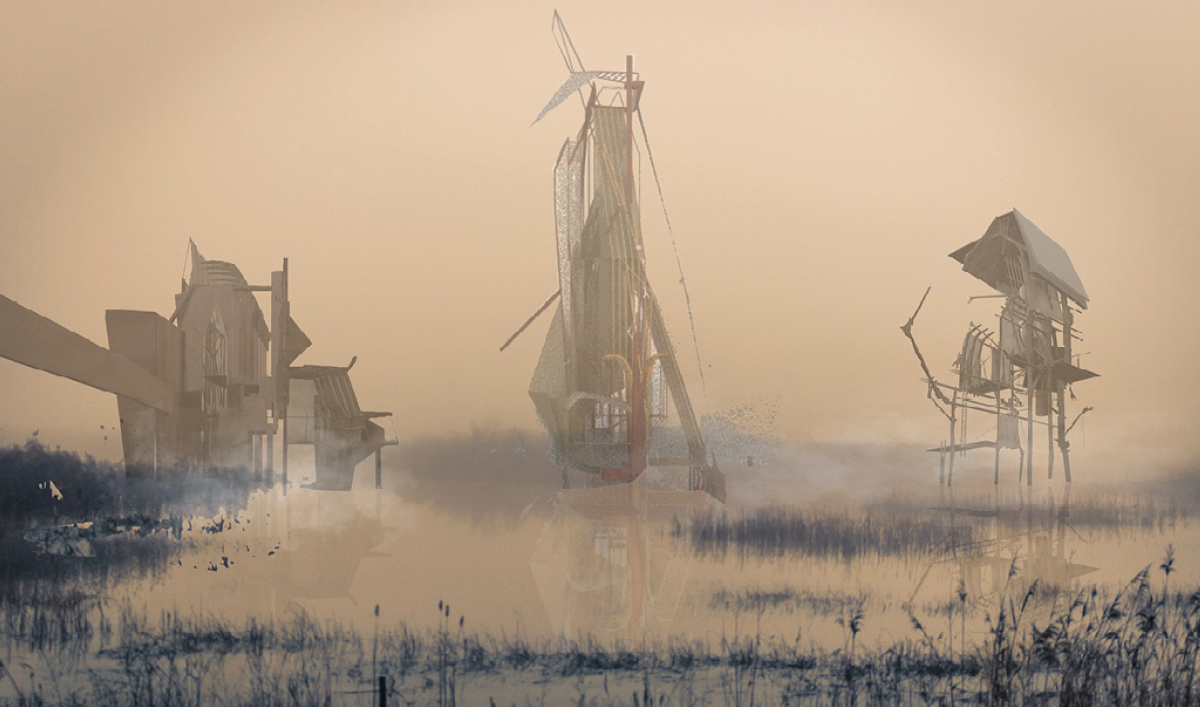
The project introduces Architectural Agencies or Creatures, which inhabit the island of Inishbofin at various prominent locations. These creatures are a direct result of the island context island, as one of social and physical vulnerability. The Creatures seek to remediate the depleted landscape and become representative of new bodily autonomy.
The project aims to examine and illuminate the precarities of vulnerable ecosystems against the forces of the Anthropocene especially around the climate crisis. Inishbofin, an island off the West coast of Ireland, is identified as an 'enchanted' island draped in myth and colonial legacies, the latter which has egregiously altered it's social and physical landscapes, acting as synecdoche for the larger Irish and global concerns of the climate crisis through systematic human intervention. The project therefore seeks to create new engagements of landscape through architectural embodiments that respond to social, political, and climactic consequences of colonialist and post-colonialist practices. \nThe thesis identifies a direct uncanny doubling of islands and Boglands within the island, emphasising these as both invaluable repositories of myth, literature, philosophy, and geography, and equally as both bodies of land and water, extremely vulnerable to ecological threat.\nThe threat to these bodies is perpetuated by the island's colonial legacies, notably inclusive of the Anthropologic studies conducted at the turn of the 20th Century, creating a prompt for new readings of the the word 'body' - the human body, the bog body, bodies of land and water. These readings have led to the drawing out of relationships between the sciences and humanities, ultimately creating new non-anthropocentric agencies in the form of architectural creatures.\nThese creatures which evolved through making, were layered, folded, and extruded, to embody figural, spatial, and architectural language resulting as expressions of new bodily autonomy, with the ultimate goal of landscape remediation. \nThe thesis therefore questions; In what ways do islands serve as laboratories, or synecdoche of larger land masses? How does the fascination surrounding islands and Boglands, and equally the loss of island-lands and Boglands directly relate to the Anthropocene? What effect has colonialist practices had on these contexts? And lastly, how might architecture have a role in thinking about landscape remediation?