-

EAST FAÇADE-ARRIVAL OF BLUE FISH
-
WEST FAÇADE-ARRIVAL OF WHITE FISH
-
WEST FAÇADE-VISITORS WALKWAY
-
PURSE SEINE FISH AUCTION ROOM
-
CENTRAL ACCESS AREA WITH PERGOLA
-
NORTH FAÇADE FISHING NET REPAIR
-
SITE PLAN
-
GROUND FLOOR
-
FIRST FLOOR
-
SECTIONS
New Fish Market at the Barcelona Port
OAB Office of Architecture in Barcelona. Barcelona, Spain
-
Name of work in English
New Fish Market at the Barcelona Port
-
Name of work in original language
Nova Llotja de Pescadors al Port de Barcelona
Prize year
EUmies Awards 2026
-
Work Location
Barcelona, Spain
-
Studio
OAB Office of Architecture in Barcelona
EUmies Awards 2026 Nominees

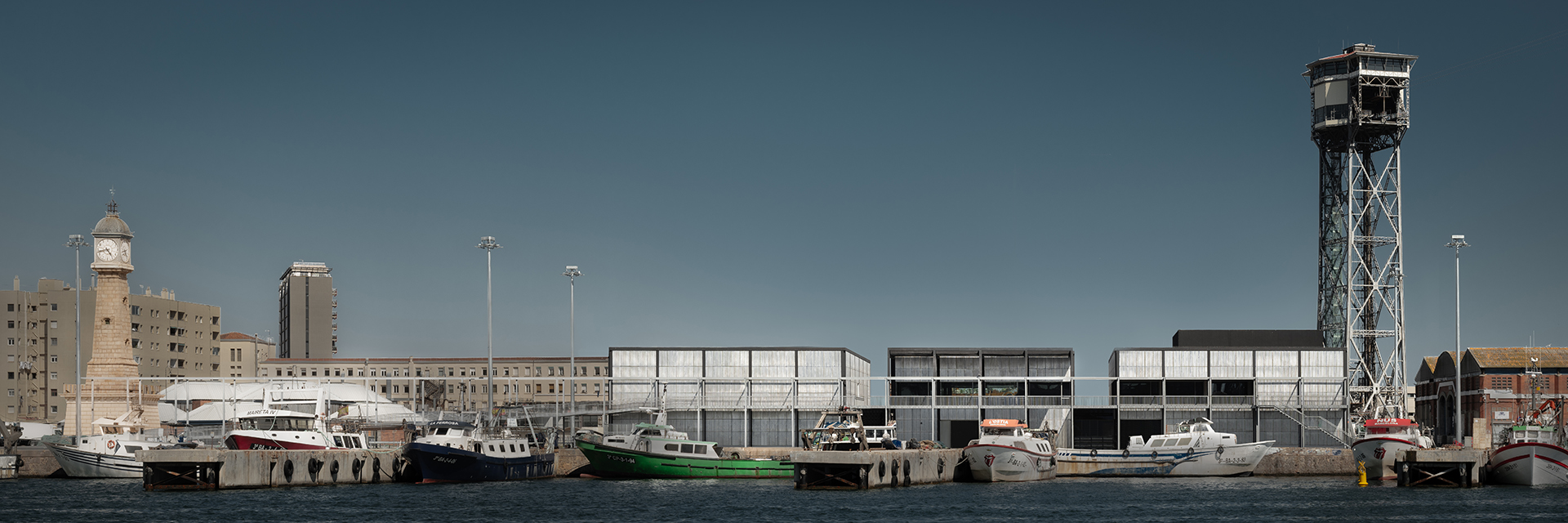


The building houses the new facilities of the Barcelona port fish auction, an activity in the primary sector, as well as the new spaces intended for the Fishermen’s Guild. All of this is presented with functional architecture that is accessible to visitors while being mindful of the port environment
Collaborators
Collaborator (office): Diana Martínez; Construction management: Fran Godoy - Meta Engineering; Photograph: Joan Guillamat
Program
Mixed use - Commercial & Offices
-
Labels
Compact · Market · Office
Site area
24103 m²
-
Client
Autoritat Portuària de Barcelona
Total gross floor
4126 m²
Cost
1999 €/m²
The new building is located on the Baleares dock, next to the historic Clock Tower. The construction is organized into three independent volumes connected to each other, with clearly differentiated functions. The north block is designated for buyers. The south block houses the box warehouse, the ice factory, the facilities, and the fishermen’s canteen. The central block accommodates the administration and management of the fishermen’s guild. The exterior finish consists of an aluminum cast panel cladding, produced from a mold specifically designed for this building.
The new fish market redefines the connection between the city and its maritime activity. It not only meets the functional demands of fishing and commercial operations but also proposes a model of openness, education, and sustainability within its urban context One of the key design decisions was to incorporate an elevated perimeter walkway, accessible from the street via a ramp located next to the Clock Tower. This walkway allows citizens and visitors to observe fish unloading and auction operations without interfering with professional tasks, creating a learning experience. Additionally, a future restaurant will reinforce the building's hybrid nature, bridging the productive and urban realms. The market is not just a facility for the primary sector: architecture unfolds a social function. Becomes an urban gesture that revitalizes the relationship between the port and the city by making a centuries old trade visible, activating collective memory, and re-signifying the port landscape.
The building is strictly modular, with a structure of in-situ concrete columns and beams spaced every 5 meters, and slabs constructed with prefabricated elements. These columns, treated with a dark, almost black wash, remain visible from the exterior, creating a façade rhythm. The most significant and relevant material in this project is the exterior ventilated cladding, made with aluminum cast panels produced through gravity casting in a specially designed steel mold. The aluminum casting stands out for its exceptional corrosion resistance and full recyclability. The interior partition and enclosure walls are made of painted concrete blocks. The ramp, the balcony on the eastern dock, and the connecting walkways to the building are constructed with a minimal section metal structure, evoking a certain maritime iconography. The building is designed to meet the hygiene, ventilation and energy efficiency requirements, typical of a space intended for handling food products.