-

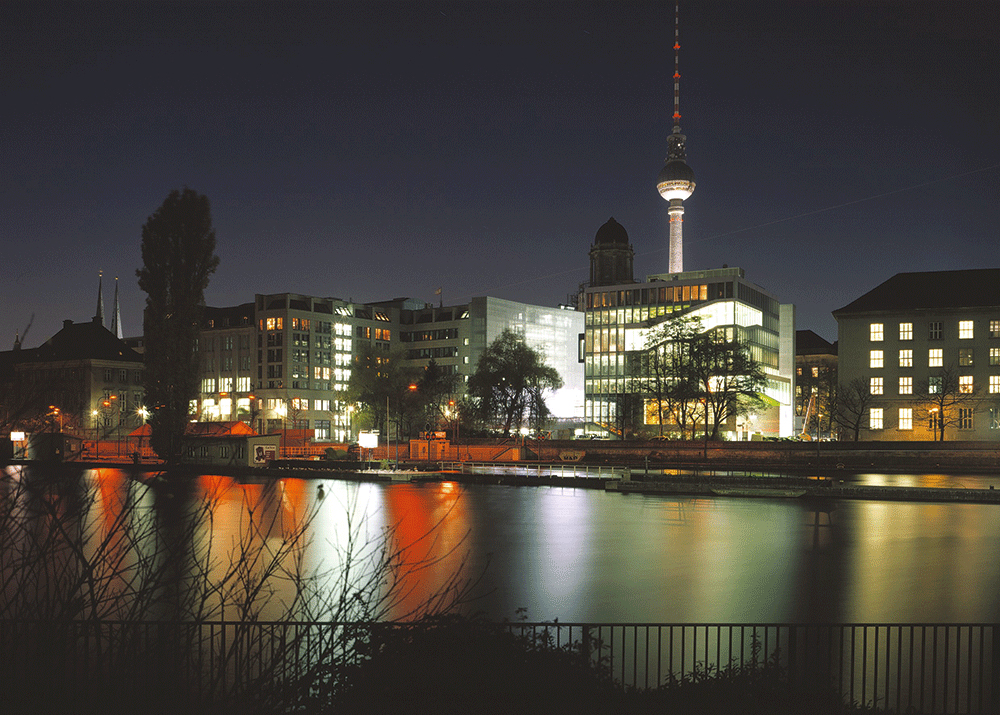
Night exterior view
-
Entrance view
-
Interior view of trajectory
-
Interior view
-
Trajectory plan with public spaces
-
cross section
-
Level 7 plan
-
Trajectory section
Netherlands Embassy Berlin
Office for Metropolitan Architecture. Berlin, Germany
-
Name of work in English
Netherlands Embassy Berlin
-
Name of work in original language
Nederlandse Ambassade te Berlijn
Prize year
EUmies Awards 2005
-
Work Location
Berlin, Germany
-
Studio
Office for Metropolitan Architecture
EUmies Awards 2005 Architecture winners


Collaborators
Structural engineering: -- Royal Haskoning, -- Arup Berlin; Others: -- Huygen Elwako (Services), -- Arup Berlin; Project management: -- Royal Haskoning; Fire consulting: -- Hosser Hass + Partner; Lighting: -- OVI; Others: -- Inside-Outside (Curtains)
Program
Government & Civic
Completion
2003
In the wake of the reunification, the German government decided to relocate the capital to Berlin 'Mitte' (Centre). The Netherlands, having sold their former embassy site after the war, was free to choose anew and preferred Roland Ufer in Mitte, next to the new government district of their main trade partner. The client demanded a solitary building integrating conventional civil service security with Dutch openness. Traditional city planning guidelines required the new building to complete the city block in 19thcentury fashion. Nonetheless, officials had an open mind towards the proposal for a freestanding cube on a blockcompleting podium. A continuous trajectory reaching all eight stories of the embassy shapes the building's internal communication. The workspaces, situated along the façade, are the 'leftovers' after the trajectory was 'carved' out of the cube. Reception spaces are activated inside the cube. Other semipublic spaces are located closer to the façade and at one point cantilever out over the dropoff area. From the entry, the trajectory leads on to the roof terrace via the library, meeting rooms, fitness area and restaurant. The trajectory works as a main air duct from which fresh air percolates to the offices to be drawn off via the double façade. This ventilation concept is part of a strategy to integrate more functions into one element. This integration strategy also applies to the structural concept. The internal walls adjacent to the trajectory are loadbearing beams that cross over each other enough to bring loads down, thereby creating big open spaces on the lower floors. Loadbearing glass mullions support the floor slabs where the trajectory meets the façade. The access road between 'cube' and 'residential wall' acts as courtyard open on one side to provide a panoramic view over the Spree and the park. In order to emphasise the difference with the surrounding stoneclad buildings, the socle and the wall with the residences are faced with aluminium.