-

facade
-
context
-
program
-
living
-
shared living unit
-
shared living space
-
structure
-
panel
-
Neighbourwood
Daniel Geistlinger, Moritz Henes. Berlin, Germany
-
Name of work in English
Neighbourwood
-
Name of work in original language
Circular Timber Building for collective housing at Haus der Statisti
Prize year
Young Talent 2023
-
Work Location
Berlin, Germany
-
Author/s
Daniel Geistlinger, Moritz Henes
-
School
Faculty VI, Planning, Building and Environment - Technical University of Berlin.
Berlin, Germany
Young Talent 2023 YT Nominees




Neighbourwood
Circular Timber Building for collective housing at Haus der Statisti
Program
Collective housing
-
Labels
Social · Master plan
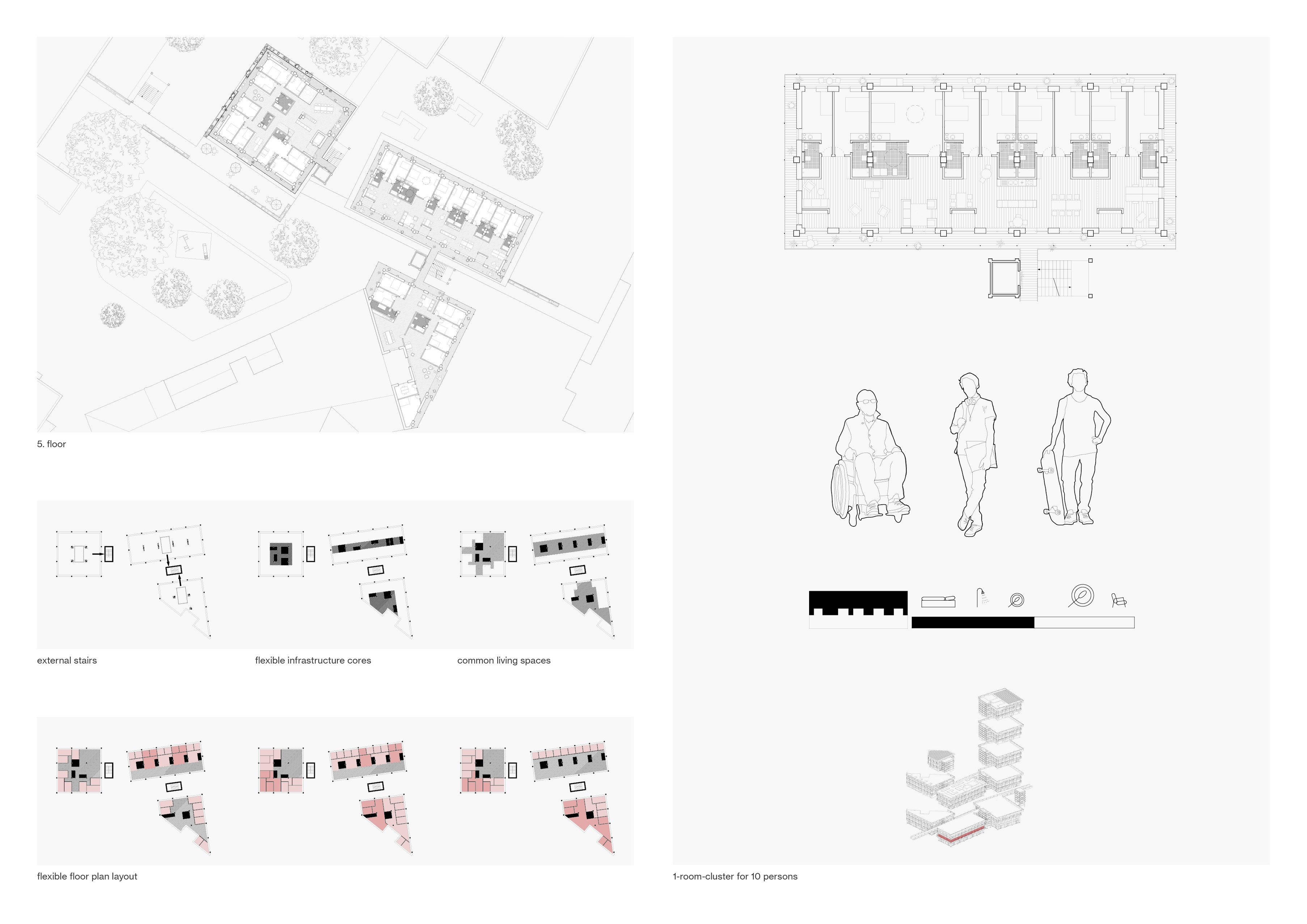
The circular conceived building ensemble "Neighbourwood" is a part of the model project Haus der Statistik in Berlin. The three building sections in timber construction connect the existing and new neighborhoods and offer space for collective and experimental living, working and culture.
At the Haus der Statistik in central Berlin a unique model project is currently being developed, in which public and private actors are working together in a cooperative process to develop the area into a mixed-use and social quarter. The building ensemble "Neighbourwood" is based on the resulting urban planning idea, integrated into the existing structures and offers space for living, working and culture. The three separately arranged volumes react specifically to the neighboring buildings and allow an independent flexible use and reuse of the individual building parts, whose form and size are based on the grid of an economical timber construction. The ground floor of the buildings offers space for public facilities for visitors and the neighborhood. The boulevard on the 3rd floor connects the surrounding buildings and provides space and Rooms for the house and neighborhood community. The 6th floor offers rooms and a roof garden for the house community. The residential concept is based on neighborhoods of different sizes, which form smaller subunits of the house community. The three building typologies serve different housing types: The “row building” is characterized by a spatial layering from public to private, the “tower” vertically links the neighborhoods, and the “annex” houses assisted and conventional apartments. The variety of housing typologies and the experimental and collective level allow for a mixed residential population. The systemic separation of the supporting structure, staircase, façade, and interior finishes allows elements to be adjusted independently of each other and a free and flexible interior space. The primary structural system of the buildings is based on a circular conceived superimposed timber framework: struts and columns running over three floors carry the horizontal and vertical loads while every third-floor slab is designed as a cross-laminated timber slab. Attention was paid to detachable connections so that the components can be dismantled again later without causing damage and keep the used materials in the cycle.