-

The Reformed Nursery School in its original contour and the modern entrance building
-
View towards the separation wall
-
The renovated stairwell, with original color schemes of the former school building
-
The façade of the Hollandsche Schouwburg in the original color scheme of Jan Leupen
-
The new entrance hall of the Hollandsche Schouwburg refers to the original design by Jan Leupen
-
The Plantage Middenlaan with a view of the Reformed Nursery School and Hollandsche Schouwburg
-
The National Holocaust Museum
-
First floor of the National Holocaust Museum
-
Former Nursery School and the new pavillion
-
The Hollandsche Schouwburg
-
Ground floor of the Hollandsche Schouwburg, with the memorial site
-
Site map of the two buildings at the Plantage Middenlaan
National Holocaust Museum
Office Winhov. Amsterdam, The Netherlands
-
Name of work in English
National Holocaust Museum
-
Name of work in original language
Nationaal Holocaustmuseum
Prize year
EUmies Awards 2026
-
Work Location
Amsterdam, The Netherlands
-
Studio
Office Winhov
EUmies Awards 2026 Nominees
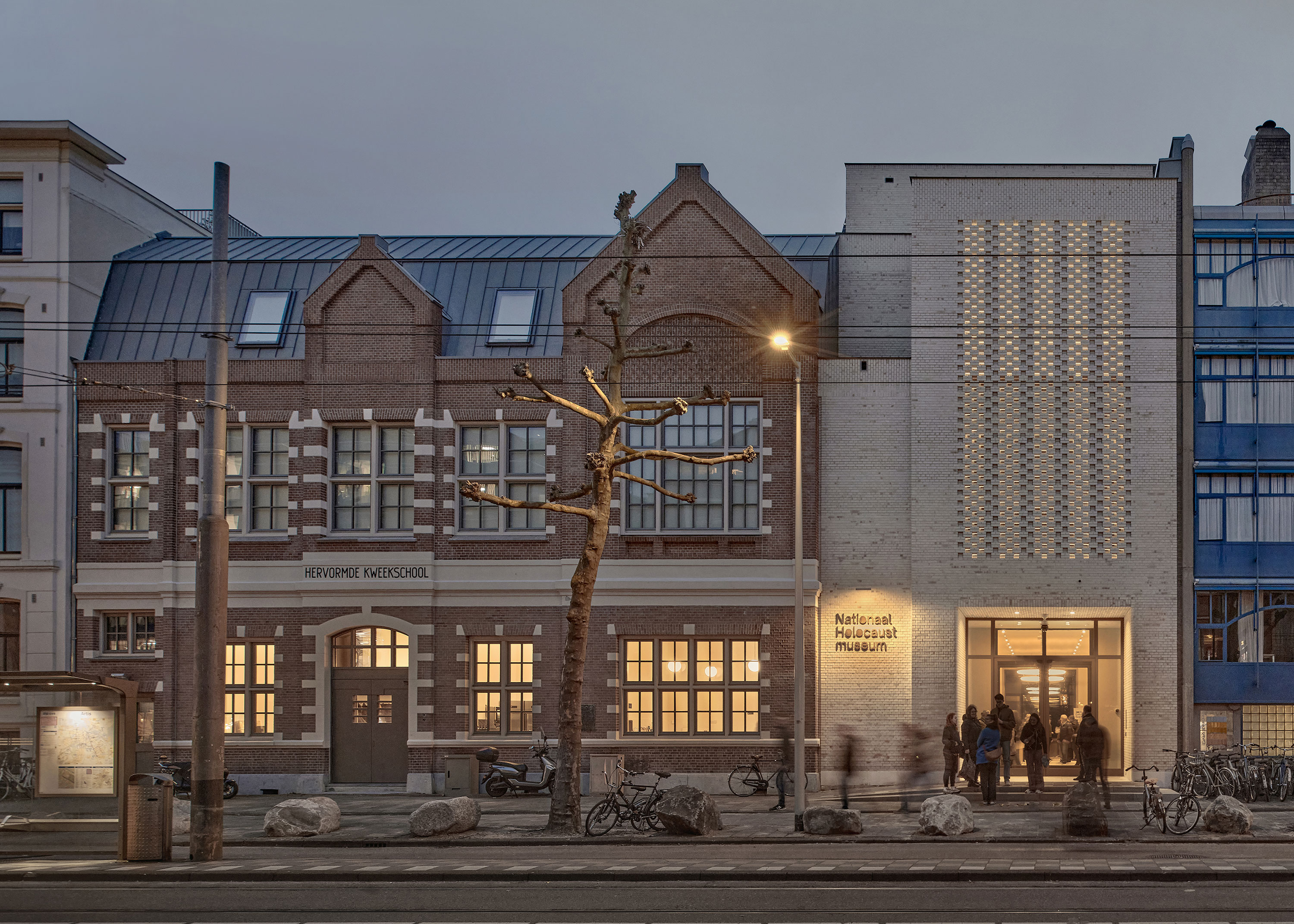


In a former teacher training school and the building across the street, the Hollandsche Schouwburg, a story unfolds of deportation and resistance. Here, 600 children were saved. Office Winhov created a space where personal stories continue to resonate — this is where it happened.
Collaborators
Fysical Exhibition Design: Boaz Bar Adon - Opera Amsterdam; Narrative Exhibition Design: Barend Verheijden - Studio Louter; Colour Research: Josefien Tegelaar; Contractor: Edwin Swart - De Nijs; Structural Engineer: Willem Klaverveld - ABT; Buidling Physics and Fire Safety: Kitty Hijbers - ABT; Cost Calculation: Mario van Veen - IGG Bouweconomie BV; Advisor on monumental interventions: M&A (Gemeente Amsterdam)
Program
Culture
-
Labels
Museum · Memorial · Heritage · Exhibition
Site area
4100 m²
-
Client
Stichting Hollandsche Schouwburg
Total gross floor
3050 m²
The National Holocaust Museum in Amsterdam, opened in 2024, is housed in a former teaching training school, forming a unified memorial with the Hollandsche Schouwburg theatre across the street. The museum documents the persecution of Dutch Jews during the Holocaust, specifically highlighting how 600 children were smuggled to hiding places via the school. Architecturally, the design by Office Winhov respectfully enriches historical elements, including restoring the contour of the building’s characteristic facade and classroom layout, while introducing modern interventions like a new pavilion for exhibition space and an auditorium. The robust brickwork of the façade evokes Amsterdam School architecture, grounding the contemporary design in local context while allowing personal stories to remain central to visitors’ experience.
The National Holocaust Museum confronted the challenge of creating a respectful memorial space that honours two distinct but interconnected narratives without overshadowing personal stories through heavy-handed design. The primary strategy was to allow architecture to serve history rather than dominate it. Office Winhov addressed the spatial separation of the two buildings by recognising that the street Plantage Middenlaan itself was integral to the escape narrative, Nazi guards’ views were blocked by the tram, enabling children to flee through the front door. Key interventions involved re-exposing the back garden wall used in the escape route and restoring the school’s former atmosphere through architectural cues: the facade contour, classroom structure and characterising materials. Rather than imposing interpretation, the design creates mental space for visitors’ own consciousness-raising.
The museum preserves its original masonry walls and timber beams, honouring the building’s historical character. Two types of brick were carefully selected to complement the existing structure: a brown restoration brick, creating a subtle transition in the roof extension, and a white brick for the new museum entrance, emphasising lightness and openness. Reflecting the museum’s philosophy of revealing stories, the interplay of color, material, and light plays a crucial role in the design. Across the street, the Hollandsche Schouwburg features materials that reinterpret the 1960s memorial, much of which has unfortunately been lost over time. Its contemporary exterior materials reinforce the sense that the building is an extension of the surrounding public space. Sustainability guides the design through a minimalist “build only what’s necessary” approach. Wherever possible, building components were reused to minimise CO₂ emissions. Retrofitted insulation enhances thermal comfort while safeguarding the existing structure from moisture. A ground-source heat pump delivers efficient heating and cooling.