-

Museum of Modern Art in Warsaw East Elevation
-
Museum of Modern Art in Warsaw Central Stair
-
Museum of Modern Art in Warsaw +2 Level Monumental Gallery
-
Museum of Modern Art in Warsaw West facade
-
Museum of Modern Art in Warsaw +1 Level
-
Museum of Modern Art in Warsaw East facade
-
Site Plan
-
Level 0 Plan
-
+1 Level Plan
-
+2 Level Plan
-
Building Section
Museum of Modern Art in Warsaw
APA Wojciechowski Architekci, Thomas Phifer and Partners. Warsaw, Poland
-
Name of work in English
Museum of Modern Art in Warsaw
-
Name of work in original language
Muzeum Sztuki Nowoczesnej w Warszawie
Prize year
EUmies Awards 2026
-
Work Location
Warsaw, Poland
-
Studio
APA Wojciechowski Architekci, Thomas Phifer and Partners
EUmies Awards 2026 Nominees
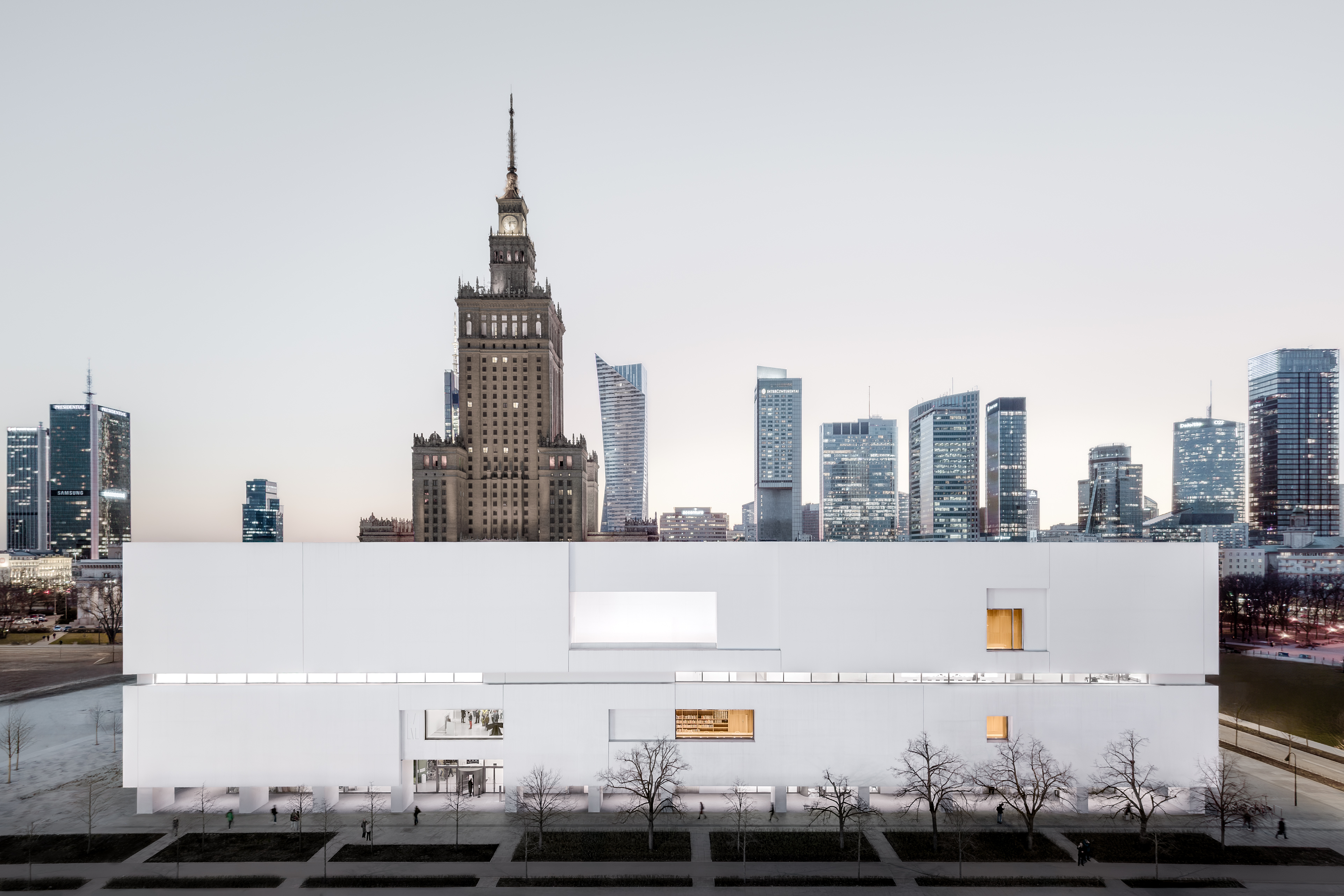


The new Museum of Modern Art in Warsaw is the institution’s first permanent home since its founding in 2005. A white cast-in-place concrete façade expresses a timeless presence. Daylit interiors illuminate the collection, bringing local perspectives into the international realm of contemporary art.
Collaborators
Engineering: Buro Happold; Concrete Façade Engineering: Structure: Skidmore, Owings and Merrill; Construction management: Portico Project Management; Owner's Representative: Paratus Group; Lighting: Arup; Gallery Acoustics: Arup; Building Acoustics: AkustiX; Audio Visual Consultant: Harvey Marshall Berling Associates; Building Enclosure Consultant: Studio Profil; Surveyor: PROGEO; Fire Protection: Tadeusz Cisek - PROTECT; Cost Consultant: LB-Projekt; Kitchen Consultant: Bartosz Cerynger; Sanepid Consultant: Halina Nejno; Health and Safety Consultant: Bartlomiej Nowak; Greenery Consultant: IN&OUT Architekci Krajobrazu; Road Engineer: PPKD; Geotechnical Investigation: ZBG Geotest; Graphic Design: Ludovic Balland; STR - Local Architectural Concrete Façade Engineering: Maciej Luczak - STRUKTURA; Architectural Concrete Consultant: Krzysztof Kuniczuk - Technologia Betonów Architektonicznych i Specjalistycznych
Program
Culture
-
Labels
Museum · Cinema · Culture Centre · Art Gallery
Site area
6603 m²
-
Client
Museum of Modern Art in Warsaw
Total gross floor
19788 m²
Cost
8146 €/m²
The museum is in central Warsaw’s Plac Defilad, between the Soviet-era Palace of Culture and Science and the modern, commercial Marszałkowska Street. The site encapsulates layers of history, from war and Communism to Poland's transformation. The building’s program includes galleries, offices, an open auditorium, a monumental staircase, a café, a public forum, and a cinema tower. The building’s freely accessible and glazed ground floor, continuous arcade, and European ash-lined “city rooms” connect interior life with the urban square, inviting light, transparency, and civic participation.
The project’s completion marks a feat of perseverance to build on the site, an accomplishment many considered impossible due to land disputes, subway construction, and other hurdles over many decades. Set amid post-war reconstruction and political memory, the museum had to establish a contemporary cultural identity beside Stalin’s towering Palace of Culture. Thomas Phifer’s strategy is one of restraint: clarity over spectacle, weight over decoration, and indifference to the vicissitudes of fashion. A fixed suite of daylit galleries replaces the institution’s twenty years of nomadism with permanence. An open and transparent ground floor welcomes all without tickets to participate. The museum’s vision for zero on-site parking prioritized access to transit and bicycle paths. Durable concrete and measured proportion assert confidence and stability, transforming a site once marked by political ideology into one of social inclusion, discourse, and cultural engagement.
The concrete façade has limited expansion joints, was cast entirely in situ, and hangs from the structure, all above active metro tunnels. Galvanized reinforcement, elastomeric bearings, and controlled jointing ensure durability. Locally sourced aggregates, a reduced carbon cement mix, and reused metro foundations reduced embodied carbon. Triple-glazed windows with solar coatings, clerestories, and skylights allow daylight to enter, while motorized shades and scrims reduce glare and heat gain. Continuous insulation, radiant heating, LEDs, and occupancy sensors lower energy use and operational carbon. Trees and permeable paving mitigate the heat island effect. Service equipment is in the basement and on the roof for discrete service and maintenance. Accessible wall cavities allow for easy adjustments to dampers and controls. The site design allows for all exterior maintenance to be performed from mobile lifts on all sides of the building. Exterior concrete has a graffiti-proof coating.