-

Concert of the Karlovy Vary Symphony Orchestra
-
Chamber music concert
-
Side entrance to the hall
-
Entrance from foyer
-
Foyer under the structure
-
Musicians of the Karlovy Vary Symphony Orchestra
-
Visualization of an inserted concert hall in the historical hall (engine room)
-
Concept sketch
-
Axonometric scheme
-
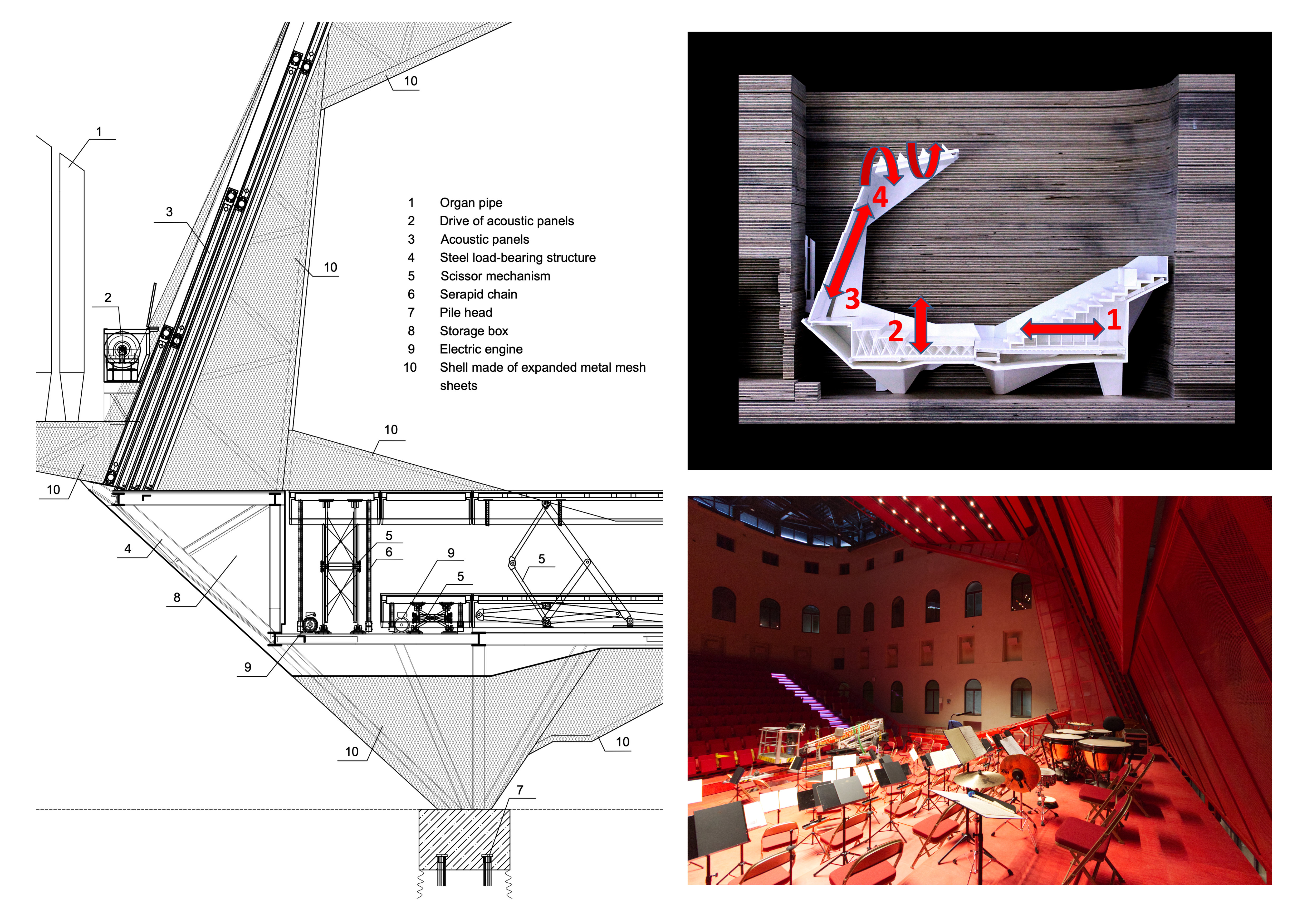
Stage front detail with serapid and acoustic panel lifts, Diagram of Variable Acoustics and Stage Te
-
Plan and section
-
Model
Multifunctional Hall in Imperial Spa
Petr Hájek ARCHITEKTI. Karlovy Vary, Czechia
-
Name of work in English
Multifunctional Hall in Imperial Spa
-
Name of work in original language
Multifunkční sál v Císařských lázních
-
Work Location
Karlovy Vary, Czechia
-
Studio
Petr Hájek ARCHITEKTI
Nominees
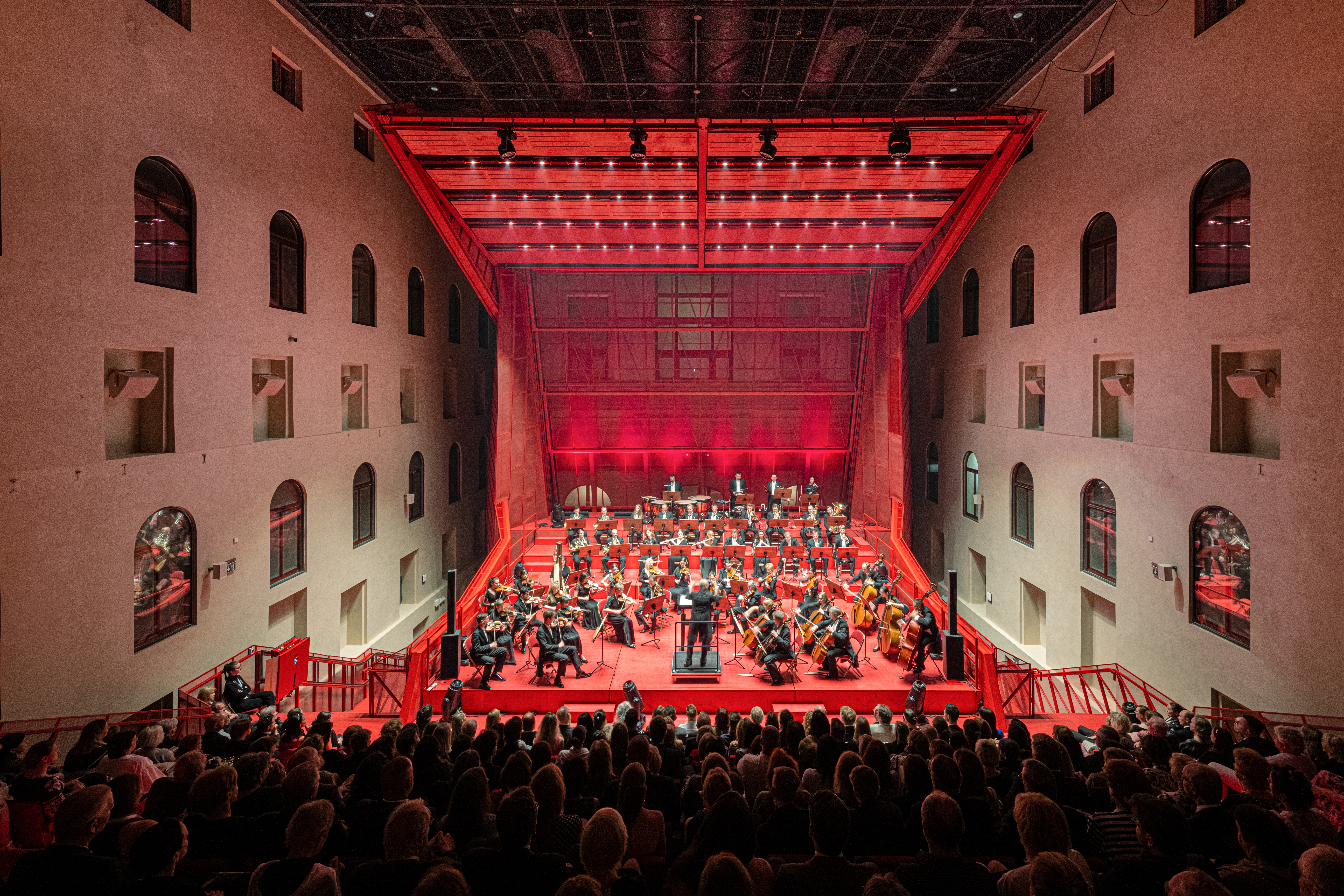


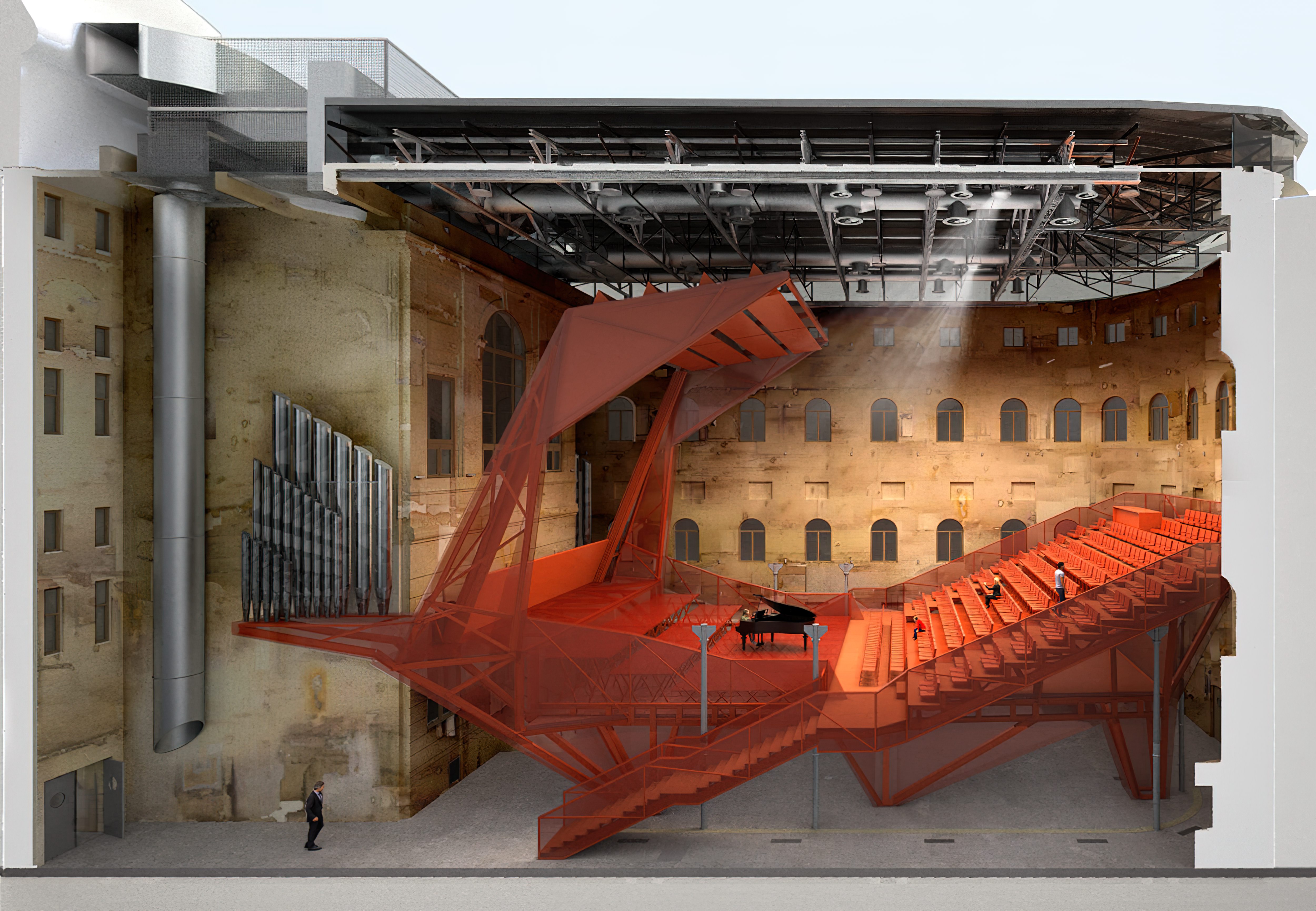




The Imperial Spa (design by Fellner & Helmer) in Karlovy Vary (UNESCO), a 19th-century listed national cultural monument, has been reborn as a cultural centre. At its core – a new heart – a freestanding steel-and-wood “robot” transforms the space into a concert, dance, cinema or theatre hall.
Collaborators
Collaborator (office): Petr Vlček - AVT Group; Acoustics: Martin Vondrášek - AVT Group; Structure: Robert Nos - GRADIOR TECH; Structure: Martin Matoušek - GRADIOR TECH
Program
Culture
-
Labels
Music · Theatre · Dance · Congress Centre · Cinema · Exhibition
Site area
492 m²
-
Client
Karlovy Vary Region
Total gross floor
492 m²
Completed in 1895, the Imperial Spa has been revived as a public landmark of culture and technology. In its central atrium, once filled with the movement of peat machinery, a new autonomous and robotic structure now hovers on six steel legs. Assembled through the roof like a ship in a bottle, it forms a reversible multifunctional hall whose acoustic, spatial and visual character adapts to music, theatre, film and dance—restoring not only a monument, but the civic spirit of Karlovy Vary.
The hall is a robotic transformer with variable acoustics. When our office joined the project, the restoration of the Imperial Spa was already underway, yet the building had no defined use—it was being repaired without purpose. The design gave the monument new meaning. The original plan for a 600-seat concert hall, impossible within the fragile structure, was re-envisioned as a 300-seat multifunctional hall that would respect the building’s proportions while defining its new civic role as the home of the Karlovy Vary Philharmonic Orchestra and the cinema of the Karlovy Vary International Film Festival. The new freestanding structure, assembled through a narrow roof opening, stands independently within the historic walls. It replaces the former peat machinery with a precise cultural mechanism capable of spatial and acoustic transformation. Entirely reversible and technically refined, the intervention transforms an inert monument into a living instrument for the city’s cultural life.
The inserted hall is an autonomous steel-and-wood construction suspended within the restored spa, standing on six slender legs that touch the historic building only lightly. Steel provides structural precision and permanence; wood defines the tactile and acoustic character of the interior. All moving parts—motors, retractable platforms, acoustic curtain and rotating panels—are designed for durability and recyclability. The modular system minimises waste and energy use through shared drives and efficient mechanisms. Even the assembly crane has been transformed into a mobile stage bridge. Entirely reversible and engineered with restraint, the structure fuses craft and technology—an elegant mechanism that protects heritage while opening it to the future of performance. In the next phase, new organs will be installed. The variable acoustic system provides outstanding reverberation times: 1.1 s for speech, 1.9 s for orchestra, and 3.0 s for organ music.