-

Elevation east – you are rewarded with great views when building with humbleness to nature.
-
Elevation north – A hint of a historical “stabbur”
-
The living room is tucked between the two old log walls and the raw, untouched nature on each side
-
Beautiful 250-year-old details preserved for the future
-
The old buliding carrying the new
-
Locally produced frames and doors with the classical “Telemark Rose” wood carving
-
Site plan showing accurate surveying data. All features, trees, and stones are documented
-
Ground floor plan with reused 250-yearold log structures at each end, enclosed by a glass perimeter
-
Loft plan with two attic spaces and the double-height living room in between
-
Section showing the construction layers, old and new together
-
Elevation West – the “twin stabbur”
-
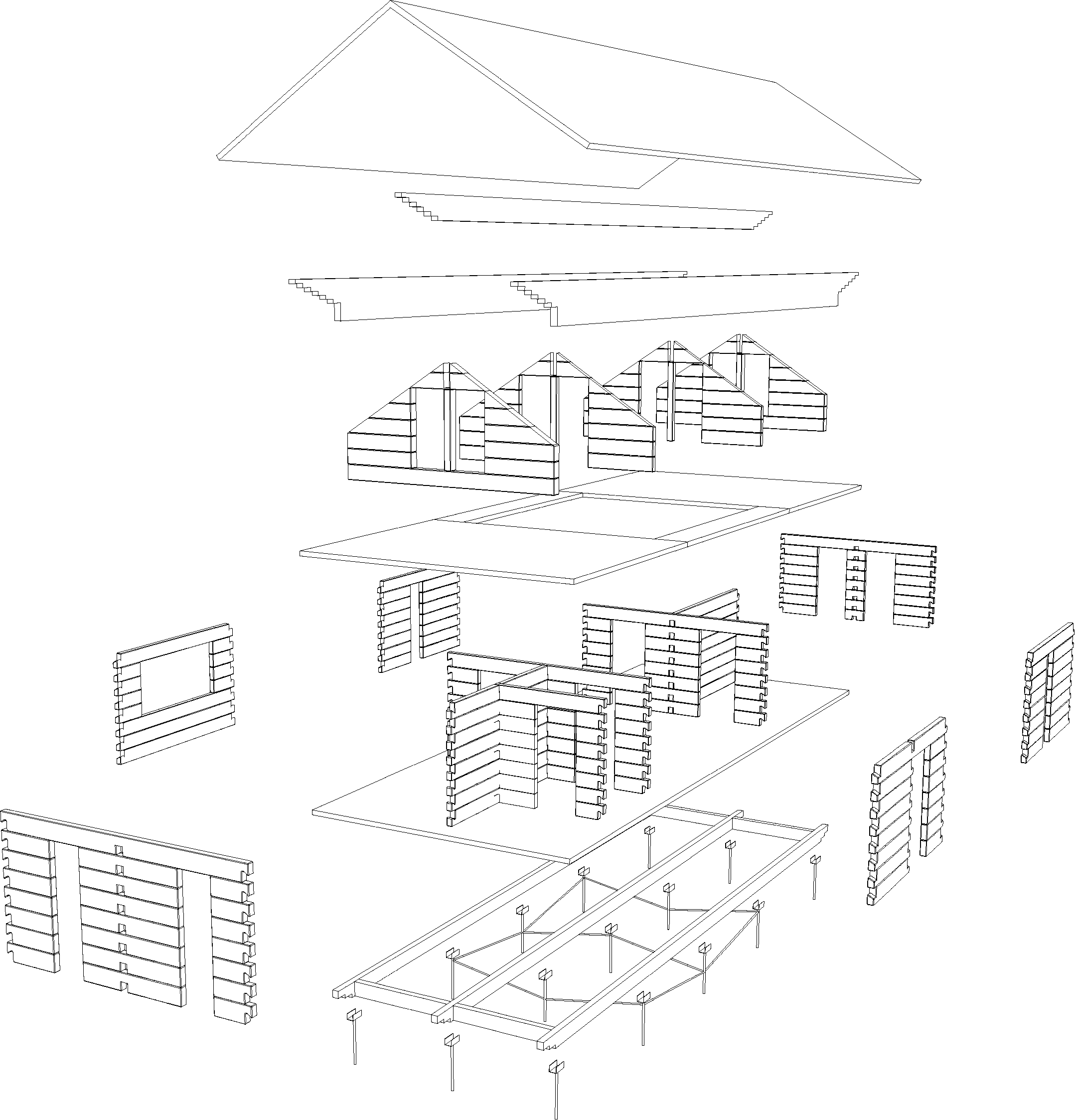
Exploded view of the building elements
Mountain Cabin
Schjelderup Trondahl arkitekter. Tuddal, Norway
-
Name of work in English
Mountain Cabin
-
Name of work in original language
Bitringsnatten - Tuddal
Prize year
EUmies Awards 2026
-
Work Location
Tuddal, Norway
-
Studio
Schjelderup Trondahl arkitekter
EUmies Awards 2026 Nominees


Collaborators
Program
Single house
-
Labels
Isolated · Holiday
Site area
906 m²
-
Client
Anonymous
Total gross floor
92 m²
Cost
1860 €/m²
The site is part of a regulated family-cabin area at the foot of the Gaustatoppen mountain range in Telemark, planned with natural space between plots and shared infrastructure. The untouched plot was surveyed in detail to locate a low-impact position. We mapped trees, landscape features and heavy stones to guide siting and views. Our goals: 1) meet spatial and regulatory requirements; 2) address environmental and economic sustainability via reuse. Almost everything is locally sourced or re-used. Access follows existing clearings; footprint and visibility are kept low with modest maintenance
In fragile landscapes, we should first ask whether building is necessary at all. If it is, methods must be reset so that nature sets the premise. On this site we set out to prove it’s possible to be humble yet offer a decent level of comfort. The cabin can be removed in the future without a trace. Current building law and local rules don’t fully address these challenges, so we had to stretch and interpret them to tell this story; Norwegian bureaucracy is not geared for experimentation, even when outcomes can benefit the public. After a thorough site survey we mapped every tree, landscape feature, and heavy stone. Combined with an architectural analysis of viewpoints, low visibility, connection to nature, and the smallest possible footprint, this led to a concept akin to the vernacular stabbur: a modest structure lifted on stones/posts above moist ground. Existing regulations did not allow this form.
Slim, interwoven steel columns with bracing rods form a low-impact foundation with minimal ground contact. Site-made solid timber slabs—each liftable by two people—stack as both structure and finish, echoing the old log houses. Between slabs we inserted a split, reused 250-year-old two-storey stabbur, forming rooms at each end and carrying attics and roof. Regulation keeps the two attics low, yet they may house two families; between them a double-height living room opens east to blueberry heather and west to birch tops. A ground-floor glass wall maximises nature contact, captures surplus heat for redistribution (also when unoccupied), adds storage without affecting allowable area, and gives a thin, efficient climate shield. Rough, robust surfaces suit wear and patination and reduces the need of maintenance to a minimum. Cost per m² is very low when the two fully usable attics are included, even though they fall outside normal housing dimensioning.