-

The entrance facade shortly after sunset. This Eastern facade including series of sliding glass bays, sun protected by porticos and canvas shading elements.
-
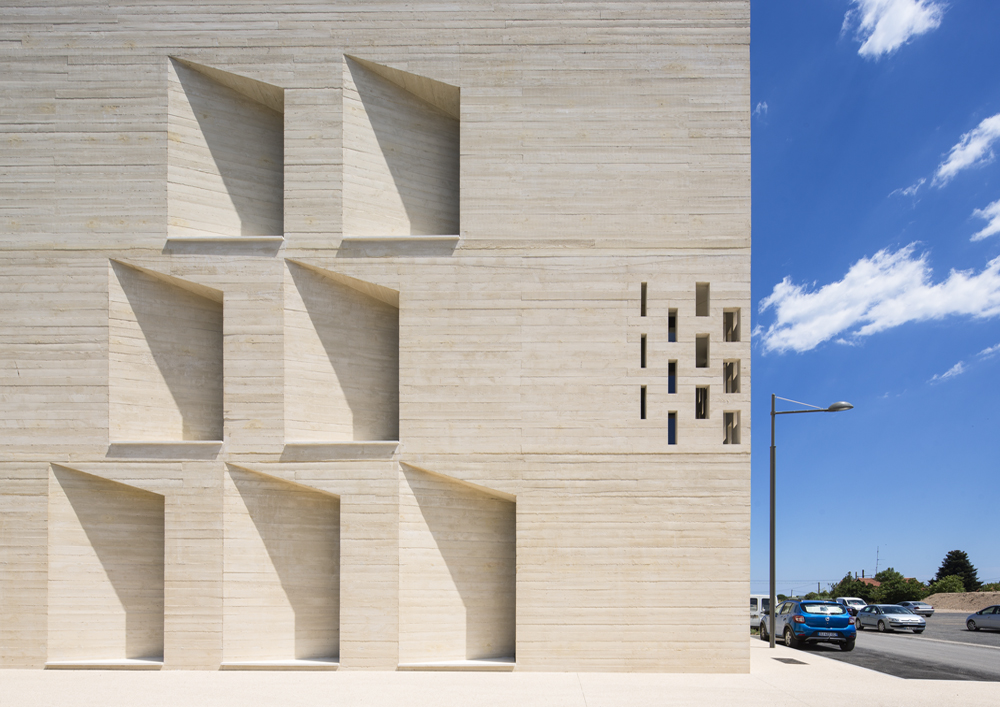
Extract of the Western facade : a sculpted aesthetic, unique folds in the concrete.
-
The Southern facade between twilight and dawn.
-
The central concrete stair adjoins the interior atrium which is designed as a « boîte à lumière/boîte à vent ».
-
From the reading room to the outside, and far view to « l’étang d’Ingrill » and the Mediterranean Sea.
-
Located on the trapezoid-shaped site of a former sulfur factory, the mineral volume of the Montaigne Multimedia Library visually anchors the future Place du Contr’un, a soon-to-be major public space for the eco-district of Pielles in Frontignan, France.
-
A floor plan largely unencumbered, one that provides a high-degree of user flexibility.
-
The solidity stands in contrast to the building’s interior with its largely open appearance characterized by ribbed floor slabs supported by a few vertical supporting elements
-
Transversal section on the the atrium and the thermal probe located at the summit
-
a white concrete slabs sandwiching a layer of insulation
-
the building’s exterior is uniform, identifiable, and has a sculpted aesthetic
-
Orientation was the determining factor in the configuration of openings and exterior bays
-
Sketches
-
Montaigne Multimedia Library
TAUTEM ARCHITECTURE, bmc2 (Arnaud BICAL Laurent COURCIER). Frontignan, France
-
Name of work in English
Montaigne Multimedia Library
-
Name of work in original language
Médiathèque Montaigne
Prize year
EUmies Awards 2017
-
Work Location
Frontignan, France
-
Studio
TAUTEM ARCHITECTURE, bmc2 (Arnaud BICAL Laurent COURCIER)
EUmies Awards 2017 Nominees



Collaborators
Program
Education
-
Labels
Library
Site area
1.087 m²
-
Client
Thau-agglo
Total gross floor
3.215 m²
Completion
2015
Cost
1.813 €/m²
Located on the trapezoid-shaped site of a former sulfur factory, the mineral volume of the Montaigne Multimedia Library visually anchors the future Place du Contr’un, a soon-to-be major public space for the eco-district of Pielles in Frontignan, France. The building is uniquely innovative. An exterior façade system of load-bearing walls – composed of a system of white concrete slabs sandwiching a layer of insulation – lend the building’s exterior a uniform, identifiable and sculpted aesthetic. The solidity stands in contrast to the building’s interior with its largely open appearance characterized by ribbed floor slabs supported by a few vertical supporting elements. The result is a floor plan largely unencumbered, one that provides a high-degree of user flexibility.
The initial client’s request for this first building in the ecodistrict, was to guarantee interior thermal comfort during summer months, without the reliance on mechanical air conditioning systems. Given the building’s Mediterranean location, orientation was the determining factor in the configuration of exterior bays. Large floortoceiling openings provide ambient light for offices lining the Northern façade, whereas recessed glazed openings make up the Southern façade. The Eastern façade is a series of sliding glass bays protected by porticos and canvas shading elements. On the Western side, thin gillslike openings oriented to the North bathe the interior with orchestrated rays of light and vertical trellis systems create cutouts in the floors and running partitions line the outdoor terraces. The recessed openings create unique folds in the concrete façades of the building with the wall thickness being sufficiently thick to incorporate multiple components: ventilation ducts (for turbofan doubleflow ventilation system) and collectors used by a floorslab heating system, shelving and storage, movable partitions, builtin seating.
The building’s mass, with its compact nature, makes use of the principle of thermal inertia, which thwarts sharp temperature swings and allows for internal temperature moderation. The building also uses geothemal wells, reaching 100m underground and process of free cooling. By day, due to the building’s wall thickness that stores daytime heat. By night, the process reverses, the walls “unloading” their accumulated heat by several means : natural (via atrium) or accelerated (via two smoke evacuation turrets). The atrium which rises the full height of the volume, distributes fresh air arriving from slatted, glazed intakes in the exterior façades and exhausts “used” air through summit opening. The orientation and opening of the slats are automatically controled by interior thermal probes. Some fifteen air movers distribute fresh air evenly amongst floor levels, and help to ensure the natural cycle of ventilation continues to push used air towards the summit of the volume. Repurposed boards of pine line the majority of the interior walls, these elements making use of the crates that held exterior formwork used during erection of the façades.