-

Modular exhibit pavilion
-
1
-
2
-
3
-
4
-
5
-
6
-
Panel
-
Modular exhibit structure
Ciaccio Federico. Torino, Italy
-
Name of work in English
Modular exhibit structure
-
Name of work in original language
additive manufacturing with ecosustainable materials
Prize year
Young Talent 2020
-
Work Location
Torino, Italy
-
Author/s
Ciaccio Federico
-
School
Architecture and Design - Polytechnic University of Turin.
Torino, Italy
Young Talent 2020 YT Nominees


Modular exhibit structure
additive manufacturing with ecosustainable materials
Program
Ephemeral - Commercial
-
Labels
Pavilion
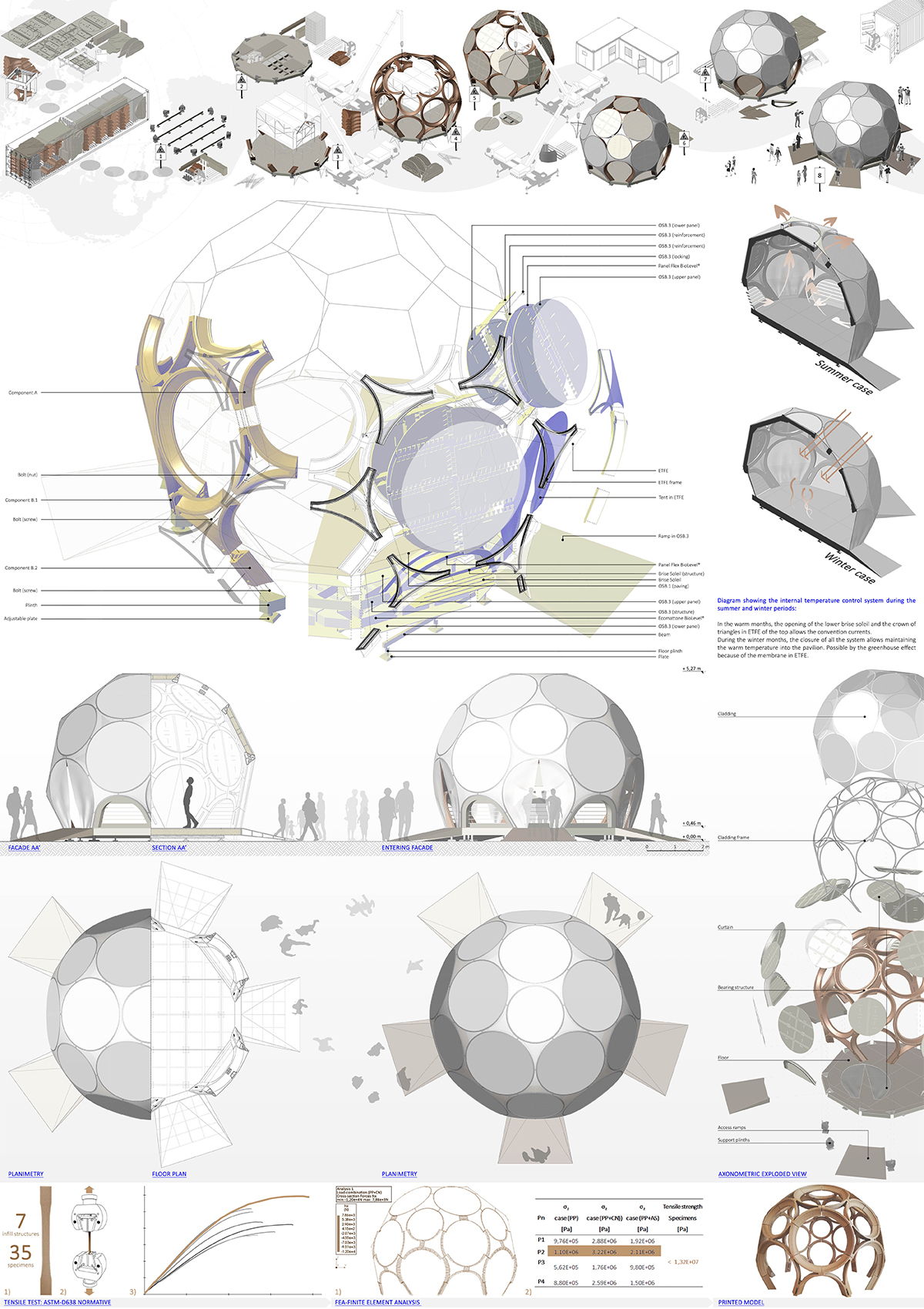
This exhibit pavilion inspired by R. B. Fuller’s geodetic structures engages the self-sufficiency and eco-compatibility architecture. The design of its modular bearing structure in HempBioPlastic®, comported an experimental approach to test that filament following the ASTM-D638 standard and the FEM analysis of the pavilion structure.
This project was born with the purpose to design a typology of inhabitant module that could be easy to produce, to transport, to build and complies with the environmental standards. These assumptions let us approach the architecture influenced by industrial thinking and prefabrication systems. In this way, it was decided to design a pavilion constituted by compostable and recyclable materials that in the first time it can host exhibition activities with high levels of thermic and acoustic comfort but without precluding a future residential use. Since 2014, an Italian start-up called Kanèsis has used the wooden part of the hemp plant (shives) combined with the polymer PLA (polylactic acid, derived from maize starch) to produce a 3D printable filament patented with the name of HBP® (HempBioPlastic). Currently the company is using it to produce small decorative or daily use objects, but with the mechanical properties results gained during our experimentation, it is possible to demonstrate that it can be used to manufacture new concept of supporting structure. To answer the question: “Could the innovative HBP® material be used for supporting structures?”, the data obtained during the trial on the printed specimens and the FEA (Finite Element Analysis) results were compared into snow load and seismic action simulations made by the Diana FEA (DIsplacement ANAlyzer) software. In all these cases, the strains are significantly lower than the tensile strength of the most performing specimen type. It is possible to affirm that, after further experimentation, it could be possible the realization of this pavilion and the use of HBP® in architecture.