-

Memorial Complex "Slanchev Bryag"
-
Research
-
Concept
-
Train Station
-
Existing structures - preservation
-
Exposition center
-
Viewpoint and chapel
-
Memorial Complex "Slanchev Bryag"
-
Memorial Complex “Slanchev Briag”
Iva Hasamska. Lovech, Bulgaria
-
Name of work in English
Memorial Complex “Slanchev Briag”
-
Name of work in original language
A connection between past, present and future
Prize year
Young Talent 2020
-
Work Location
Lovech, Bulgaria
-
Author/s
Iva Hasamska
-
School
Faculty of Architecture - University of Architecture Civil Engineering and Geodesy.
Sofia, Bulgaria
Young Talent 2020 YT Nominees




Memorial Complex “Slanchev Briag”
A connection between past, present and future
Program
Culture
-
Labels
Memorial · Heritage
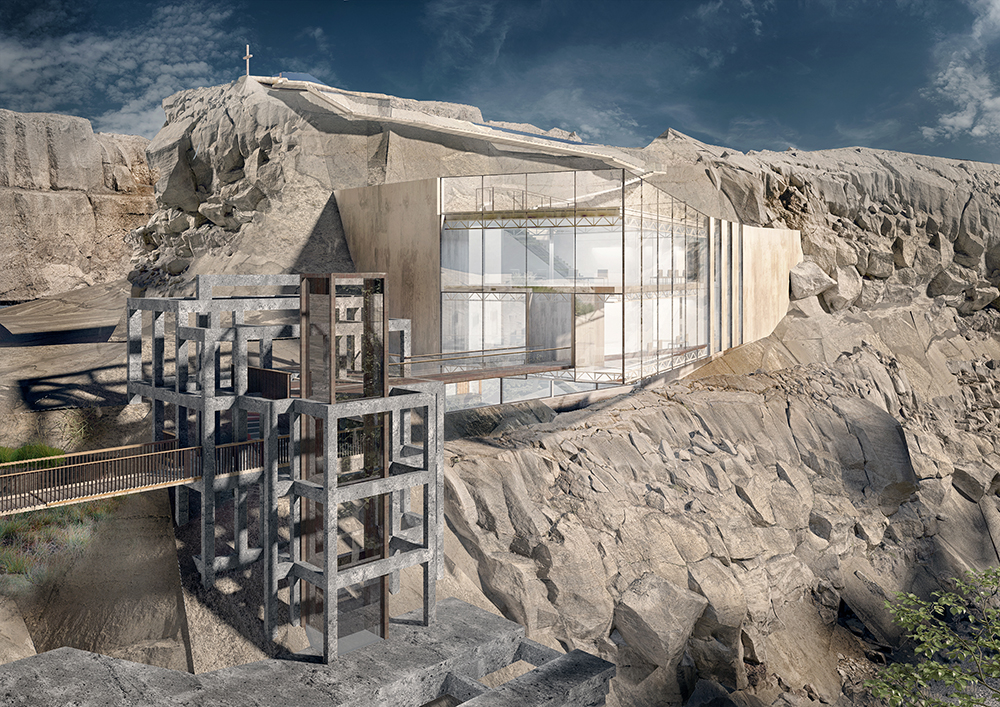
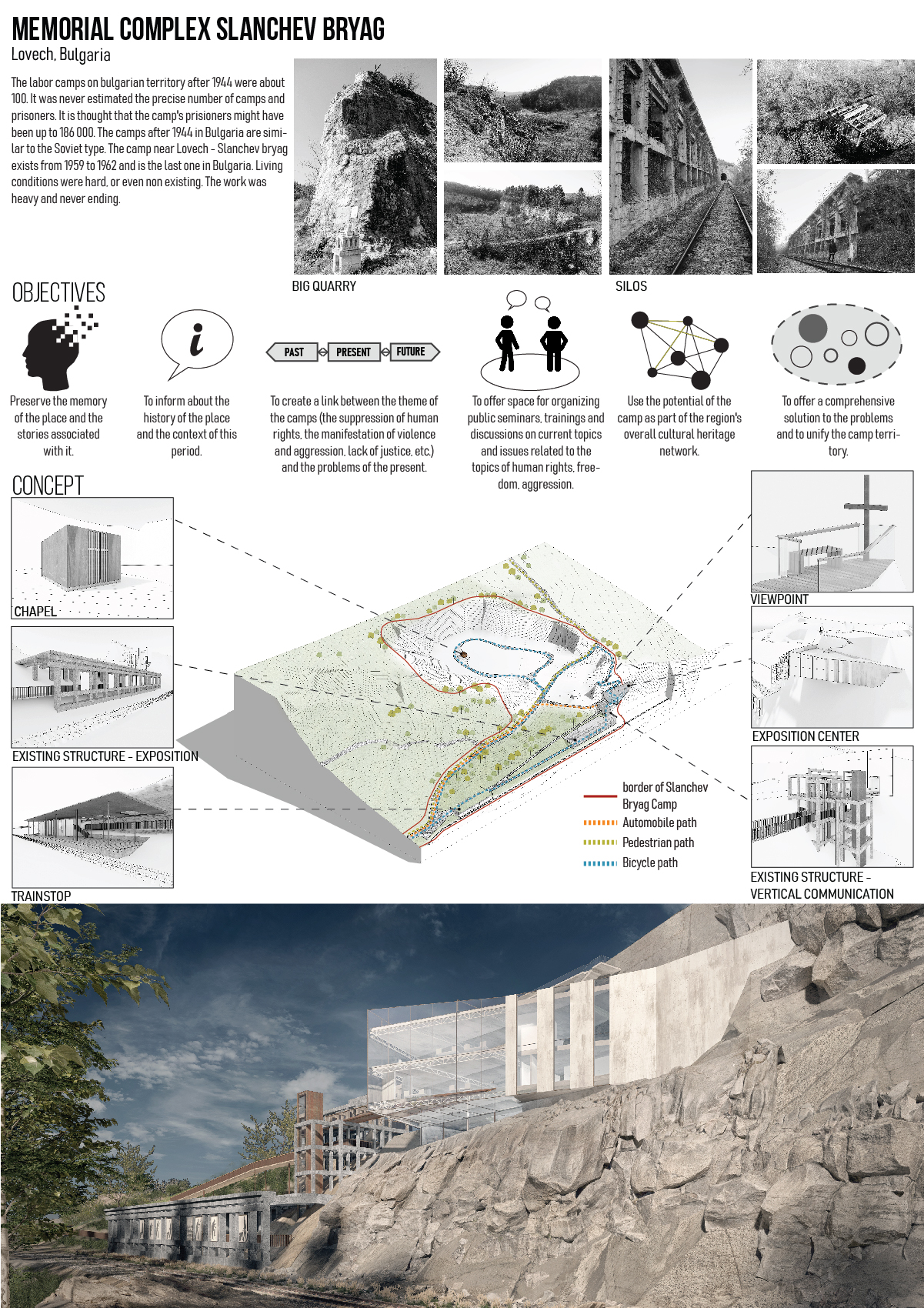
The purpose is to provide adaptation of the former labor camp ‘Slanchev bryag’, to preserve its memory and to inform about the past. The intention is to create connection between past, present, future through the camp’s problematic history and to find its projection in today’s life. It aims to create space for discussion and reflection of these subjects.
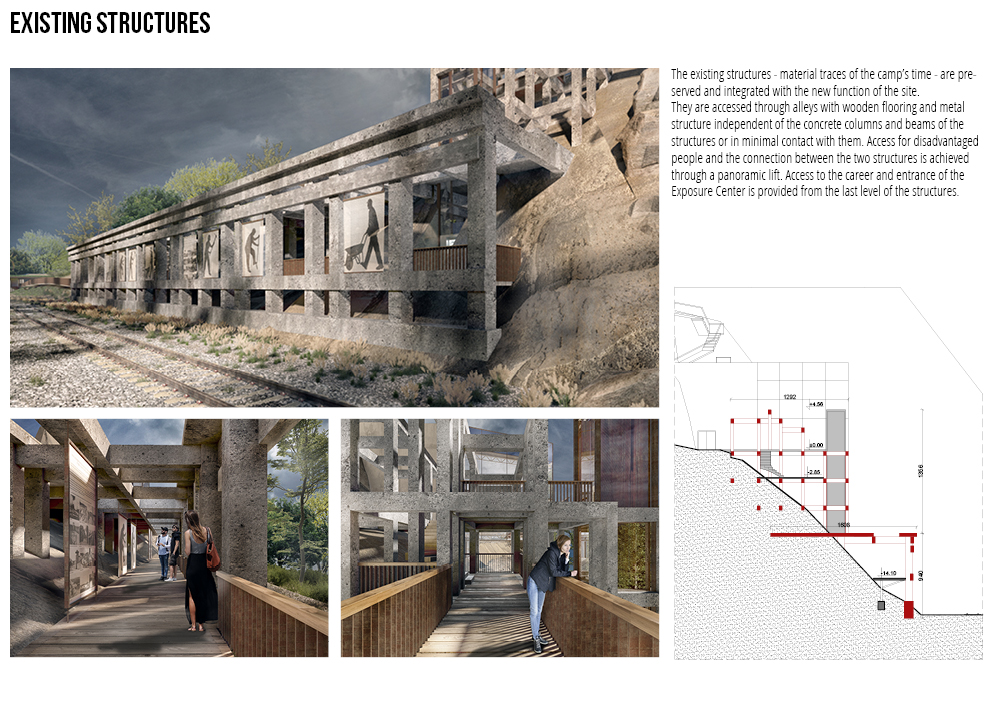
The proposal is providing a variety of possibilities for access to the site. The campsite is accessible not only by car, but it is also becoming a part of the existing railway network – a new train stop is designed on the site. Alternative bicycle and pedestrian paths are provided from the town to and throughout the camp. The existing structures – silos for loading of stones and the stone quarry are traces of history and are preserved and integrated with the new concept. A memorial complex is planned on the territory of the camp with several functions, organized in a logical order that visitors would follow. Begins with the train stop and parking, a path to the existing structures, then exposition center, viewpoint, located near a cross, placed in the 90s and finally - the stone quarry and a new small chapel inside it. The memorial function is the only existing on the site nowadays, through the viewpoint and chapel this function is going to be enhanced. The new structures and buildings are incorporated into the natural environment. The exposition center is integrated into a rock wall with the intention for the stone wall to be preserved as much as possible and exposed in the interior of the building (stone was the main material that the prisoners had to work with). The new building should be subordinate to the existing structures – and differentiated by their tectonics, it should direct the visitor’s eye to them. The train stop is incorporated in the terrain and designed to be less dynamic in architectonics than the existing structures. The new objects are designed with materials that combine well with the natural and stone environment – wood, corten steel, glass, and concrete. Three connected exhibitions are planned – the first one is with open access and placed inside the structures – it would explain the context of the time and history of the camp, followed by second in the exposition center which further deepens inside the history and people, related to the camp, as well as subjects about – human’s rights, aggression, violence, freedom and the third – temporary exhibitions about the interpretation of these subjects.