-

façade ouest
-
cour d'accueil
-
terrasse
-
coursive
-
forum d'exposition
-
bibliothèque
-
section N/S
-
section O/E
-
ground floor plan
-
main facade
-
axonometrie
-
R+3 plan "bel étage"
Mediterranean Institute of the City and Territories
NP2F, Marion Bernard architectes, Point Supreme, Seyler & Lucan. Marseille, France
-
Name of work in English
Mediterranean Institute of the City and Territories
-
Name of work in original language
Institut Méditerranéen de la Ville et des Territoires
Prize year
EUmies Awards 2026
-
Work Location
Marseille, France
-
Studio
NP2F, Marion Bernard architectes, Point Supreme, Seyler & Lucan
EUmies Awards 2026 Nominees
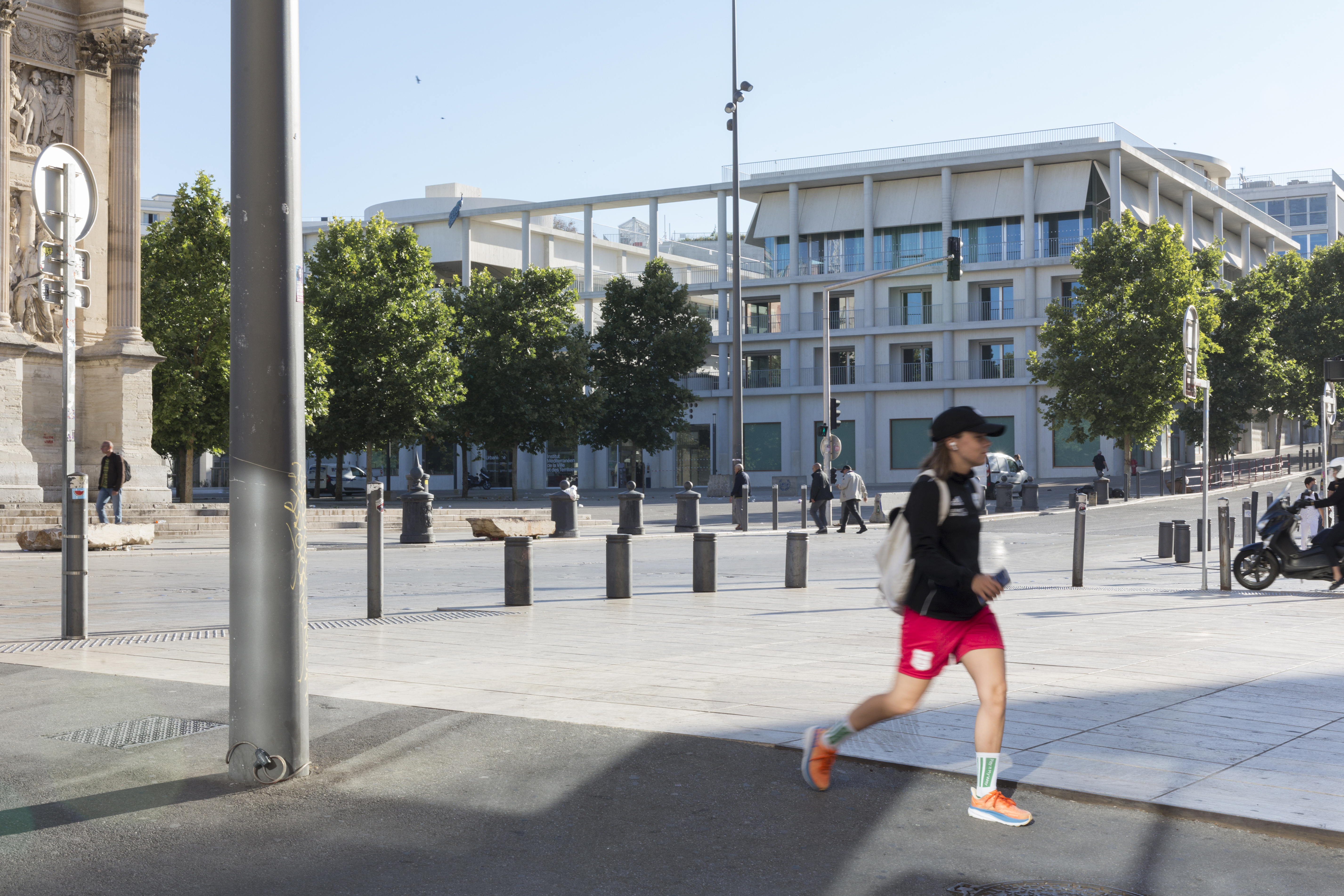


The IMVT is not simply the sum of three existing schools (architecture, urban planning, landscape). The Institute is a unifying entity. Its purpose is to develop relationships, exchanges, and collaborations between the three institutions, as well as with a broader geographical and disciplinary environment.
The Institute is primarily aimed at Marseille and its region. However, it also intends to have an influence on a European and Mediterranean scale. As such, the Institute may welcome students, researchers, and partners from other schools or institutions who are concerned with the Mediterranean world, its developments, and transformations.
The Institute has two main objectives: teaching and research. Teaching requires access to numerous spaces with varying degrees of temporary use (for classes, seminars, design studios, etc.). Research requires a more permanent use of laboratories, researchers, and doctoral students, whom the Institute will train and host to fulfill its ambitions.
Collaborators
Collaborator (office): Edouard Champalle - NP2F; Collaborator (office): Marc Aurèle Rondot - NP2F; Collaborator (office): Mathieu Friedli - NP2F; Collaborator (office): David Bavard - Marion Bernard
Program
Education
-
Labels
Architecture · University · Library · Research · School
Site area
4998 m²
-
Client
OPPIC
Total gross floor
12500 m²
Cost
2080 €/m²
The IMVT is set within an architectural framework that does not fix its uses but rather offers great possibilities for occupation, adaptation, or transformation. Rather than housing each of the three disciplines and fields of study (architecture, urban planning, landscape) in separate buildings, the building distinguishes uses and functions for which the spaces are shared. This choice explains the organization of the whole into three hubs, each shared by the three disciplines and fields of study: . The studio hub, where the studios can be configured in various layouts and sizes; . The common hub, whose three main elements are the forum, administrative offices, and the library; . The research and experimentation hub, accompanied by a courtyard that can host installations. The arrangement of the three parts facilitates transversal relationships and encourages interdisciplinary exchanges.
In relation to its surroundings, the IMVT presents a façade on Place Jules-Guesde that is open to the city, with a great depth of field. Indeed, it reveals the functional differences of its constituent parts. The architectural design distinguishes several planes of depth: . The arrangement of the pillars, intersected by the floors, spans the entire height of the building and is spaced to create regular bays that give the façade its monumental rhythm. . Within this “grid” of the arrangement are located the different spaces of the IMVT, creating varying depths depending on how open they are and whether they are preceded by balconies, walkways, or loggias. . Within this “grid”, the interior courtyard produces the greatest depth of field: it further emphasizes that the IMVT is composed of parts brought together into a single whole.
The buildings that make up the IMVT have specific architectural and construction characteristics: . The studio hub is longitudinal and consists of large frames, with divisions allowing the creation of various studio sizes; . The common hub is rectangular, allowing the creation of large open floors for the forum and the library; . The research and experimentation hub has a grid layout that offers complete freedom for its uses. The architecture of the IMVT is at once strong and light, but not fragile. Some of its elements are familiar, such as the galleries and walkways that connect spaces and functions, making the building easy to appropriate and navigate. The IMVT’s architecture is predominantly light in tone, reflecting a distinctly Mediterranean palette that plays with contrasts, sunlight and shadows, projections and recesses, exposure and protection. To shield against the sun, the IMVT’s design maximizes simple, durable features that require little maintenance: extended galleries, walkways, balconies, and loggias. The architecture simultaneously welcomes light and creates shade. The perception of the IMVT is not that of a compact, closed-off complex hiding from view. Rather, it is seen as a porous ensemble that embraces openness, reveals the diversity of its uses, allows the interior to breathe into the exterior, and opens decisively to the city to capture all its echoes.