-

Dramatic aerial view hourglass glass crown.
-
Close up view of bulging glass crown.
-
Mid level view dark hotel entrance.
-
Close up of geometric facade texture.
-
Worm's eye view of towering black grid.
-
Geometric structural grid against blue sky.
-
Ground Floor
-
First Floor
-
Second Floor
-
20Th Floor
-
Section
Marigona Tower
ARCHIDES. Prishtine, Kosovo
-
Name of work in English
Marigona Tower
Prize year
EUmies Awards 2026
-
Work Location
Prishtine, Kosovo
-
Studio
ARCHIDES
EUmies Awards 2026 Nominees
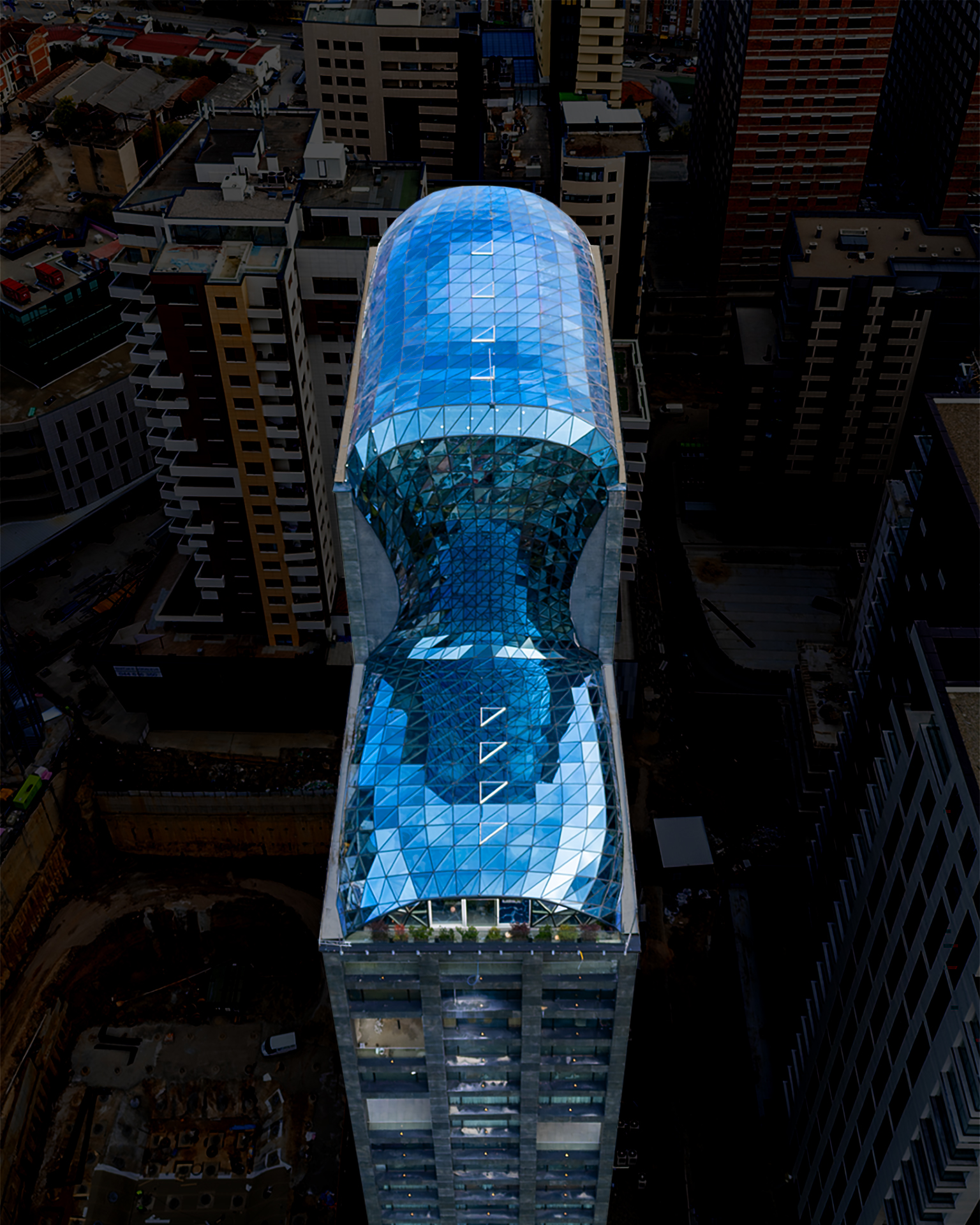


Marigona Tower - Courtyard by Marriott marks one of the first international hotel chains operating in Prishtina, bringing global hospitality standards to the local market. The project contributes to the local economy by creating hundreds of direct and indirect employment opportunities in hospitality, management, and maintenance. The Business Hub within Marigona Tower provides high-standard office spaces and conference facilities that meet international business needs, enhancing Prishtina capacity to host corporate and professional events.
As one of the tallest and most modern towers in Prishtina, Marigona Tower enhances the city skyline and contributes to the modernization of the central urban area with sustainable and contemporary design standards.
Collaborators
Project management: Arber Canhasi - ARHING Architectural designer Expertise in architecture design, construction, supervision, and project management; Building physics: Ali Krasniqi - Mada Group; Collaborator (office): Fatos Rexhepi - Archides studio; ventilation facade: Vullnet Sefaja - Kerasan; Lighting: Besnik Beqiri - Solos; skylighte: Hyzri Durmishi - DG; Carpeting: Kushtrim Kërnja - Kërnja; Installations: Xhemail Shabani - PROTEC
Program
Mixed use - Commercial & Offices
-
Labels
Compact · Café · Food · Office · Sleeping · Studio
Site area
2800 m²
-
Client
Marigona Tower
Total gross floor
1528 m²
Cost
1000 €/m²
The Marigona Tower - Courtyard by Marriott is a landmark mixed-use high-rise located in central Prishtina, Kosovo, serving as a key urban node between the city’s commercial core and emerging residential districts. The project combines hospitality and business functions within a single vertical composition - hosting a four-star Courtyard by Marriott hotel on the lower floors and a business hub with premium office spaces on the upper levels. This integration creates a dynamic environment that supports both local and international business activity. Architecturally, the tower responds to its urban context by emphasizing verticality and transparency, reflecting Prishtina rapid economic growth and evolving skyline. Its placement and height establish it as a new visual landmark visible from key city approaches. In terms of materiality, the design employs a refined palette of glass, aluminum, and stone cladding, ensuring both durability and a contemporary aesthetic. The transparent façade allows natural light to penetrate deep into the interior spaces, enhancing user comfort and reinforcing the project’s commitment to energy efficiency and modern urban living.
The Marigona Tower - Courtyard by Marriott project faced several key challenges related to site constraints, urban integration, and functional diversity. Situated in a rapidly developing area of central Prishtina, the site demanded a design that could mediate between the dense urban fabric of the city center and the open suburban developments of its surroundings. Balancing these two scales while maintaining a coherent architectural identity was a central design challenge. Another major issue was the integration of mixed-use functions-a hotel and business hub-within a single vertical structure. Each program required distinct access systems, privacy levels, and operational logistics. The design strategy addressed this by organizing clear vertical zoning, separating hospitality and office functions while maintaining visual and spatial continuity through shared public areas such as the lobby, restaurant, and conference zones. From the client’s perspective, the priority was to achieve a modern, internationally recognizable building that met Marriott’s global standards while remaining sensitive to local conditions. The architectural response combined efficient spatial planning, high-performance materials, and a façade system emphasizing transparency and lightness, which aligned both with the client’s branding goals and with environmental considerations. In terms of urban and environmental strategy, the design introduced passive daylighting, optimized building orientation, and energy-efficient façade glazing, ensuring comfort and sustainability in Prishtina continental climate. This holistic approach successfully reconciled the needs of the client (brand quality), the users (functionality and comfort), and the location (urban integration and identity).
Structure was designed using local standards regarding earthquake Based on fact that the that Marriot has request to have all the building on it’s own standards all the material used in the construction are based on Quality, FLS Fire exit doors are 120minute fire rate by Novoferm All of the Outdoor and Indoor walls are fire resistant The building is covered with Wet and Dry Sprinklers system Has ANSUL suspension system (for each kithcen) The building will use rain collector to be used in water tanks The glasses are triple glazed (low-e) to The heating will use thermopomps and HVAC systems The building has BMS including all the features including guest behaviour memory Consist of 9 elevators Schindler brand (2 of them available for use in case of fire), 3 of them with a speed of 2.5m/s Interior materials including furniture designed by: Giorgetti, Boffi, Floss lightning system. Most of the furniture was implemented by Porcelanosa (Spain) and the rest by local contractors.