-

Perched above Navarino Bay, Mandarin Oriental Costa Navarino is a landscape-led resort
-
The repetition of the structures stitched into the landscape produces an organic form
-
The volumes submerge and rise above ground to create spectacular spatial moments
-
Nestled in the terrain, the serpentine volumes follow and continue the natural topography
-
The rooms, submerged in the sloped terrain, ensure natural cooling via cross ventilation
-
Stone volumes with green roofs rise from the ground, blending with the topography
-
Axonometric Concept Diagram
-
Masterplan
-
Main Building Section
-
Hillside Villas Section
Mandarin Oriental Costa Navarino
Alexandros N. Tombazis & Associates Architects, K-Studio. Pylos, Greece
-
Name of work in English
Mandarin Oriental Costa Navarino
Prize year
EUmies Awards 2026
-
Work Location
Pylos, Greece
-
Studio
Alexandros N. Tombazis & Associates Architects, K-Studio
EUmies Awards 2026 Nominees
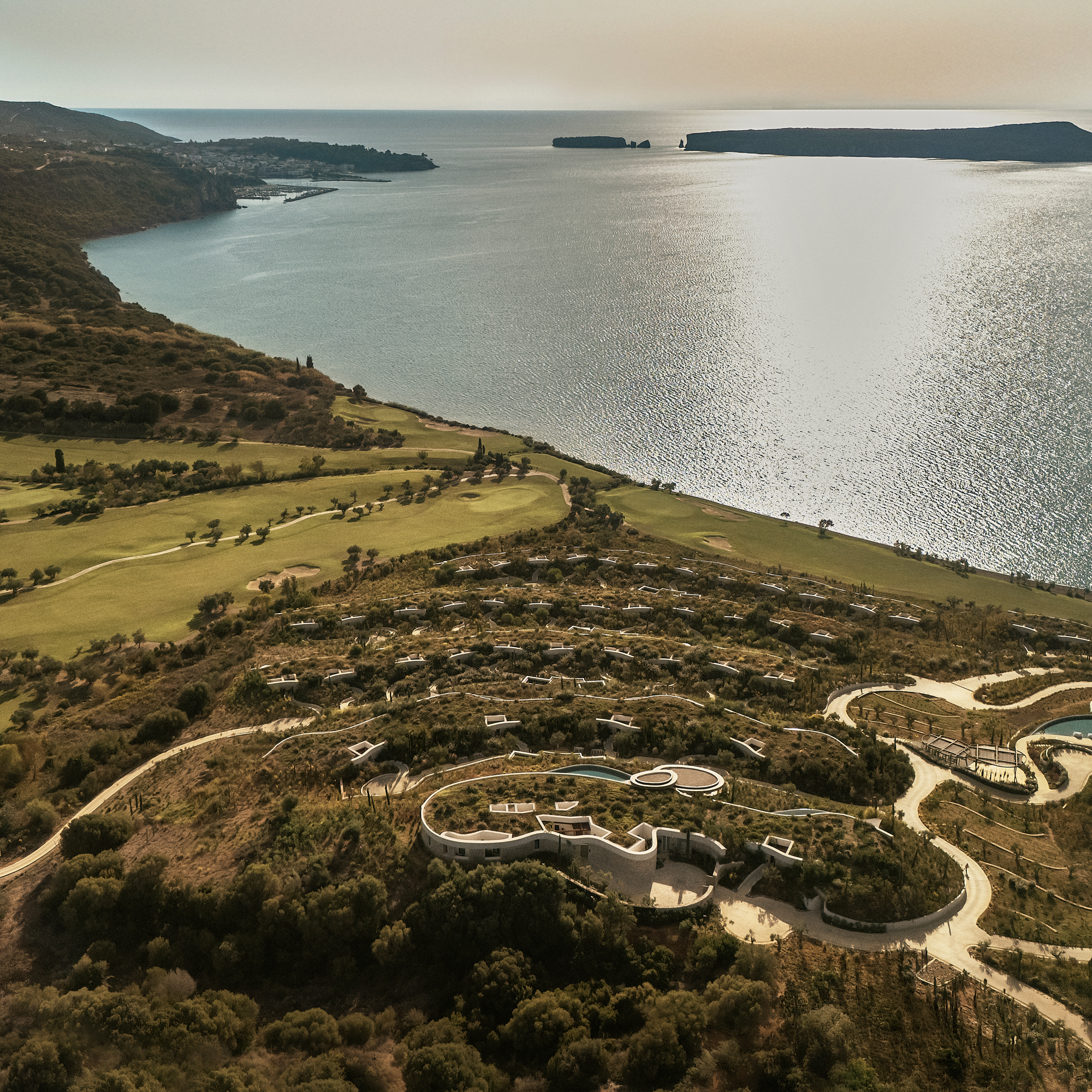


A landscape-led resort in Costa Navarino Messinia, Greece, where architecture and terrain merge seamlessly. Rooted in local tradition and bioclimatic design, Mandarin Oriental Costa Navarino redefines sustainable luxury through integration, restraint, and timeless material honesty.
Collaborators
Landscape Designer (to Schematic Design): Coopers Hill; Landscape Designers (Final/As-Built Design) – Hardscape: Alexandros N. Tombazis & Associates Architects; Landscape Designers (Final/As-Built Design) – Hardscape: K-Studio; Landscape Designers (Final/As-Built Design) – Softscape: Alexandros N. Tombazis & Associates Architects; Landscape Designers (Final/As-Built Design) – Softscape [Planting Design]: Greenways Hellas
Program
Food & Accommodation
-
Labels
Nature · Resort · Food
Site area
1530000 m²
-
Client
TEMES S.A.
Total gross floor
27000 m²
Perched above the Bay of Navarino in Messinia, Greece, Mandarin Oriental Costa Navarino comprises suites and villas embedded in a hillside landscape of olive groves and cypresses. Inspired by the local “mandria” enclosures, the resort’s stone, concrete, and planted roofs create a seamless dialogue between architecture and nature.
The brief called for a world-class resort deeply respectful of Messinia’s landscape and heritage and of Costa Navarino architectural guidelines. The challenge was to integrate a large program —99 rooms, villas, spa, and restaurants— into a fragile, historic terrain without visual or ecological intrusion. Drawing from the agricultural logic of the “mandria,” the earth sheltered design follows the topography with low, stone-built ribbons embedded in the earth. This strategy minimizes impact, enhances privacy, and creates a fluid sequence between interior and exterior spaces. Passive bioclimatic principles —orientation, shading, cross-ventilation, and planted roofs— reduce energy demand while enriching guest comfort. The result is a resort that feels discovered rather than built, both grounded in its land and elevated in its experience, while aligned with the sustainable development of Costa Navarino.
Construction follows a principle of local authenticity and endurance. Buildings are formed from locally sourced stone, cast concrete slabs, and anodized glazing — materials chosen for permanence, low maintenance, and graceful ageing. Structural walls and slabs express clarity and strength, while planted roofs extend the terrain, improving thermal performance. Native vegetation —olive, thyme, lavender— provides shading and ecological continuity. Sustainable strategies include passive cooling, cross-ventilation, and modular zoning that adapts seasonally to occupancy. Maintenance mirrors landscape care rather than upkeep, ensuring longevity with minimal intervention and energy use.