-

View from Marine Street with the new extension
-
View from Marine Street showing the integration of the new and old buildings into their surroundings
-
Daytime view while walking along the sidewalk.
-
View from the living and dining room looking towards the balcony, with the integration of vertical a
-
View from the balcony highlighting the multifunctionality of the interior-exterior space and the sol
-
View from the bedroom towards the kitchen.
-
Diagram of the typical house concept. Optimization spaces in between new and old
-
Ground floor plan, showing the integration of the new extension in relation to the existing building
-
Main façade. Marine street.
-
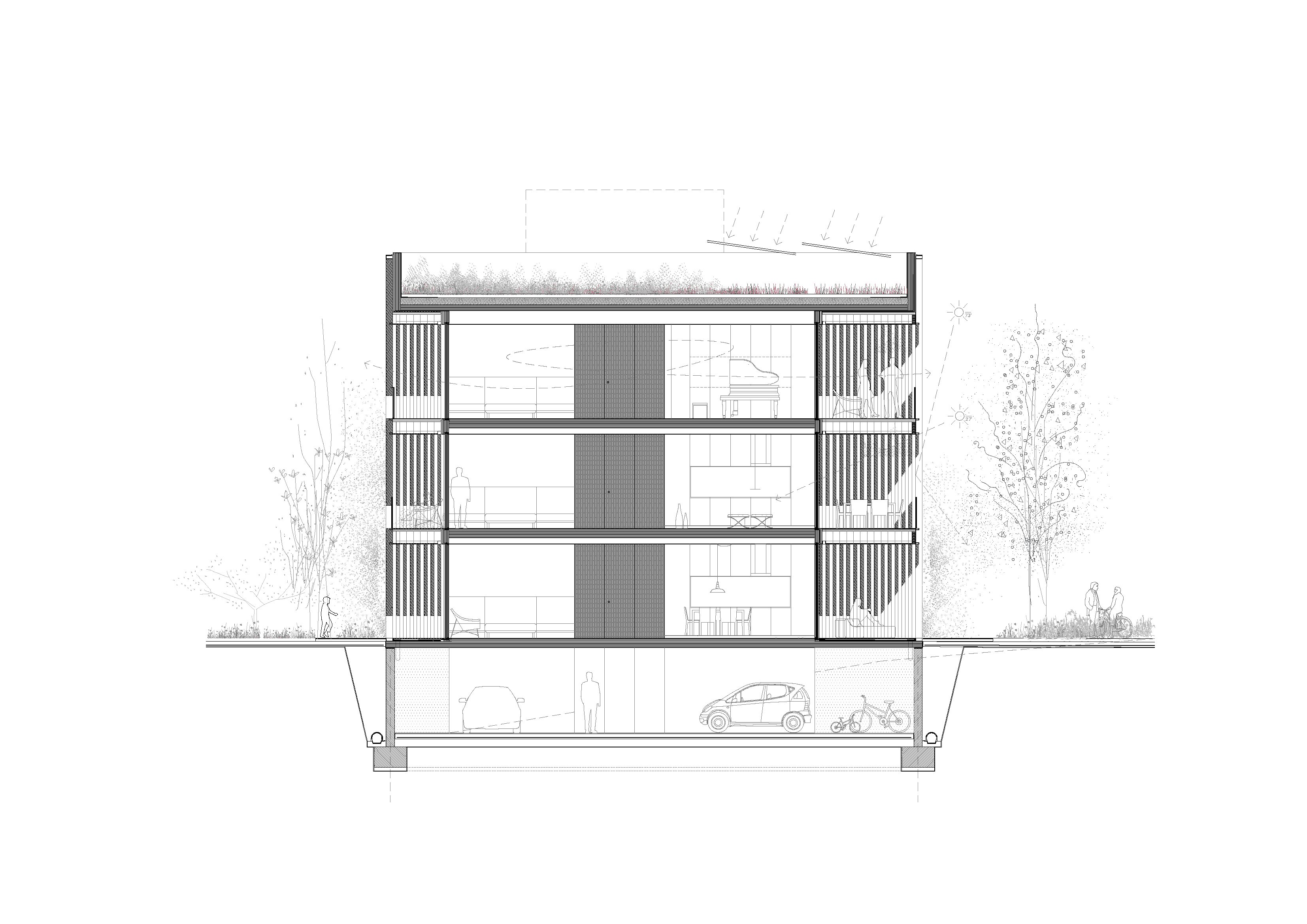
Longitudinal section. Construction and energetic system.
-
Axonometric diagram. The complexity of the construction system.
-
Axonometrical asendent diagram. Screen construction system.
-
Name of work in English
MA House
-
Name of work in original language
CASA MA
Prize year
EUmies Awards 2026
-
Work Location
Sant Cugat del Vallès, Spain
-
Studio
bxd arquitectura, cra-de.studio
EUmies Awards 2026 Nominees




Collaborators
Program
Collective housing
-
Labels
Infill · Social
Site area
525 m²
-
Client
Juan Anguita, Montse Rigola
Total gross floor
195 m²
The project is located in Sant Cugat del Vallès, within a consolidated residential area characterized by low-density multifamily buildings and typological diversity. The flat, rectangular 525m² plot contains an existing building with a ground floor and two upper floors above a basement. The intervention adds a symmetrical volume separated by a central staircase, completing the block with three new dwellings that optimize south-north orientation to maximize cross ventilation, natural lighting, and visual connections through terraces
The project addresses the challenge of completing a building started in 2006 without exceeding buildability limits and respecting the heterogeneous urban context. The symmetrical volumetric strategy employs a central communication core that functionally separates day and night zones. The dual south-north orientation promotes cross ventilation and natural lighting, enhancing indoor comfort. Terraces compensate for surface limitations, creating exterior spaces visually and functionally linked to the interior. This solution integrates into the residential fabric, prioritizing energy efficiency, sustainability, and user functionality.
Construction is based on a double-skin system: the inner box, formed by prefabricated cross-laminated timber panels, provides structural support and high-efficiency thermal-acoustic insulation. The outer skin, composed of a steel tubular structure, glass, and louvers, forms a permeable façade that modulates solar radiation and allows natural ventilation. The existing building measures 6 x 17 m, with a 2 m-wide lateral staircase separating the new symmetrical volume. Buildability regulations limit total volume, so front and rear terraces complete the footprint to equalize both volumes. The dry construction system facilitates quick assembly, sustainability, and efficient maintenance.