-

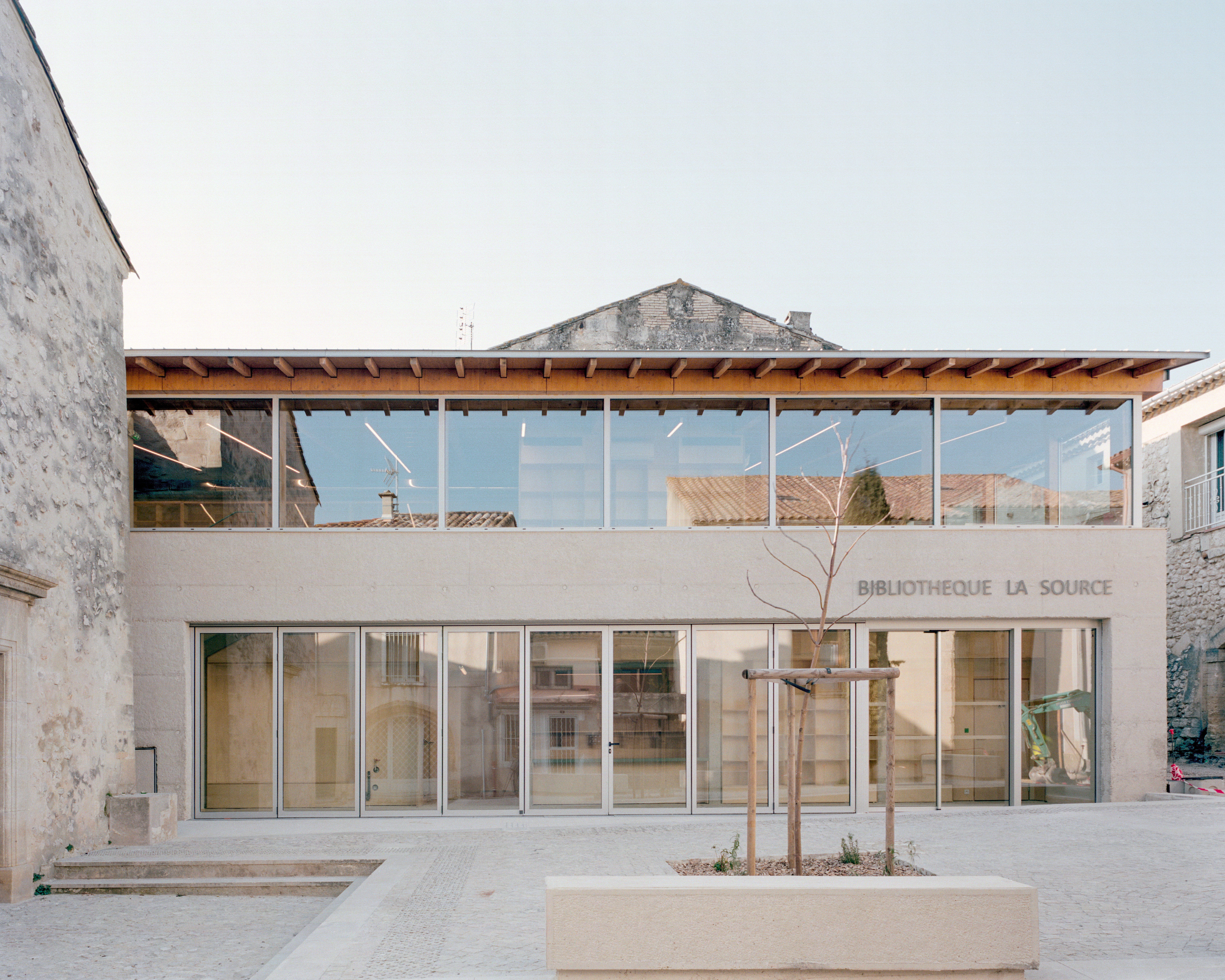
The Third Place Library establishes a porous relationship with the village of Rochefort-du-Gard.
-
The extension is connected to the Saint-Joseph Chapel through a wooden walkway.
-
Once opened, the Third Place Library blurs the boundaries with the square.
-
The way the space engages with visitors is humble, straightforward, and generous.
-
The upper floor’s timber structure is left visible to support the overall atmosphere of the space.
-
The chapel was restored, structurally reinforced, and upgraded to house a digital museum.
-
Axonometric drawing of the project within its context.
-
Contextual axonometry of the Third Place Library, open to the village square.
-
Ground floor.
-
Floor plan of the upper floor.
-
Exploded axonometric projection.
-
Drawing of the custom wooden furniture integrated into the sequences of concrete columns.
La Source - Third-Place Library
NAS Architecture. Rochefort-du-Gard, France
-
Name of work in English
La Source - Third-Place Library
-
Name of work in original language
Bibliothèque Tiers-Lieu "La Source"
Prize year
EUmies Awards 2026
-
Work Location
Rochefort-du-Gard, France
-
Studio
NAS Architecture
EUmies Awards 2026 Nominees


Collaborators
Program
Education
-
Labels
Library
Site area
1000 m²
-
Client
Municipality of Rochefort-du-Gard
Total gross floor
500 m²
Cost
2800 €/m²
Rochefort-du-Gard is a small rural village in the south of France, known for its rich religious heritage. The Saint-Joseph Chapel was built, expanded, and repurposed since 1638 but has been endangered and closed in 2017. The project brief involved restoring and consolidating this heritage, while designing a new venue to accommodate a wide range of cultural activities such as a library, fab lab, digital museum, and public events. The intervention had to find the right balance by respecting a dense, stone-built vernacular context while revitalize the relationships among the inhabitants.
The Third Place Library is organized around the village square which resulted from the demolition of a dilapidated building in the 1990s. By lowering the ground level of the new construction and installing a large folding door, the north façade fully opens onto the public space to foster engagement with the town, blurring boundaries and enable cultural events to extend outdoors. The idea was to maximize openings toward the village so that the library’s activity would be clearly visible, radiate outward, and establish an open, unpretentious access to culture for all. The connection between the new building and the Saint-Joseph Chapel is established via a footbridge built between the old buttresses. Extensive reinforcement work on the vaults and surrounding walls stabilized the historic structure, enabling the reopening of this space to the public. The work on the furnishings integrated all technical requirements while preserving the exceptional volume of the place.
At ground level, the mass of the concrete base forms a protective plinth that echoes the village’s stone architecture. The walls are bush-hammered to develop a texture and patina that harmonize with the surrounding masonry. Concrete is primarily used for its economic feasibility and structural strength, allowing a span of over fifteen meters so that the library’s boundary disappears entirely when the folding doors are opened. The upper level is built with a local wooden post-and-beam structure, adding lightness while allowing for overhangs and discreet rainwater management. The metal roof adjusts to the neighboring parcel’s geometry, sloping gently toward the square and reducing the volume’s scale near the historic chapel. The stone masonry of the Saint-Joseph Chapel was restored using traditional techniques, consolidated, and treated with limewater. The roofing, windows, doors frames and ironwork were replaced with the aim of preserving the site's heritage character.