-

Passageways in the interior courtyard
-
Main façade
-
Main entrance
-
Common room with mezzanine
-
Dwelling and balcony
-
Dwelling interior
-
Site plan
-
Ground floor
-
1st floor
-
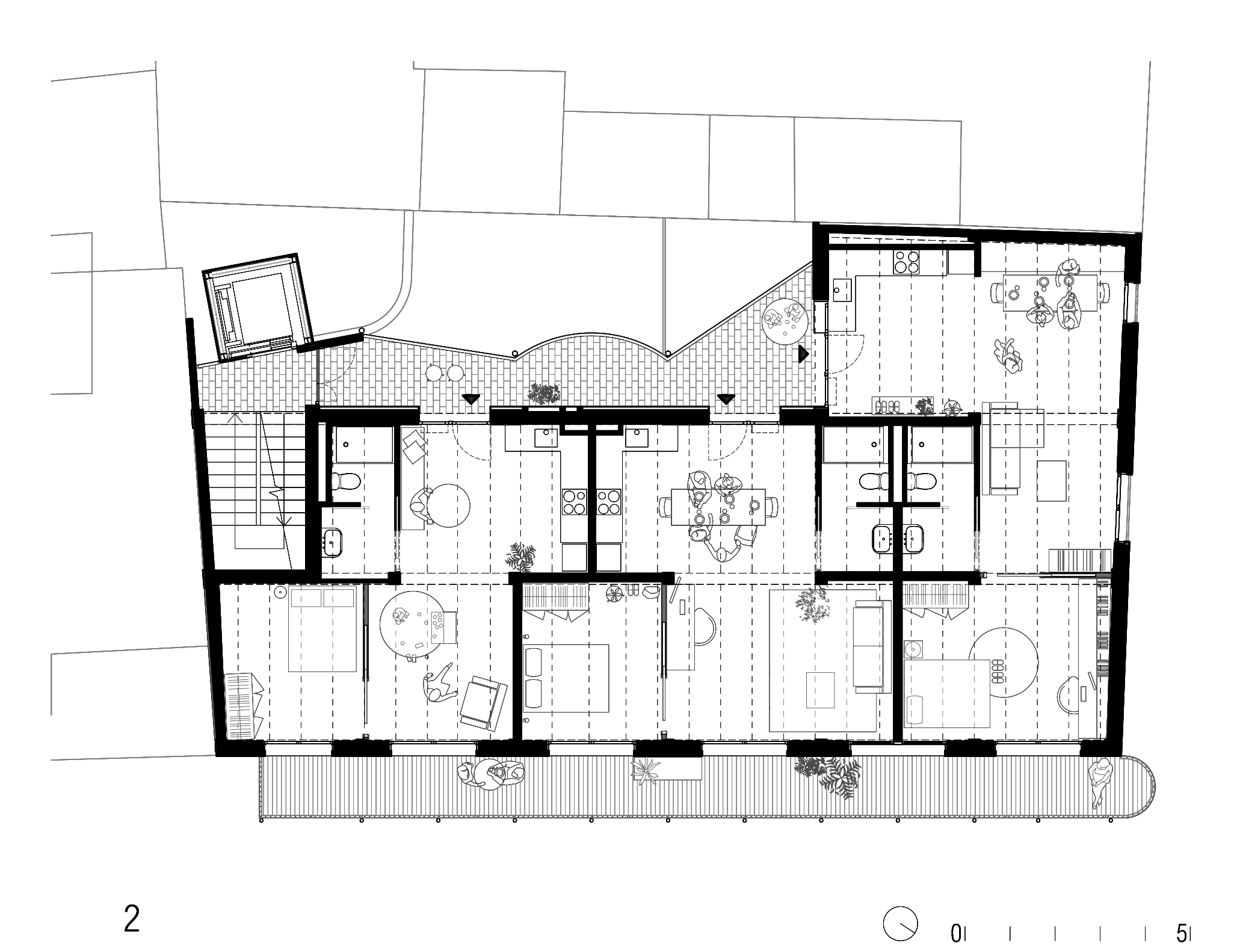
2nd floor
-
Rooftop
-
Axonometric drawing
La Morada - Cooperative Housing for Trans and Lesbian Community
Lacol. Barcelona, Spain
-
Name of work in English
La Morada - Cooperative Housing for Trans and Lesbian Community
-
Name of work in original language
La Morada cooperativa d'habitatges per a la comunitat trans i lesbianes
Prize year
EUmies Awards 2026
-
Work Location
Barcelona, Spain
-
Studio
Lacol
EUmies Awards 2026 Nominees




La Morada is a housing cooperative with the main goal of guaranteeing the right to housing and doing so in a transformative way. Promoted by a group of lesbians, trans, and feminist activists, the project seeks to create a sustainable, community-based model of living centred on care. Architecture becomes a tool to foster this new collective imagination.
Collaborators
Environmental: Societat Orgànica; Structure: Bernuz Fernandez Arquitectes; Acoustics: Àurea Acústica; Installations: M7 Enginyers; technical architecture: Arrevolt SCCL; Project management: La Dinamo Fundació
Program
Collective housing
-
Labels
Infill · Social
Site area
250 m²
-
Client
La Morada SCCL
Total gross floor
1197 m²
La Morada is a cooperative housing project under the "cessió d’ús model" (use-rights cooperative) located in the Roquetes neighbourhood of Barcelona. It comprises 12 housing units and a range of shared indoor and outdoor spaces. The main aim of the project is to provide housing through this cooperative model while also fostering community building and networks of mutual support. Aware of the project’s transformative potential and its role as a reference within Barcelona’s Queer movement, the building is conceived as a meeting place — open to the neighbourhood and to the public square where it stands, encouraging interaction and relationships with the local community.
To understand the residents’ needs, the design process ran in parallel with a participatory process involving the whole group. Together they defined a shared vision of coexistence that shaped both the communal areas and the private homes. On the ground floor, facing the square, a large community kitchen opens completely to connect with public life. The entrance porch acts as a welcoming threshold — a cool, shaded space benefiting from the cross-ventilation between the square and the inner courtyard. Above the kitchen, a mezzanine hosts guest rooms and a co-working area. The rooftop (fully accessible by lift) offers a large terrace with a green roof, a photovoltaic pergola, and a shared laundry. Altogether, the 290 m² of communal spaces significantly expand the usable area beyond the private dwellings. The project aims to maximise outdoor space and natural light, prioritising openness by building less and creating a larger inner courtyard. Access to the dwellings is via generous walkways that also act as social spaces. The kitchen, located at the entrance, mediates between the public and private realms and connects visually with the walkways. Kitchens and bathrooms occupy the inner structural bay, while bedrooms and living rooms face the exterior, allowing flexibility for future changes.
One of the project’s main challenges was cost. Built during a period of steep price increases, it is an affordable housing project on private land, developed without profit. To meet budget constraints, a very simple structure was designed, optimising concrete use through columns, hanging beams, and one-way slabs made of concrete beams and ceramic blocks. The structural rhythm defines the layout of the dwellings, allowing small variations between floors and potential future adaptations by the residents. The building is wrapped with 10 cm of external insulation and high-quality wooden joinery. Combined with photovoltaic panels and an aerothermal system with underfloor heating and cooling, it achieves an A energy rating with zero CO₂ emissions. Leaving the structure exposed reduces costs while providing thermal inertia — a key feature in Mediterranean climates, where nighttime cooling is crucial to reduce active energy demands.