-

View from Rosa-Luxemburg Strasse
-
View from Linienstrasse
-
View towards Tower/Streetscape
-
Interior view skylit soace and streetscape/park
-
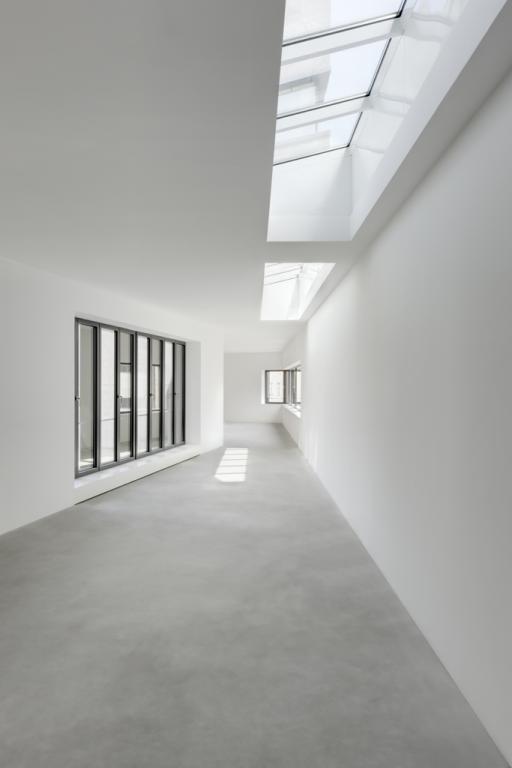
Interior view "long gallery"
-
View along Rosa-Luxemburg-Strasse, cantilevered Volumes
-
Elevation Rosa-Luxemburg-Strasse
-
Floorplan ground floor
L40, residential and commercial building
Bundschuh Architekten. Berlin, Germany
-
Name of work in English
L40, residential and commercial building
-
Name of work in original language
L40, Wohn und Geschaeftshaus
Prize year
EUmies Awards 2011
-
Work Location
Berlin, Germany
-
Studio
Bundschuh Architekten
EUmies Awards 2011 Nominees




Architect Roger Bundschuh and Artist Cosima von Bonin were commissioned to design a piece of outdoor sculpture for a small site in Berlin-Mitte. Architect Hans Poelzig had won one of the first major urban renewal schems on Rosa-Luxemburg Platz in the 1920's, much of the original plan and buildings is still visible.
Collaborators
Art: Cosima von Bonin; Construction manager: Jacob van Ommen; Project architect: Christiane Schmitz, Carolus Traenkner, Fabian Schwade; Structural engineering: Henning Ecker; Building physics: Michael Pfister; Building technology: Edeltraut Hallmann
Program
Culture
Completion
2010
As it turned out, the original site was slated to become part of a larger, though very irregularly shaped site due to the relocation of the adjacent street back to its location in 1900. The original sculpture project was abandoned and translated into a brief for a 2000 m² residential project. The new project, though much larger, incorporates the sculptural approach and emphasis on abstract shapes that were formulated in the design of the original project. Cantilevering out more than 20 meters, the solid shapes are at once dynamic and static, responding to and reacting with the hectic urban flow in this busy intersection, yet also anchoring the building firmly through their perceived weigth and durable construction. The design references the strong horizontality of the original Poelzig plan and fuses this with the exuberant modernism found in International Style buildings of the 1960's on adjoining Alexanderplatz. Breaking with the rigid Berlin urban planning codes, the building disposes of the hierarchical approach to the urban block and opens up the typical Berlin interior courtyard to the street (and vice versa).
The stark interior of the apartments is offset against the black and rough exterior of the exposed concrete, creating a dynamic tension between interior and exterior. This tension is further heightened by the large expanses of windowless exterior walls that reveal brilliantly skylit interior spaces. No two apartments are alike. While some spaces are intimate, microscosmic spaces more reminiscient of the classic 'white cube' of art galleries, others are completely open to the surrounding streetscape. Positioning oneself on the building (and in ones apartment) also means positioning yourself in relationship to the city. Spaces are designed as highly specific and encourage conscious interaction between user and architecture. As such, the project can be seen as an extension of the city into the domestic scale. The specificity of such spaces as the 'long gallery' (reminiscient of such spaces in Elizabethan country houses) defines one of our approaches to sustainable design.
The building is constructed completely in concrete. The outer layer of black, exposed leightweight concrete covers all exterior surfaces and is applied over a layer of thick foamglass insulation. The high mass of this construction, the extreme insulation values it delivers and the siting and insulation values of the glazing combine to situate the project at the forefront of sustainable planning schemes. In addition, the entire building is sound proofed by insulation applied to the basement walls. No part of the building actually is in contact with the surrounding soil, thereby assuring high levels of sound and vibration proofing in the apartments. The achieved 'remoteness' from the hectic bustle of the surrounding traffic serves to reinforce the idea of microcosmic and serene spaces and contributes to the overall effect of contrasts and dynamic tension.