-

GARDEN VIEW
-
OLD & NEW
-
STREET VIEW
-
INSIDE_STAIRS "HISTORY WALL"
-
INSIDE_OLD PART_STAFF ROOM
-
INSIDE_NEW PART_DINING
-
SITE PLAN
-
GROUND FLOOR
-
1ST FLOOR
-
2ND FLOOR
-
3RD FLOOR
-
Section
Klösterle - Time of Awaking
STUDIO LOIS ZT GmbH - Barbara Poberschnigg. Imst, Austria
-
Name of work in English
Klösterle - Time of Awaking
-
Name of work in original language
KLÖSTERLE - ZEIT DES ERWACHENS
Prize year
EUmies Awards 2026
-
Work Location
Imst, Austria
-
Studio
STUDIO LOIS ZT GmbH - Barbara Poberschnigg
EUmies Awards 2026 Nominees




Although the demand for building land is very high. Just like many historical buildings in the town center, the Klösterle has been standing empty for decades. An abandoned monastery next to a care center, this empty building presented an opportunity to revitalize a dormant part of the city center.
Collaborators
STUDIO LOIS Junior Architect: Carolin Hellrigl - STUDIO LOIS ZT GmbH; STUDIO LOIS Junior Architect: Paul Rossi - STUDIO LOIS ZT GmbH; Structure: Alfred Brunnsteiner - DIBRAL; Installations: Helmut Penz - A3 Haustechnik; Installations: Robert Schmitzer - A3 Haustechnig; Installations: Clemens Dablander - A3 Elektrotechnik; Lighting: Christian Ragg - Conecptlicht; Environmental: Peter Gahleitner - Geotechnik Team; Acoustics: Josef Sailer - Fiby ZT GmbH; Building physics: Josef Sailer - Fiby ZT GmbH; Fire Safety and Accessibility: Andre Kurpreweit - IBS; Construction management: Dietmar Rudigier - RS Planbau
Program
Health
-
Labels
Health Centre · Specialized Centre
Site area
2333 m²
-
Client
GEMEINDEVERBAND
Total gross floor
4485 m²
The original part of the monastery is from the 14th century and was further developed in subsequent centuries. The demolition of extensions from the 19th century, created a small building area between the old monastery and a care center, into which a new building has been placed as a discreet neighbor to the old. Adjacent to the internal staircase, elements of the old building have been preserved as a walk-in museum wall for contemporary witnesses. For the future, the old & new buildings fulfill the important task of enabling older people to participate in and enjoy their daily life.
By reusing long dormant land, our valuable resource wasn´t further consumed. Despite neighboring grassland seemingly providing a logical building site, irreversible land consumption was avoided. Thus preserving the natural environment for the public. ‚‚Demolition and new construction or renovation?’ this question arose repeatedly during the planning phase. The goal was to identify the strengths and quality of the original structure. The feasibility of meeting the demanding functional requirements of a care center was defined by a limited budget. Functional allocations were determined according to logical principles, both to avoid excessive changes to the existing structure and for economic reasons. The various functional areas of the care home perfectly complement the existing care center as an integrated neighbor. The building's visible contemporary history is also intended to be accessible to the general public.
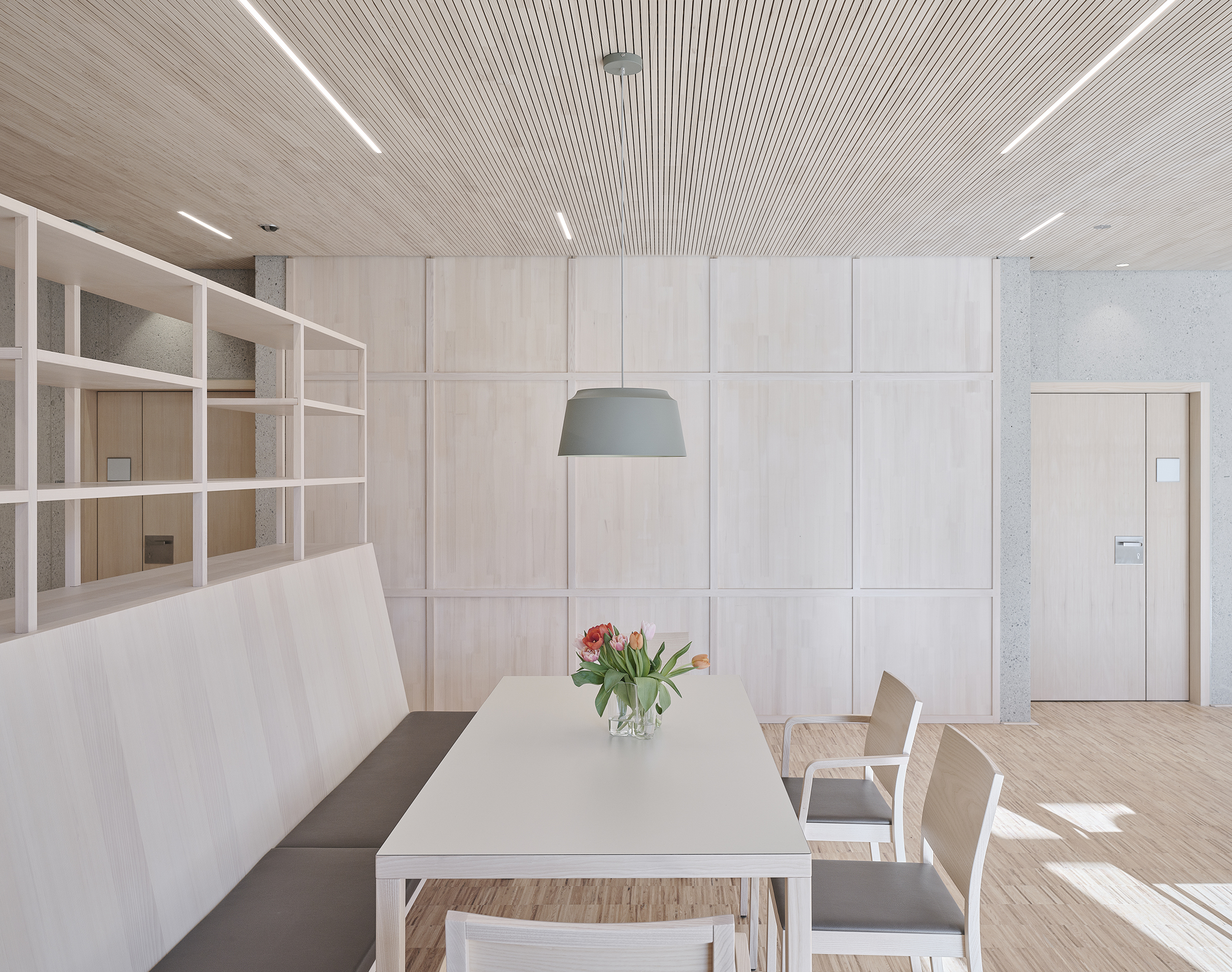
‚It is what it is‘– this simple principle applies equally to both the historic old building and the new building. By demolishing pre-existing extensions, the monument is strengthened as a simple solitary feature, while the new building serves as a discreet companion without revealing its significantly larger volume. Its color scheme results from historical comparisons with the existing building, whose appearance from the Rococo period has been restored. In the new building, the structural support framework is visible in concrete, as a counterpoint to the massive walls of the old building constructed of stone boulders. Sustainably produced and natural raw materials were used in the construction process. Silver fir comprises the material used for the paneling and furniture. Use of ground source heat pumps for heating and cooling, supported by photovoltaic sytems enhanced the envioronmental credentials. Great emphasis was placed on regional value creation in this economically weak region.