-

Exterior view from the Street
-
Exterior view from the Altoona Park
-
View into the Exhibition space
-
Exhibition Space
-
View from the Exhibition Space into the Park
-
Outdoorlab with an installation from Toshiko Horiuchi MacAdam
-
site plan, KinderKunstLabor
-
ground floor, KinderKunstLabor
-
first floor (Exhibition Space), KinderKunstLabor
-
second floor (Laboratory), KinderKunstLabor
-
third floor (offices), KinderKunstLabor
-
Axonometry, KinderKunstLabor
KinderKunstLabor
Schenker Salvi Weber. St. Pölten, Austria
-
Name of work in English
KinderKunstLabor
-
Name of work in original language
KinderKunstLabor für zeitgenössische Kunst
Prize year
EUmies Awards 2026
-
Work Location
St. Pölten, Austria
-
Studio
Schenker Salvi Weber
EUmies Awards 2026 Nominees
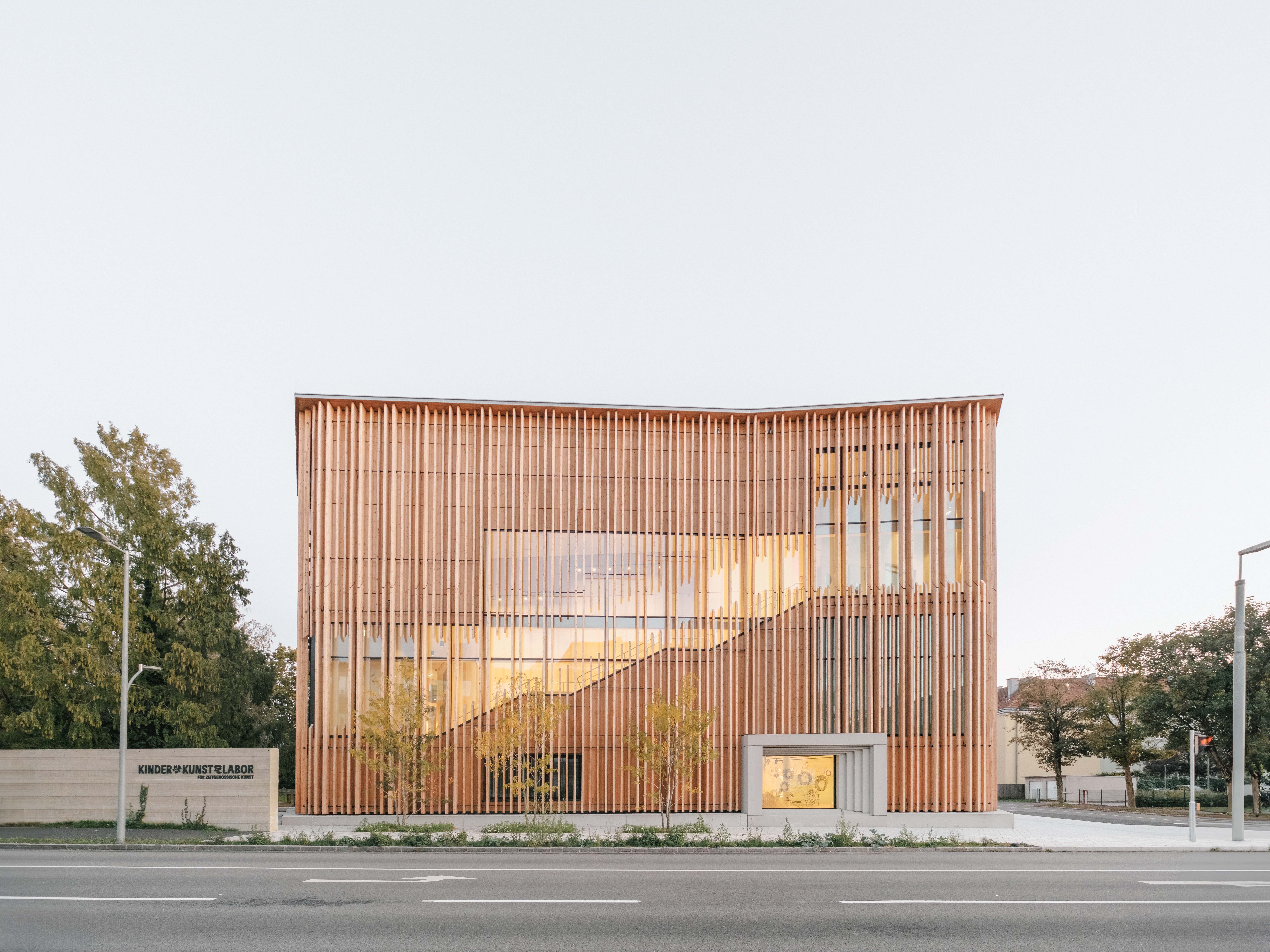


KinderKunstLabor in St. Pölten is a one-of-a-kind cultural building: neither museum nor playground, but a laboratory where children engage with contemporary art through play and exploration—designed from a child’s perspective with a serious commitment to art.
Collaborators
Structure: Werner Sobek AG, Vienna; Fire Safety and Accessibility: IMS Brandschutz, Vienna; Lighting: Designbüro Christian Ploderer GmbH, Vienna; Landscape: bauchplan ).( , Vienna; Construction management: Buchegger 7, Vienna; Installations: BPS Engineering, Vienna
Program
Mixed use - Cultural & Social
-
Labels
Compact · Art · Children & Youth · Community · Culture Centre · Exhibition · Museum
Site area
7179 m²
-
Client
Stadt St. Pölten / Land Niederösterreich / Bundeskanzleramt
Total gross floor
2930 m²
Cost
3975 €/m²
KinderKunstLabor in St. Pölten is located within Altoona Park and serves as a new cultural landmark for children. The compact triangular building accomodates exhibitions, workshops, a library, and outdoor labs. A central “tree column” and spiralling staircase connect art, play, and learning across four levels. Timber interiors, circular windows at children’s height, and seamless transitions into the park create a dialogue between architecture, nature, and community.
The project redefines the relationship between children, art, and architecture. The client’s brief—“a laboratory for art and children”—demanded an entirely new typology, one that balances curatorial quality with play and discovery. Developed through a participatory process with a Children’s Advisory Board, the design reflects young users’ perception of space, scale, and flow. The building engages Altoona Park as an open cultural landscape, not as an isolated object. A spiralling helix stair acts as a vertical promenade, connecting exhibitions, studios, and outdoor labs while encouraging exploration. The concept transforms movement into experience and learning into play. Rooted in inclusivity, the architecture becomes both instrument and invitation—blurring boundaries between education, art, and daily life.
KinderKunstLabor is built as a hybrid timber-concrete structure. A central concrete “tree column” branches into six arms that support the floor slabs and define the geometry of the main exhibition hall. The surrounding glulam beams and prefabricated timber façades are joined with dry, reversible connections that allow disassembly and reuse. Concrete is limited to the foundation and structural core, reducing embodied carbon while ensuring stability. Natural insulation materials, a photovoltaic roof and a groundwater heat pump reduce operational energy. Bird-friendly lighting and rainwater infiltration sustain the park’s ecosystem. The structure’s clarity makes construction itself part of the spatial experience, visible and tangible to its youngest users. The visible branching structure translates the idea of a growing house – an architecture open to change, learning and reuse.