-

New entrance
-
Social Heart at the entrance
-
Garden atrium
-
Entrance zone
-
Atrium, office downstairs, study space upstairs
-
South facade with reused solar shades
-
Situation drawing
-
Floor 1
-
Floor 2
-
Section
-
Detail
-
Concept drawing
ITC Faculty
Civic Architects, DS Landschapsarchitecten, Studio Groen+Schild, VDNDP. Enschede, The Netherlands
-
Name of work in English
ITC Faculty
-
Name of work in original language
ITC faculteit
Prize year
EUmies Awards 2026
-
Work Location
Enschede, The Netherlands
-
Studio
Civic Architects, DS Landschapsarchitecten, Studio Groen+Schild, VDNDP
EUmies Awards 2026 Nominees
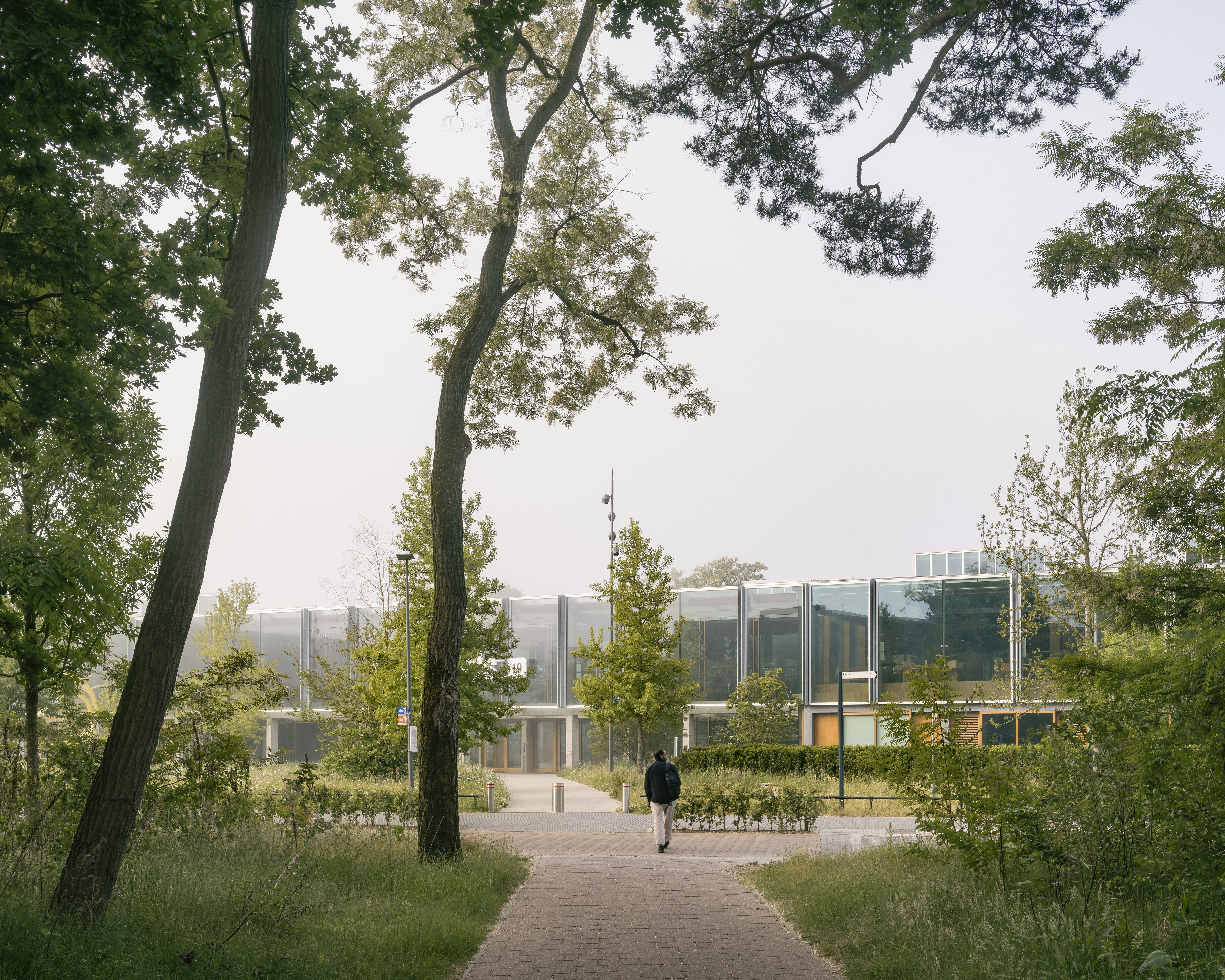


The International Institute for Geo-Information Sciences (ITC) is a special faculty of the University of Twente. Students and researchers from around the world come to Enschede to work on sustainability. The 13,605 m² building serves as their home base, meeting place, and symbol of sustainability.
Collaborators
Collaborator (office): Fernanda Romeu - Civic Architects; Collaborator (office): Theresia van Koppen - VDNDP; Collaborator (office): Fred Jager - VDNDP; Collaborator (office): Marc Wools - VDNDP; Collaborator (office): Thijs Bongers - Studio Groen+Schild; Collaborator (office): Rosanne Bommartini - Studio Groen+Schild; Building physics: Arup; Installations: Valstar Simonis; Construction management: Schreuders Bouwtechniek; Lighting: Joost de Beij
Program
Education
-
Labels
University · Research · Nature
Site area
9760 m²
-
Client
University of Twente
Total gross floor
14806 m²
Cost
2165 €/m²
ITC houses classrooms, labs, a study center, offices, a restaurant, and three patio gardens. The faculty occupies a former 1972 laboratory on the Drienerlo estate, a green campus of standalone buildings. The design unites landscape and architecture through four atria connecting indoors and outdoors, nature and technology. One atrium serves as the new central entrance. The architecture reflects ITC’s sustainable mission, preserving the brutalist structure and minimizing material use by attaching all new elements to the existing framework.
The existing building, 220 meters long and 38 meters deep, with a low ground floor and a tall upper floor, had a distinctive character but was unfit for modern education. The redesign creates openness and light not through addition but through subtraction: four atria are carved from the structure to bring greenery, fresh air, and daylight, transforming the building through one clear intervention. ITC functions as a community, and the design places social interaction at its core. The “Social Heart” is an open space linking entrance, restaurant, and library. Departments surround the atria, giving every workspace a view of green. Teaching areas, offices, labs, and study zones intertwine, allowing teachers, students, and researchers to meet in the inner gardens. One atrium forms the new entrance where landscape folds inward and trees grow inside, giving ITC a new address at the crossroads of two important urban axes and turning the former parking lot into a park.
Architecture follows climate: Reused sunshades on the south façade prevent summer overheating. Systems for both floors are combined in one air plenum, with air naturally refreshed through the atria—the lungs of the building. The landscape is generous, with plants rooted in over a meter of soil and irrigated by rainwater. Circularity: Preserving the structure forms the basis. All new elements stand on or hang from the existing framework, saving material. The concrete and steel structure remains visible, showing wear and traces of use. Circular materials—finger-jointed oak, bamboo—add natural texture. Design and detailing create coherence. The interior is demountable, materials used in pure form without paint; even table frames are uncoated. Landscape architecture: The architecture is modest; the landscape leads. Three inner gardens host flora and fauna. Stable temperatures favor (sub)tropical plants in deep soil. Glass roofs collect and channel rainwater visibly into the gardens.