-

Water Eco-Infrastructural Hub in the Chamizal Area, El Paso/Juarez. An Infrastructural Monument.
-
The Border Region. A paradoxical condition of attraction and division.
-
Border Waters. The precarious state of transboundary aquifers.
-
Integrated Eco-Infrastructural Apparatus. Strategic embedding of water infrastructure in the city.
-
As Infrastructural Equipment. Mechanical dissection of the water-infrastructure components.
-
Contact. Materialization of conflicting natures.
-
Hueco-Mesilla Bolson Infrastructural Hub. Embodying ideology in an eco-infrastructural system.
Infrastructural Topologies
Maicol Cardelli.
-
Name of work in English
Infrastructural Topologies
-
Name of work in original language
Hueco-Mesilla Bolson Infrastructural Hub
Prize year
Young Talent 2016
-
Author/s
Maicol Cardelli
-
School
Faculty of Architecture and the Built Environment - Delft University of Technology.
Delft, The Netherlands
Young Talent 2016 YT Nominees
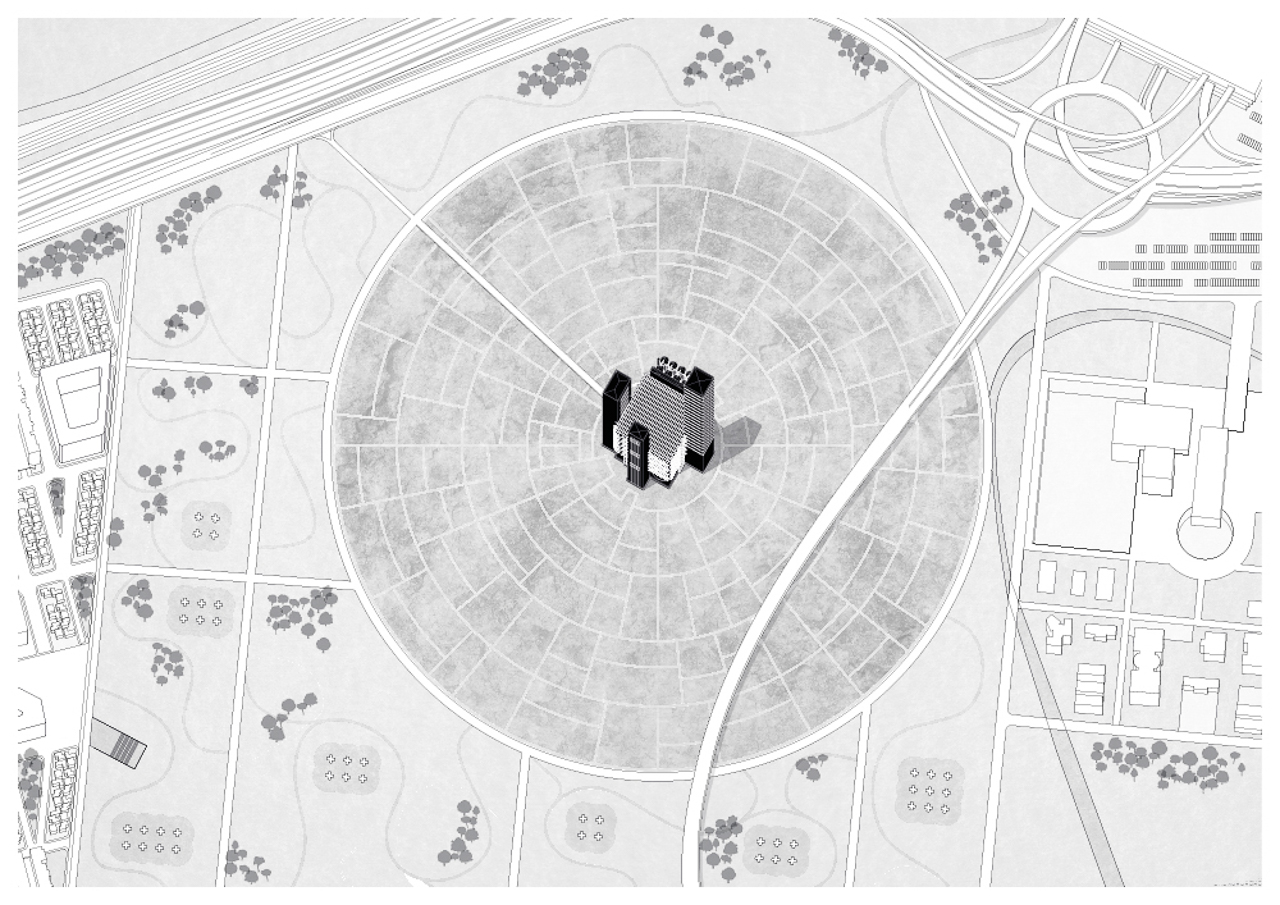


Infrastructural Topologies
Hueco-Mesilla Bolson Infrastructural Hub
Program
Infrastructure
-
Labels
Treatment · Facilities
The project addresses the current water crisis within the context of the border region between USA and Mexico. Materialized in a constructed wetland for wastewater treatment and an infrastructural hub, it represent through an infrastructural monumentality, the ideological value that infrastructure assumes in the natural and cultural landscape.
The border between USA and Mexico traverses a variety of landscapes and geographical conditions, but at the same time it divides two colliding nations-systems. Both the ideological implications and the physical manifestations of the border are responsible for defining an apparatus of systematic violence. However, the fundamental premise of this thesis is discarding the notion of the U.S. – Mexico border as a line, but rather as a region, which is the results of a manifest interdependence on cultural, political, and environmental levels. Therein, the current water crisis that the region is facing bounds the two sides in a sole entity. The thesis investigates the phenomenology of the relation between water infrastructure and landscape as a tangible, structuring device for human inhabitation, while proposing the possibility of a diverse paradigm of infrastructural development that resets its relation with the environment towards an ecological integration of mechanical equipment and natural systems. This is materialized in an integrated infrastructural apparatus that combines hard and soft infrastructure components, which implements an infrastructural paradigm of ecological integration of mechanical apparatuses and natural systems. Thus, the project implements a strategy of recharge/withdrawal for the aquifer, while proposing a bi-national agency for the management of the border aquifers. In the Border Region the task of representing sovereignty over the territory, and history, is seized by water infrastructure: the control of water has a historical and cultural significance that produces a unified image of the natural environment transformed through man made actions. In this respect the project investigates an architectural language for infrastructure, and subverts the implicit and silent representation of monumentality that the traditional water infrastructure embodies. This is anchored in the context with a political and civic performative action, in order to foster an active presence of it in the landscape, while keeping its efficiency-driven role.