-

01_main plan of project.jpg
-
02_figure-ground plan.jpg
-
03_process.jpg
-
04_guiding principles.jpg
-
05_visualization.jpg
-
06_base zone shared space.jpg
-
07_standard floor shared space.jpg
-
08_visualization.jpg
-
09_base zone hostel.jpg
-
10_standard floor hostel.jpg
-
11_base zone high rises.jpg
-
12_standard floors residential.jpg
-
13_section residential tower.jpg
-
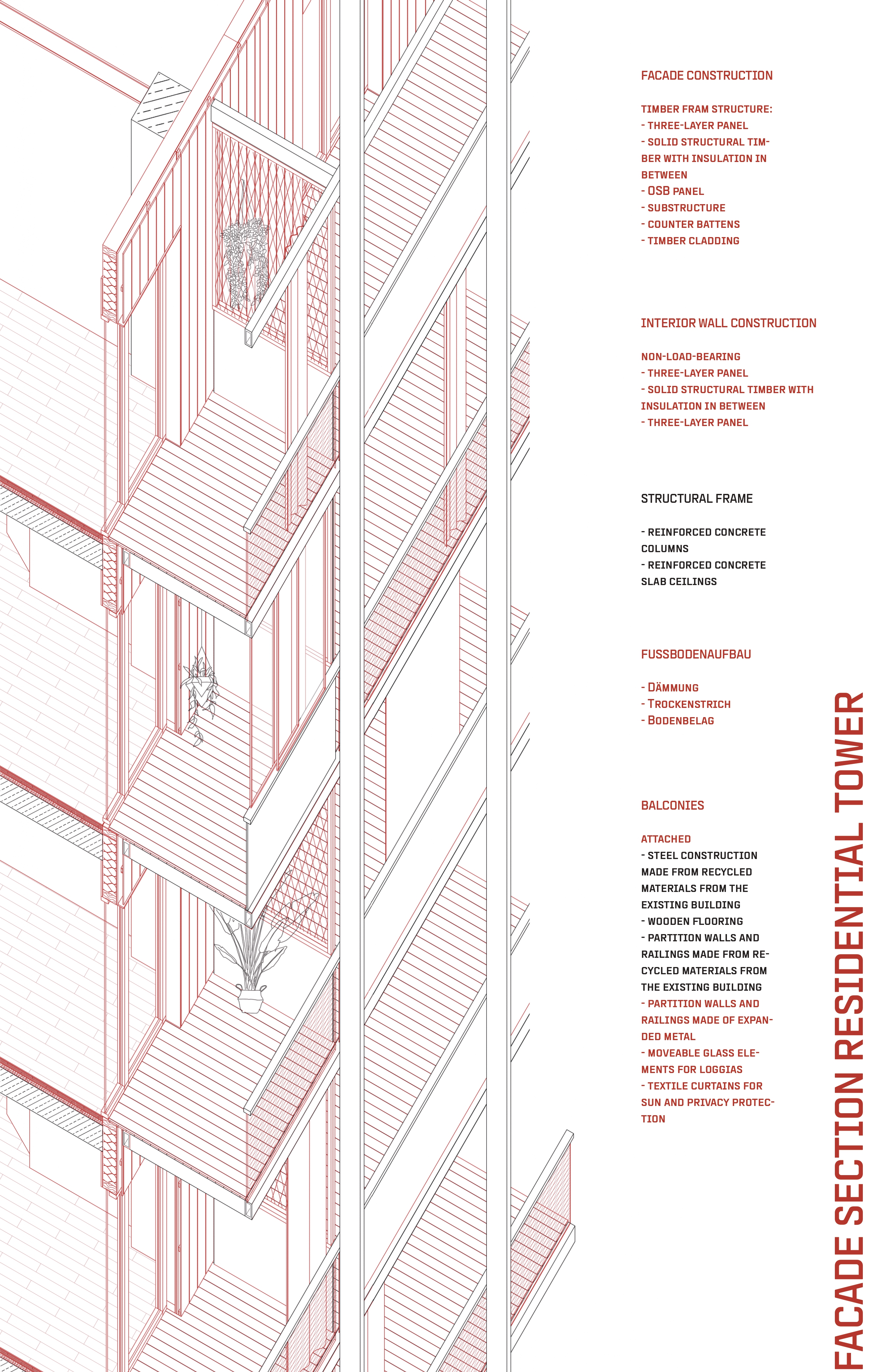
14_facade section residential tower.jpg
-
15_standard floor office.jpg
-
16_model.jpg
-
17_model.jpg
-
18_model.jpg
-
20_model.jpg
How To Not Demolish A Building
Moira Schmid. Stuttgart, Germany
-
Name of work in English
How To Not Demolish A Building
-
Name of work in original language
KARLSHÖHEPUNKT / How To Not Demolish A Building
Prize year
Young Talent 2025
-
Work Location
Stuttgart, Germany
-
Author/s
Moira Schmid
-
School
Department A - Architecture and Design - HFT Stuttgart - University of Applied Sciences.
Stuttgart, Germany
Young Talent 2025 YT Nominees




How To Not Demolish A Building
An Old Office Complex In Stuttgart - A Story Continued
Program
Mixed use - Infrastructure & Urban
-
Labels
Aggregation · Public Space · Regeneration · Redevelopment · Facilities · Collective housing
A vacant office complex in Stuttgart-West—a trendy and vibrant district—needs to be reimagined and transformed. The challenge is to turn this site into a lively and dynamic part of Stuttgart, that connects with the surrounding neighborhoods, remains open to all, and creates an inviting space where work and living coexist. Located at the foot of the city’s hill, the site includes two high-rise buildings and other existing structures. The challenge is to work with these structures, adapting and repurposing them to create a dynamic, lively neighborhood.
The transformation of an old, mono-functional office complex in Stuttgart-West, Germany, into a dynamic and vibrant urban neighborhood. The site consists of two high-rise buildings situated at the foot of the Karlshöhe, the city’s green hill, surrounded by other existing structures that frame the area. The key ideas for this transformation are circularity, empowerment, and flexibility—principles that shape not only the design but also the overall development process. How can we create a neighborhood that serves both the city and its people? How do we design a space that allows individuality, while also creating a sense of belonging and community? How can we ensure that the area is not only utilized today but continues to evolve by future generations? We have to repurpose and reimagine structures, materials, and spaces and work with what is already there instead of starting from scratch. Developing a framework that allows adaptability, enabling us to respond to changing needs and urban dynamics, is key. This design outlines a step-by-step process that brings this vision to life. Over ten phases, the neighborhood will be activated and revitalized through innovative construction methods, interim uses, and—most importantly—active participation from the community. People will have the opportunity to engage in decisions, contribute ideas, and becoming a part of the process. This approach shows that change can begin immediately. With each step, the once anonymous and gray office site will transform into a lively, colorful, and open neighborhood, which combines housing, working and community space. Buildings and public spaces will be renovated, reimagined, and brought to life, turning this former office complex into an urban and diverse part of the city.