-

Front view with clock
-
Dynamic transparency
-
Loggias overlooking the historic town
-
Vertical spatial integration
-
Spacial vistas
-
Minimal and calm materiality
-
Site plan
-
Ground floor
-
First floor
-
Third floor
-
Section
-
Elevation north
Hohenems Town Hall
BERKTOLD WEBER Architekten. Hohenems, Austria
-
Name of work in English
Hohenems Town Hall
-
Name of work in original language
Rathaus Hohenems
Prize year
EUmies Awards 2026
-
Work Location
Hohenems, Austria
-
Studio
BERKTOLD WEBER Architekten
EUmies Awards 2026 Nominees
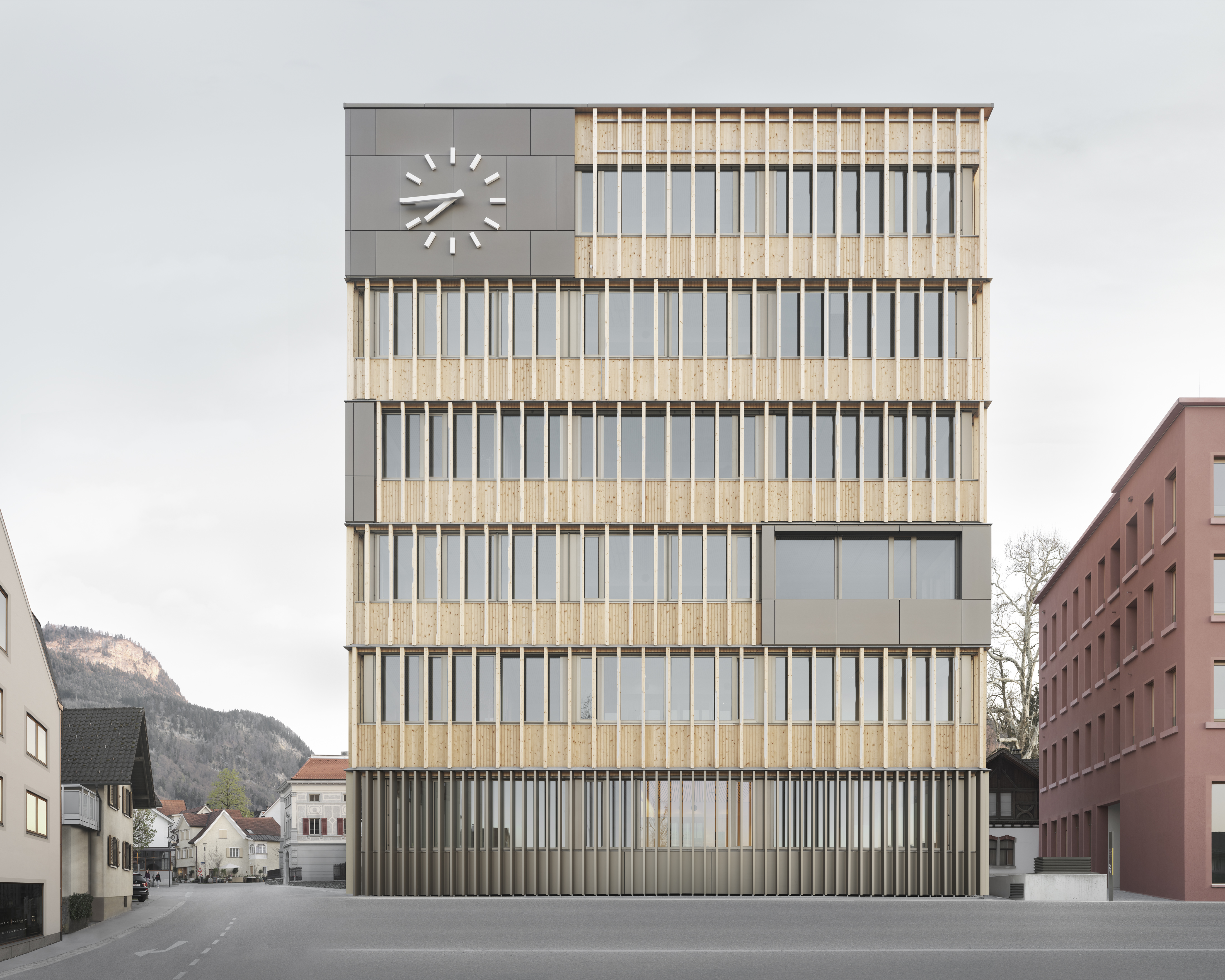


The new Hohenems Town Hall, a six-story timber landmark, redefines the northern entrance to the town’s historic core. Open-plan interiors around a spatially layered atrium foster transparency and interaction, while its sculptural façade and sustainable design set new ecological and social standards.
Collaborators
Collaborator (office): Susanne Bertsch - Berktold Weber Architekten; Collaborator (office): Natalie Krieg - Berktold Weber Architekten; Collaborator (office): Denise Ludescher - Berktold Weber Architekten; Collaborator (office): Verena Mutschlechner - Berktold Weber Architekten; Structural engineering, GP Management, Façade: gbd ZT GmbH, gbd Projects (Dornbirn, Austria); Building Services Engineering: Planungsteam E-Plus GmbH (Dornbirn, Austria); Electrical: Hecht Licht- und Elektroplanung (Rankweil, Austria); Building physics: Hafner Weithas Bauphysik (Lauterach, Austria); Fire Protection Planning: K&M Brandschutztechnik GmbH (Lochau, Austria); Signage Design: Sägenvier DesignKommunikation (Dornbirn, Austria)
Program
Government & Civic
-
Labels
City Hall
Site area
977 m²
-
Client
Stadt Hohenems
Total gross floor
2030 m²
The wooden Town Hall marks the beginning of the Rathaus quarter, fostering identity, responsibility, and community. Flexible offices, central communal zones, and vertically connected spaces spark dialogue, collaboration, and interaction across all levels. Its deep, sculptural façade shifts with light and perspective, revealing glimpses of interior life, softened by full-height loggias and framed windows. Built to the highest sustainability standards with Cradle2Cradle guidance, it embodies circular economy, CO₂ management, biodiversity, high-quality architecture, and exceptional craftsmanship.
The urban and architectural task of planning the new Town Hall was highly challenging. It also required unifying dispersed administrative departments, reconciling political demands, and meeting the highest ecological standards within a defined cost framework. In response, the design strategy centers on a structural timber concept that creates flexible, open spaces rich in spatial experience, fostering dialogue and transparency. Close collaboration between architects, engineers, municipal authorities, and political stakeholders ensured a careful balance of tradition and innovation. By using predominantly regional materials, low-tech principles, and Cradle-to-Cradle guidance, the project achieves sustainability, efficiency, and economic responsibility. The crafted spruce façade, featuring Jean Améry’s inscription “Geburt der Gegenwart”, anchors the building in local identity, linking past and present through an architecture of civic presence and responsibility.
Spruce columns form the vertical load-bearing framework of the timber construction. Diagonally dowelled, ecological solid-wood slabs made from regional spruce are combined with wood-based panels to form rigid diaphragm slabs. Lateral stability is provided by these diaphragm slabs in combination with timber beams and massive cores capable of transferring wind and seismic loads. This structural concept allows open floor plans and maximum spatial flexibility on each level. The exterior reveals the timber construction through a layered tongue-and-groove façade and untreated spruce louvers. The robust and durable material palette ensures economic efficiency in both construction and operation while supporting the building’s low-tech approach. During planning and construction, ecological supervision ensured compliance with defined environmental standards and resolved potential conflicts without compromising the project’s sustainable and qualitative goals.