-

Helsinki Biennial Pavilion in the South Harbour of Helsinki, next to the Market Square.
-
Helsinki Biennial Pavilion - The yard of the pavilion
-
Helsinki Biennial Pavilion - Interior of the pavilion that will serve as a waiting space for the Helsinki Biennial 2021
-
Helsinki Biennial Pavilion - The pavilion seen from south-west
-
Helsinki Biennial Pavilion - The pavilion among the wooden boats in the harbour during a herring market.
-
Helsinki Biennial Pavilion - Site plan
-
Helsinki Biennial Pavilion - Plan
-
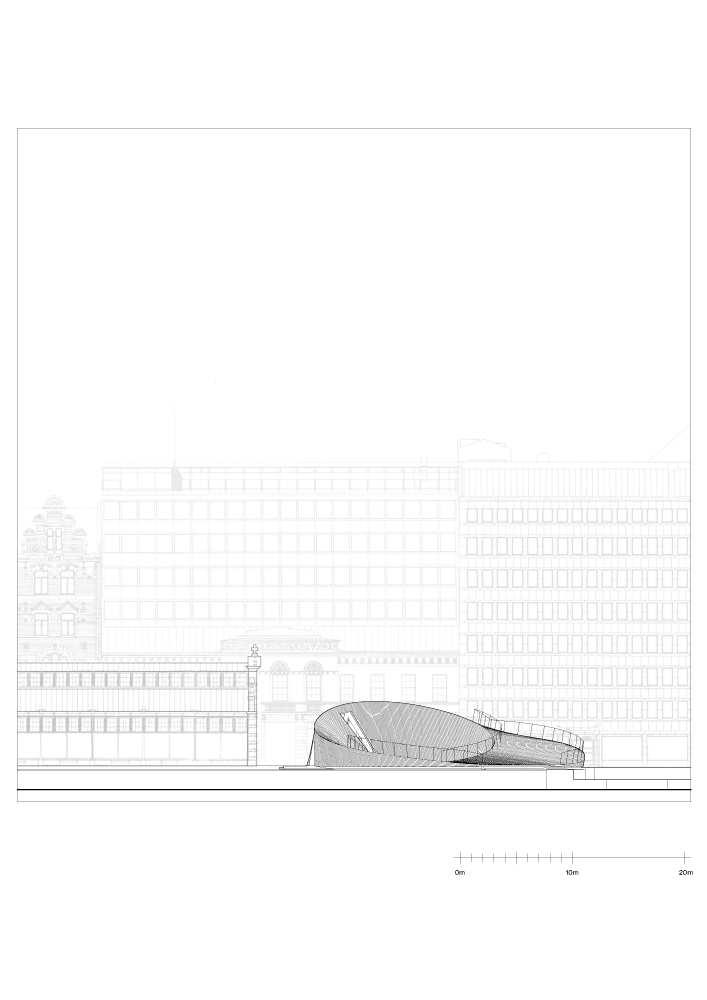
Helsinki Biennial Pavilion - Elevation, East
-
-
Helsinki Biennial Pavilion - A2 Panel
Helsinki Biennial Pavilion
Verstas Architects. Helsinki, Finland
-
Name of work in English
Helsinki Biennial Pavilion
-
Name of work in original language
Helsinki Biennaali -paviljonki
Prize year
EUmies Awards 2022
-
Work Location
Helsinki, Finland
-
Studio
Verstas Architects
EUmies Awards 2022 Nominees


The Helsinki Biennial Pavilion serves as the entry point for the ferry landing from which to embark on the boat that takes the visitors to the new biannual arts festival on the Vallisaari island. Accessible all year round, it provides an open-air urban living room space and offers an opportunity to pause to enjoy the presence of the sea in the heart of the city.
Collaborators
Collaborator (office): Sitowise (Pier design); Structural engineering: Expecon Oy Kai Palin (Structural engineer); Construction: Konepaja Mäkelin; Engineering: City of Helsinki / Urban environment division Mirva Koskinen (Geotechnical engineering); Fire consulting: Paloässät Oy Sami Loukkaanhuhta; Engineering: City of Helsinki / Urban environment division Pekka Nikulainen (Traffic planning); Construction: Helsinki City Construction Services / Stara Jari Mikkola; Project architect: Mikko Rossi (Verstas Architects); Architect: Otto Autio (Verstas Architects); Project architect: Pyry Kantonen (Verstas Architects); Interiors: Ulpu Kojo (Verstas Architects); Collaborator (external): Juulia Kauste
Program
Culture
-
Labels
Exhibition
Site area
1200 m²
Total gross floor
187 m²
Completion
2020
The Biennial Pavilion houses ticket sales and tourist information as well as ancillary spaces in a simple rectangular volume next to the pavilion itself. It provides a place for people to meet in and to wait for the ferry. Like a nomad dwelling, the pavilion is built with no foundation and is not fixed to the ground. It is made of wood, a material traditionally used for buildings in the archipelago. Over time, the wood will acquire a patina, and as a local material it will sustain the seasonal changes in the harsh northern climate. Echoing the forms of the coastal cliffs rounded by the ice and shaped like a swirl, the pavilion takes inspiration from the ocean life with seashells and clams. With its organic shape and natural material, it stands in a stark contrast to the surrounding 19th century maritime city with the bustling Market Square and the neoclassical and neo-Renaissance buildings.
The Helsinki Biennial on the Vallisaari island is part of the city’s strategy to make the archipelago more accessible. The pavilion was designed to provide an anchor point for the event in the city. As a wooden “vessel” it enters into dialogue with the ships in the harbor and ties in with the history of the Market Square. At first, the intention was to have the pavilion dismantled after each Biennial and to have it shipped in pieces to Vallisaari to be stored there for the winter, like a boat is kept over the winter and prepared for use in the summer again. This prompted the decision to make the pavilion with prefabricated wooden elements that can easily be moved around by ship. However, it was quickly realized that the pavilion has a much bigger role to play if left to stand in place all year round. It provides a place for people to hang out by the sea. One can rest on the sloping auditoriumlike space observing the colorful marketplace or seek shelter under the tentlike roof supported by triangular timber frames. The importance of such an open public space has been highlighted in unexpected ways by the experience of the limitations on indoor gatherings in response to the Covid19 pandemic.
After initial studies with clay models, the final form of the pavilion was created digitally. Without conventional construction drawings, the fabrication process was guided by a digital 3D building model. Built in a carpenter’s workshop in a small harbor town, the prefabricated parts for the pavilion were shipped by sea and loaded directly onto the site for installation. The structure is composed with two types of prefabricated elements connected with bolts: open and closed ones. Both consist of glue-laminated timber frames and steel ties, clad with laminated veneer lumber and topped with fine sawn pine battens stained dark with a mix of tar and linseed oil. The wooden surfaces in the interior parts are treated with wood oil to maintain their natural light color. Lighting is carefully hidden in slots between the triangular parts of the frame. The deck is made of oiled pine planks, while the round yard in the middle is paved with greyed crosscut logs and white quartz sand. As a locally available material with a capacity to store carbon, wood is ecologically sustainable and long lasting in the northern climate. It is easy to maintain and quick to repair by replacing worn out parts