-

Dockside facade with subtle differentiation of bays
-
The harbour building from across the dock
-
Corner view showing bays and arches
-
Detail of concrete arch, brick pier and decorated ceiling tiles to passageway
-
Detail of passageway with window into apartments entrance hall
-
Site plan
-
Site plan
-
Typical floor plan
-
Section AA
-
Section BB
-
-
A2 board
Harbour building
Sergison Bates architects. Antwerp, Belgium
-
Name of work in English
Harbour building
-
Name of work in original language
Havengebouw
Prize year
EUmies Awards 2022
-
Work Location
Antwerp, Belgium
-
Studio
Sergison Bates architects
EUmies Awards 2022 Nominees

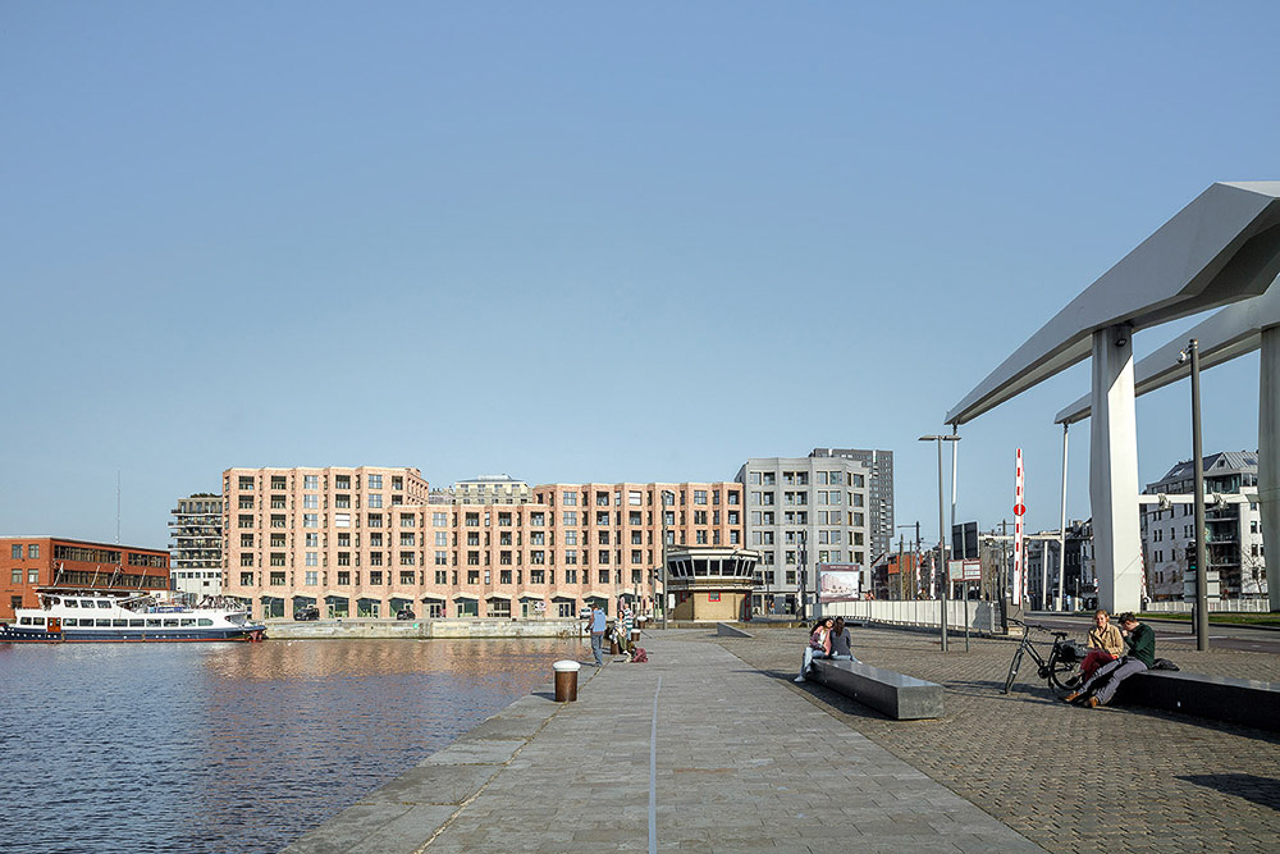


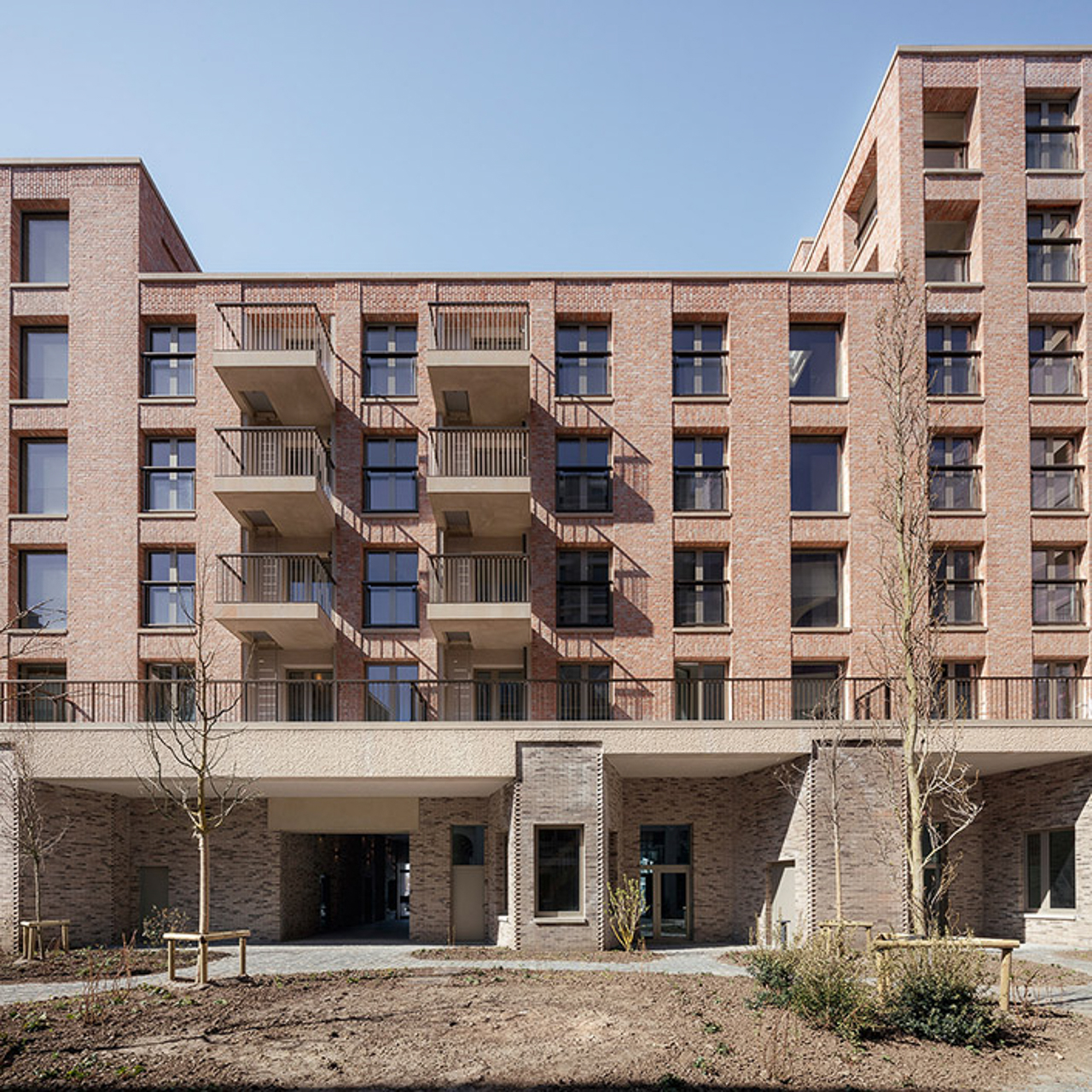


Part of a new urban block in the Cadix dock regeneration area, the building establishes a continuous but heterogeneous frontage along the old quay. 72 apartments arranged above commercial spaces, with shared access to the blocks’s central garden courtyard, offer different types of tenure to a diverse, multi-generational community of residents.
Collaborators
Coordination: Bart Anthonissen (eld); Structural engineering: Geert Wante (ABT); Mechanical: Frank Segers (STABO); Environmental: Antwan Van Haaren (DGMR); Landscape architect: Bjorn Gielen (LANDINZICHT); Construction company: Joren Bracke (N.V.STRABAG Belgium S.A.); Collaborator (office): Camiel Van Noten (Sergison Bates architects), Angel Solanellas, Jasper Caenepeel, Daniel Waterstone; Acoustical: Ariane Segers (VENAC); Environmental: Glynn van Nieuwenhuyse (Bopro); Electrical: Frank Segers (STABO)
Program
Collective housing
-
Labels
Linear block
Site area
5140 m²
-
Client
Construction and Investment Partners
Total gross floor
8800 m²
Completion
2021
Cost
1485 €/m²
The development site lies at the southern end of the Cadix regeneration area in the former dockland district of Antwerp, where the historical city fabric and the former industrial port structure meet. The site forms a new frontage to the large expanse of the Kattendijkdok, establishing a new street, the Oostkai, that restores the connection between the new residential quarters on the Eilandje and the rest of the city. The Harbour building is part of an urban block of five separate buildings that form a single conglomerate with a landscaped garden courtyard at its centre, accessed from the street via arcades and passageways and planted with trees and shrubs to provide an oasis-like space. Three spacious apartments with 2.8m-high ceilings are organised around each stair core: two dual-aspect apartments stretch 14 metres from front to back, with balconies looking east and west, and a third apartment stretches across a double bay facing west. Balconies are detailed like rooms and their facetted shape creates intimate nooks in the main living spaces. The building profile is stepped to create a roof terrace, and corner apartments on the upper floors have linear loggias.
The design intention was to create a powerful urban facade to this largescale residential building, which shares some of the qualities of the harbour warehouse buildings and residential mansion blocks of the nineteenth century: a combination of robust materiality and fine formmaking. Inspired by industrial quayside buildings in terms of its massing and material presence and by residential mansion blocks in the detailing of repeated undulating forms, its asymmetrical twosided bays form the two street facades. The combination of irregular repeated bays, stepped elevation and changing arch height gives a subtly syncopated rhythm to the 86mlong facade. The different angles and projections of the bays mirror the different dimensions of the party walls within, giving the repeated form a faint irregularity. The facade is stepped, changing height from five to seven storeys to allow light into the courtyard and form a communal roof terrace for use by residents. Within the bays, southfacing loggias offer views over the water and towards the city. The open loggias, where the everyday life and work activities are visible, indicate that this is a residential building.
A large pink-grey clinker brick laid in a running bond with a horizontal band of vertically stacked bricks emphasises the tri-partite proportioning of the facade. The bays rest on projecting concrete arches which rise in height at each end of the facade. The arcade that leads to the garden courtyard has a ceiling of bespoke patterned hydraulic tiles and light grey brick walls with a dog-tooth patterning to absorb the subtle geometric shifts as one moves from the street to the courtyard within the block. The emphasis on the detailing of the building’s common areas extends to the entrance halls, where warm earth-clay floor tiles are combined with highly glazed, profiled wall tiles. These ‘special moments’ express a generous approach to the interface between the private and the public realm, offering visual and tactile delight at the points where the building meets the city. The brick facades and deep reveals create an imposing armature with a strong material presence, embodying the project’s ambition for solidity and permanence, while the rhythmic movement of the street elevation tempers the building’s monumental character and gives it a playful presence and a human scale.