-

ATA / ENTRETEMPOS, General Silveira Building
-
ATA / ENTRETEMPOS, General Silveira Building
-
ATA / ENTRETEMPOS, General Silveira Building
-
ATA / ENTRETEMPOS, General Silveira Building
-
ATA / ENTRETEMPOS, General Silveira Building
-
ATA / ENTRETEMPOS, General Silveira Building
-
ATA / ENTRETEMPOS, General Silveira Building
-
ATA / ENTRETEMPOS, General Silveira Building
-
ATA / ENTRETEMPOS, General Silveira Building
-
ATA / ENTRETEMPOS, General Silveira Building
-
ATA / ENTRETEMPOS, General Silveira Building
-
ATA / ENTRETEMPOS, General Silveira Building
-
ATA / ENTRETEMPOS, General Silveira Building
-
ATA / ENTRETEMPOS, General Silveira Building
-
General Silveira Building
ATA Atelier, ENTRETEMPOS. Porto, Portugal
-
Name of work in English
General Silveira Building
-
Name of work in original language
Edifício General Silveira
Prize year
EUmies Awards 2024
-
Work Location
Porto, Portugal
-
Studio
ATA Atelier, ENTRETEMPOS
EUmies Awards 2024 Shortlisted
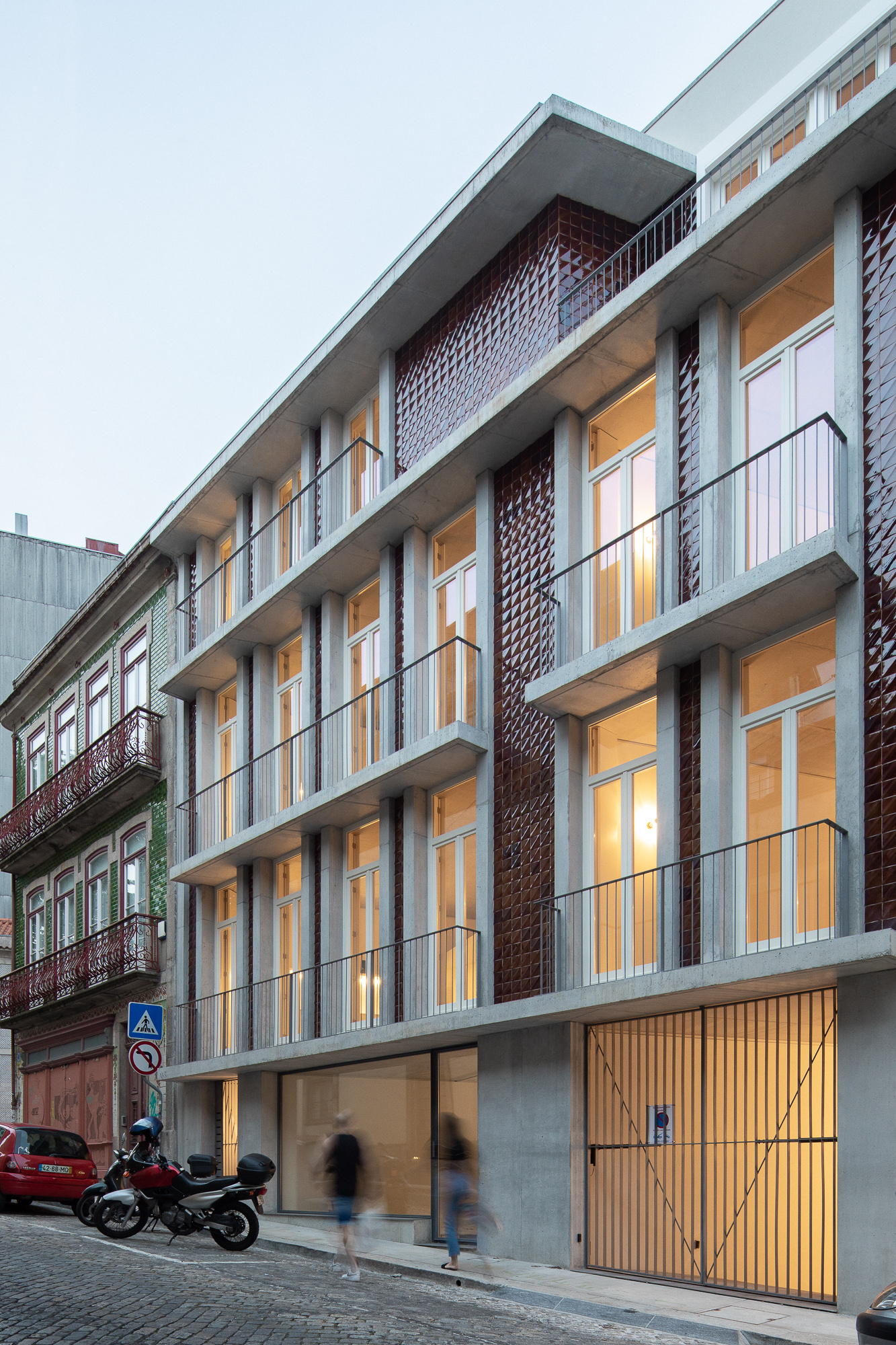


The General Silveira building is a mixed collective housing and commerce project located in a classified block in Porto’s city centre that, between the haze of memory and the increasingly contemporary city, was born in the inexorable circumstance that dictates its formal lexicon.
Collaborators
Architect: Abílio Silva; Architect: Catarina Fernandes; Structural engineering: João Lima; Hydraulic: Luísa Miguel; Electrical: Daniel Pires; Climatisation: Carlos Bastos; Construction manager: Nuno Silva; Construction company: Invenio Engenharia, SA.
Program
Collective housing
-
Labels
Courtyard · Compact
Site area
312 m²
-
Client
Zhiang Zhou
Total gross floor
1378 m²
Completion
2022
The General Silveira building design is based on a morphological model that characterizes housing in Porto. Through the design of 4 smaller-scale volumes, contiguous 2 by 2 and separated by a courtyard inside the block, the proposal volumetrically functions as 4 buildings, evoking the memory of the 4 pre-existing fractions as well as the predominant scale of the surrounding urban fabric - integrating itself into the city's typological housing matrix. However, the intention is not to mimic the architectural language of the late 19th and early 20th centuries but rather to design a contemporary architecture that seeks to reinterpret the relationships of proportion, materiality and form.
The initial concern was the interconnectivity of the whole design since access to the interior of the city block from the streets was strongly conditioned. Schematically, the typological distribution 4 apartments per floor evokes the 4 original plots, in a morphological corollary that results in 4 hipped roofs, assuming the 5th elevation of the project. The ground floor is physically and visually permeable, acting as a mediating space between public and private, the moment where commerce and housing converge and the streets interconnect. In a strong compromise between adapting to the needs of the present and intervening in existing heritage, the project introduces a profound improvement in terms of accessibility. Starting from the outside, through two accesses at the level of each of the streets, allowing access to a courtyard cut into the interior, where there is a central stairwell and an elevator that is the centrepiece of the project, not only because of the impact on the perception of the space, but above all, because this is the element that defines all the altimetric relationships with the surroundings, namely cornices, eaves, dormers, balconies and openings.
Environmental sustainability has also been addressed throughout the project, especially with passive systems that reduce the building's ecological footprint. The implementation of a central courtyard, where the vertical accesses are located, not only allows the introduction of natural lighting in the areas furthest from the streets but also allows cross ventilation in all the commercial and residential units, which is so important for the healthiness of the spaces. The houses are accessed from this outdoor patio via galleries, taking advantage of the same ventilation and natural lighting. Finally, the metrics of the elevations, the choice of tile pattern and colour, and the distance between openings refer to the dynamic and tectonic design of the adjacent buildings. The Genius Loci is the inexorable circumstance that dictates the formal lexicon. Considering that an intervention in a historic and classified area such as this always requires a sensitive and careful process between improving the quality of the spaces and their appropriate urban insertion, the project sought a compromise between the past and the new ethical and environmental needs of the present.