-

The New Railway Infrastructure
-
The Intervention Site
-
The Profile of the Boulevard
-
The New Wall
-
The Bridge Building
-
The Cultural Path
-
The Building Materials
-
The Smooth Mobility Path
-
From Infrastructure as Limit to Infrastructure as Link
Ana Catarina Santos. Lisboa, Portugal
-
Name of work in English
From Infrastructure as Limit to Infrastructure as Link
-
Name of work in original language
A Smooth Mobility Path in Planalto de Lisboa
Prize year
Young Talent 2023
-
Work Location
Lisboa, Portugal
-
Author/s
Ana Catarina Santos
-
School
ISTA - School of Technology and Architecture - ISCTE - University Institute of Lisbon.
Lisboa, Portugal
Young Talent 2023 YT Nominees



From Infrastructure as Limit to Infrastructure as Link
A Smooth Mobility Path in Planalto de Lisboa
Program
Mixed use - Cultural & Social
-
Labels
Aggregation · Facilities · Archaeology
The train line works as a physical barrier while plays an important role in the way we move and live in the city. This investigation aims to study the contrast between the infrastructure as a limit and as a link through the creation of a cultural path.
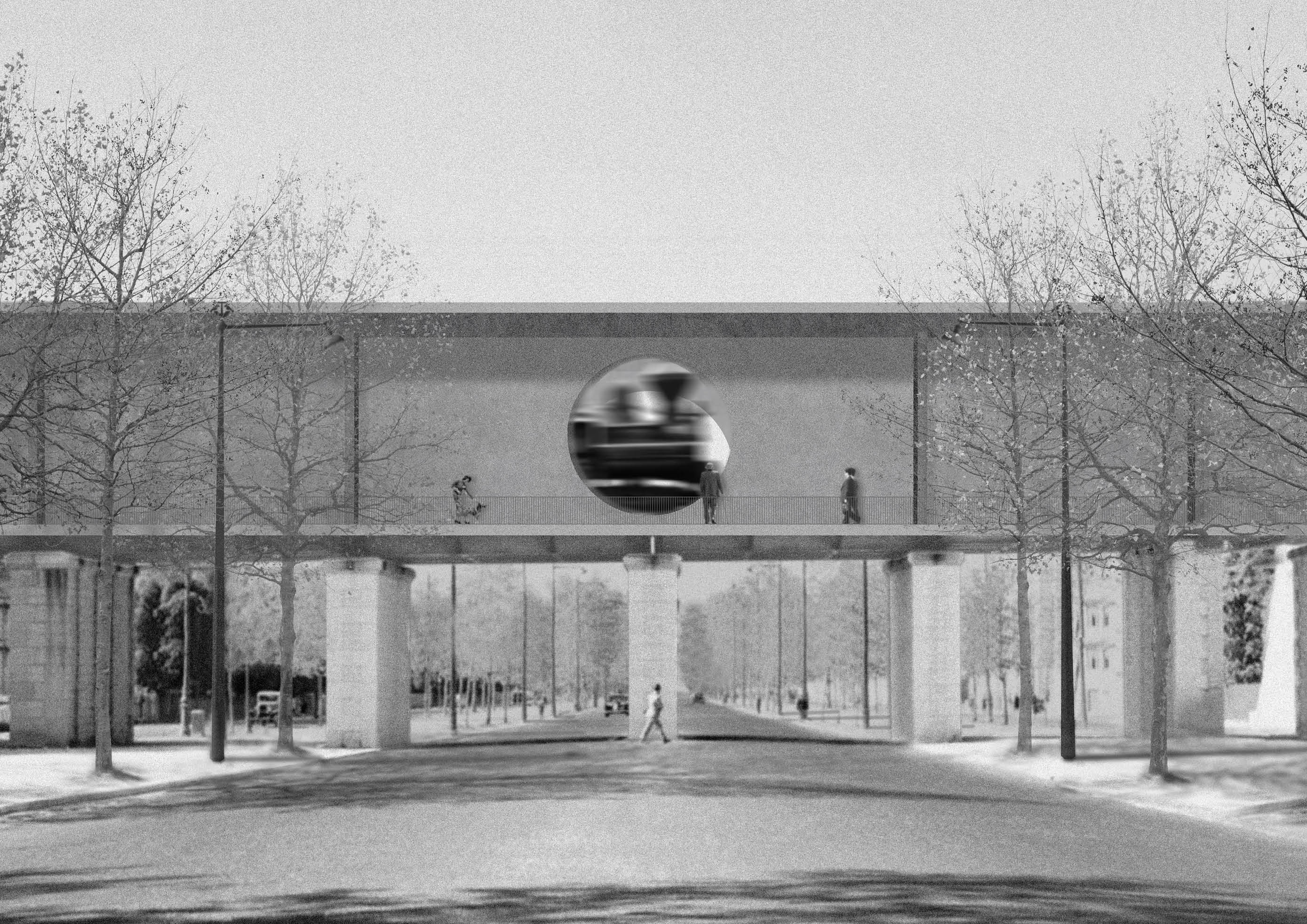
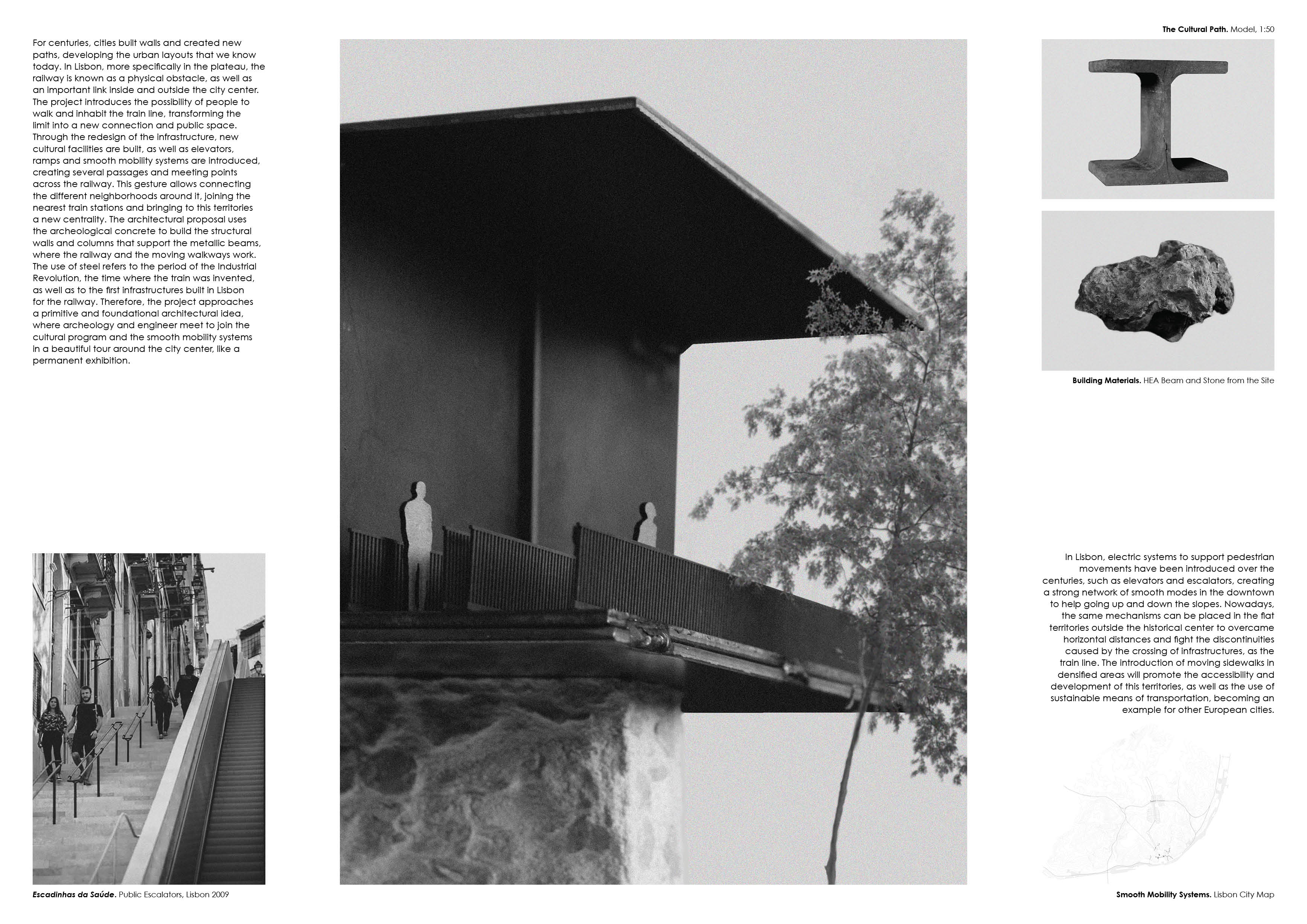
In Lisbon, architecture and urban planning have been focusing on the historical areas around the seven hills for years. Nowadays, is mandatory to look at the flat territories on the city’s surroundings, where their development have been mostly supported by the infrastructures’ network, as the railway. The project aims to transform the physical obstacle of the train line on an opportunity to restore and create new connections, as well as bringing to the places around it a new centrality. These territories are mostly characterized by residential and service buildings, until the recent discovery of ruins near the intervention site. The archeological objects found belonged to agricultural structures from the 19th century which do not have considerable heritage value for their preservation. Therefore, the ruins will be used as the project’s building material and program. From the redesign of the infrastructure, new cultural spaces are created as well as pedestrian, bike and green lanes are introduced allowing people to stay and walk along the train line. At a time when urban mobility is being discussed, the introduction of soft modes to overcame horizontal distances will improve the accessibility of flat territories as well as promote new sustainable means of transportation. The addition of electrical systems to support pedestrian movements in urban areas can be found in densified places with steep topography, where escalators and elevators were built to help going up and down the slopes. In the 1900 Paris Exposition, a moving sidewalk was created to transport the visitors around the city while providing a beautiful and unique tour of the exhibition. The proposal approaches a primitive and foundational architectural idea, where above a solid stone rests a large metallic beam, creating a cultural path that highlights the smooth modes while crossing the territory as a permanent “Exposition Universelle”.