-

Web gallery1_Cover.jpg
-
Web gallery2.jpg
-
Web gallery3.jpg
-
Web gallery4.jpg
-
Web gallery5.jpg
-
Web gallery6.jpg
-
Web gallery7.jpg
-
Web gallery8.jpg
-
Web gallery9.jpg
Form Follows Tradition - A Tale of Craftmanship in East Africa
Alberte Emilie Fogh Hansen, Rasmus Scott Bommersholdt Nørulf. Moshi, Tanzania
-
Name of work in English
Form Follows Tradition - A Tale of Craftmanship in East Africa
-
Name of work in original language
Form Follows Tradition - A Tale of Craftmanship in East Africa
Prize year
Young Talent 2025
-
Work Location
Moshi, Tanzania
-
Author/s
Alberte Emilie Fogh Hansen, Rasmus Scott Bommersholdt Nørulf
-
School
Department of Architecture, Design and Media Technology - Aalborg University.
Aalborg, Denmark
Young Talent 2025 YT Nominees


Form Follows Tradition - A Tale of Craftmanship in East Africa
Form Follows Tradition - A Tale of Craftmanship in East Africa
Program
Mixed use - Cultural & Social
-
Labels
Aggregation · Health Resort · Heritage · Architecture · Community · Nature
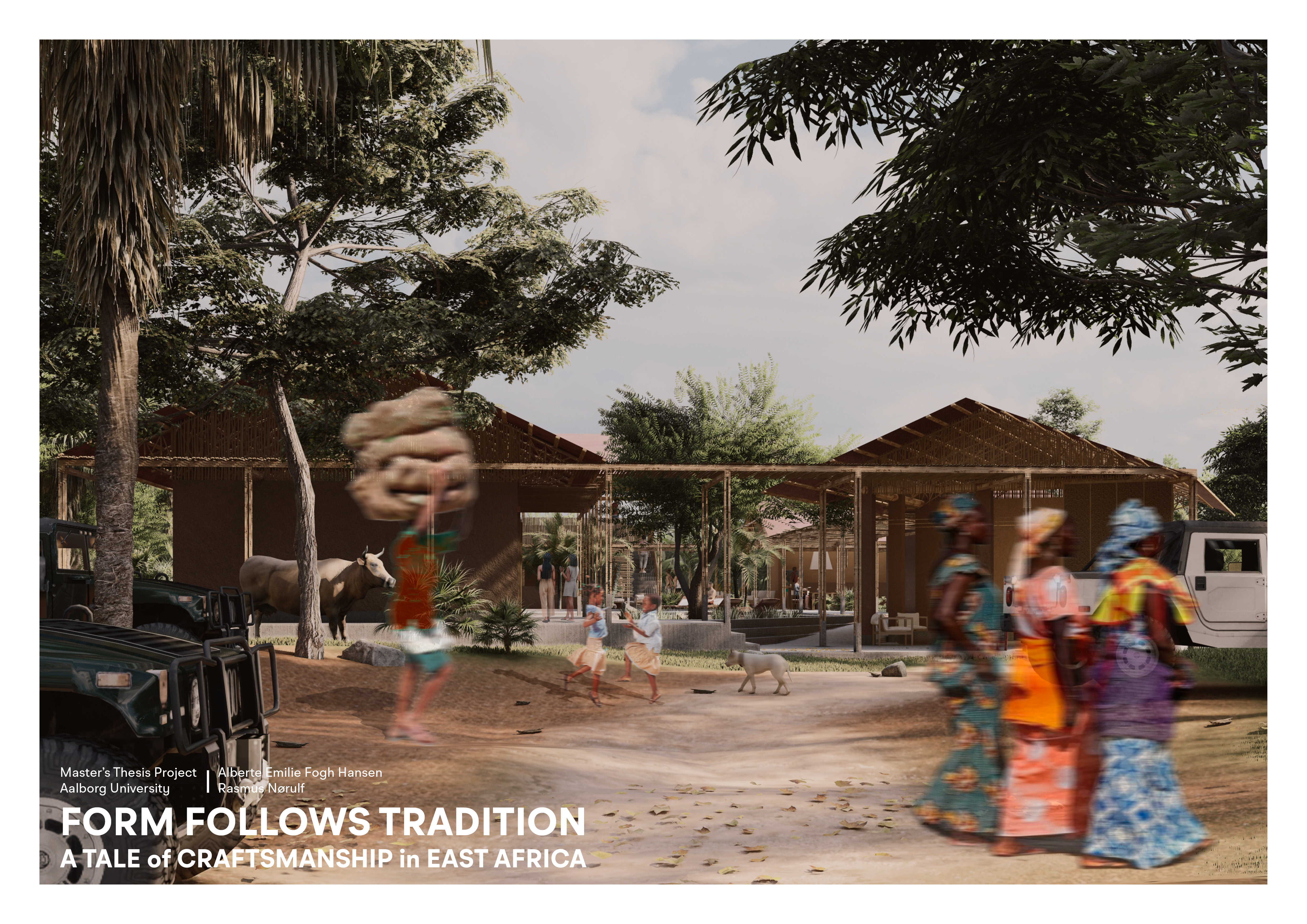
We collaborated with a landowner in Tanzania to partially transform his farmland into a lodge focusing on permaculture and cultural exchange aiming at tradition preservation. We conducted extensive field work, including interviews, observations and prototyping. We found that recent buildings rely heavily on concrete and active systems for indoor comfort, undermining the rich values of local cultural heritage and vernacular knowledge, thus affecting the health of occupants and craftsmen. This project sought to challenge the perception that traditional building technology is a symbol of poverty.
The design proposal explores the possibilities of creating a lodge that is deeply rooted in the cultural heritage of the local people, while presenting a contemporary design that would inspire local builders to reacknowledge the qualities of the cheap, available and environmental-friendly resources. Through several study trips to indigenous tribal settlements, and by hands-on learning from numerous local craftsmen, we acquired a deep sensibility towards local materials, the construction methods and their relation to the surrounding environment. Living in a tent on site together with local craftsmen for four months, we built a full-scale dwelling unit as a prototype, testing the structural stability of unburned mud bricks and natural cladding resilient to the microclimate. The prototype explored the possibilities of participatory design allowing knowledge exchange across professions and cultures. This experience provided insights into local building requisites, which informed the masterplan that articulates the dwellings with supporting complex buildings. The prototype laid the foundation for the design proposal proposing a building system that is easily reproducible, and materials suitable for affordable and long-lasting housing. We learned that the direct involvement of all stakeholders in the process supported a sense of belonging and ownership towards the place and the structure, which is paramount in its maintenance and valorization. The design is supported by digital simulations to articulate both passive bioclimatic design strategies and structural considerations with local vernacular building techniques. The result is a resilient structure, easy to build and completely passive as it delivers indoor comfort without resorting to mechanical systems.