-

lagoon panorama altered222.jpg
-
scenario protect.jpg
-
scenario accommodate.jpg
-
scenario retreat.jpg
-
principles raised piantata.jpg
-
principles fishvalley.jpg
-
landscape qualities.jpg
-
analysis maps.jpg
F[L]OOD: Landscape-inclusive agriculture and drowning deltas
Inge van Wijk. Brussa, Caorle, Italy
-
Name of work in English
F[L]OOD: Landscape-inclusive agriculture and drowning deltas
-
Name of work in original language
Improving food security and flood control at the north-eastern Italian coast
Prize year
Young Talent 2025
-
Work Location
Brussa, Caorle, Italy
-
Author/s
Inge van Wijk
-
School
Chairgroup Landscape Architecture - Wageningen University and Research Centre.
Wageningen, The Netherlands
Young Talent 2025 YT Nominees




F[L]OOD: Landscape-inclusive agriculture and drowning deltas
Improving food security and flood control at the north-eastern Italian coast
Program
Landscape
-
Labels
Regeneration · Green Belt
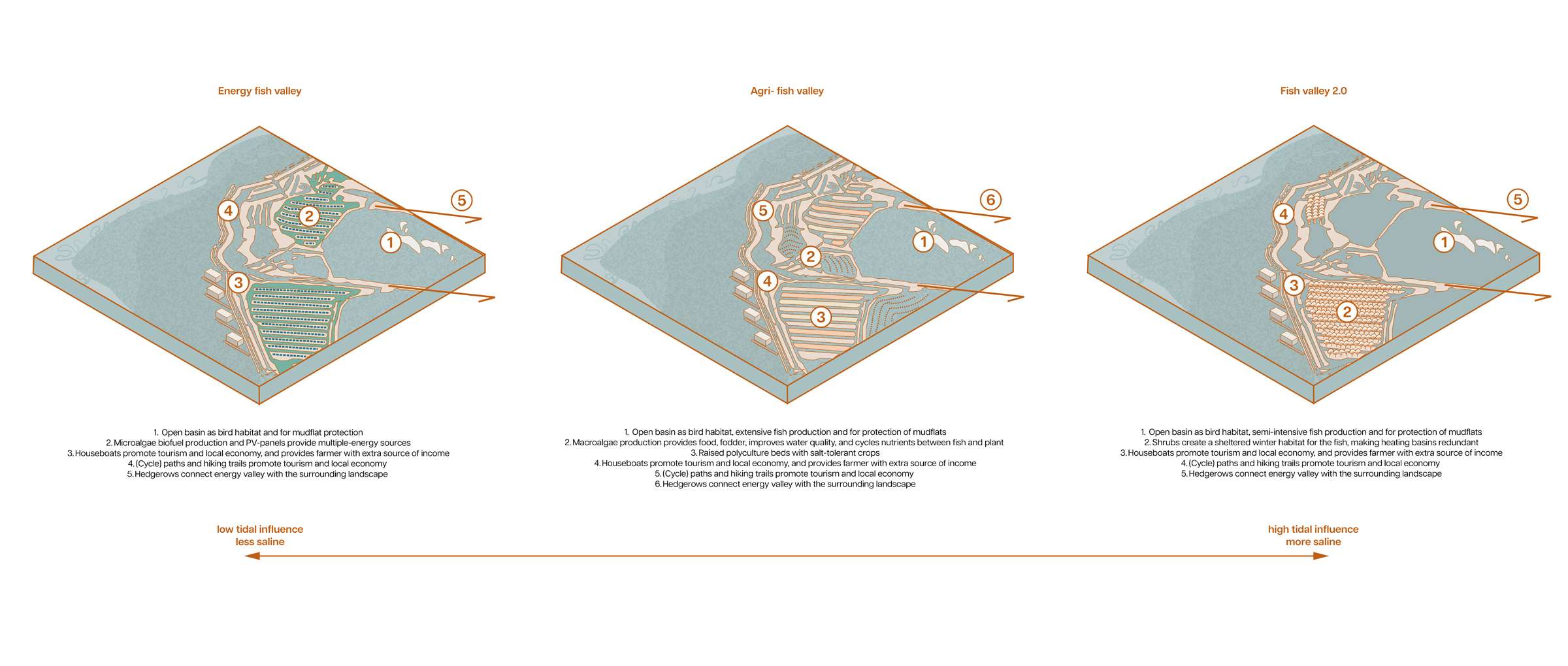
As sea levels rise and land sinks, fertile deltas are disappearing. The north-eastern Italian coast exemplifies this crisis, where freshwater and seawater dynamics challenge agriculture and flood safety. Conventional farming fails to adapt, necessitating an integrated approach. F[L]OOD explores how Landscape-Inclusive Agriculture (LIA) can transform these vulnerable deltaic regions. By designing with natural gradients—fresh to saline, land to water—it transforms risk into resilience, creating a dynamic and future-proof foodscape.
F[L]OOD proposes Landscape-Inclusive Agriculture (LIA) as a transformative strategy for drowning deltas, focusing on the north-eastern Italian coast. By integrating ecological, social, and economic dimensions from the Sustainable Development Goals (SDG's), LIA enhances food security while improving flood resilience. The thesis develops adaptable design principles to guide sustainable agricultural transformation in deltaic landscapes. The study identifies key landscape gradients—ranging from freshwater to saline zones and lowlands to alpine influences—as opportunities for rethinking agriculture. Rather than enforcing rigid farming methods, it advocates for creating conditions where agriculture can adapt naturally. This includes shifting from conventional crops to saline-tolerant farming and aquaculture, utilizing landscape characteristics to sustain productivity. By co-designing with researchers and farmers, the project formulates diverse design solutions that integrate flood management with resilient agricultural practices. Water dynamics, soil conditions, and biodiversity become key elements in designing multifunctional landscapes. Through this integrative approach, the thesis envisions a new model where food production and flood control work in synergy, setting a precedent for global deltaic regions facing similar threats.