-

Floathub: a mobile resilient community.
-
Local Implementation Strategy: Timeline
-
Float Trust: Behind the scenes
-
Plan
-
Catalogue of typologies: generators of affordability
-
Urban Implementation: Network of reliance
-
Context: Possibilities and restrictions of a mobile lifestyle
-
Floathub- a mobile resilient community.
-
Floathub! Mobile living in the 21th century
Daniela Lamartine. Stockholm, Sweden
-
Name of work in English
Floathub! Mobile living in the 21th century
-
Name of work in original language
Re-imagining housing in the quest for freedom
Prize year
Young Talent 2020
-
Work Location
Stockholm, Sweden
-
Author/s
Daniela Lamartine
-
School
Umeå School of Architecture - Umeå University.
Umeå, Sweden
Young Talent 2020 YT Nominees


Floathub! Mobile living in the 21th century
Re-imagining housing in the quest for freedom
Program
Mixed use - Infrastructure & Urban
-
Labels
Aggregation · Collective housing · Public Space · Regeneration · Waterfront
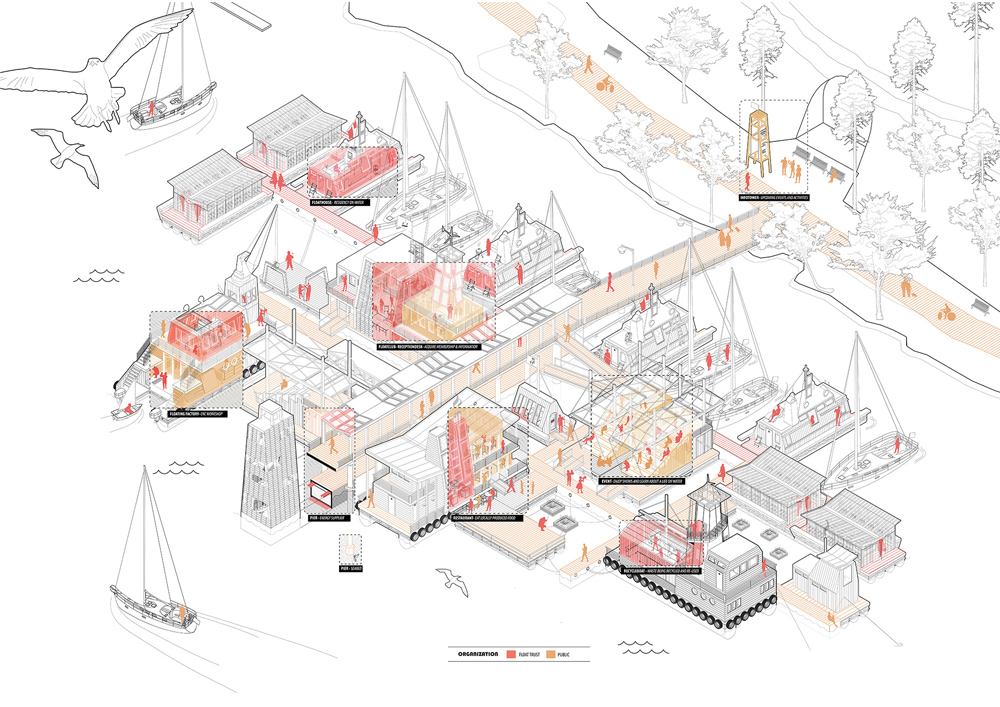
The project FloatHub demonstrates a new mobile floating society to achieve a long-term economic and residential security as a solution to Sweden's national housing crisis. As a result the mobile dwelling becomes more than a temporary solution.
Floathub aims to enable a long-term economic and residential security. This is achieved through the co-operative Float Trust where residents themselves become developers and owners through a collective action. The main idea is to maintain the flexibility of a mobile lifestyle on water through a catalogue of typologies that benefits the floating community. The Trust would then invest in different necessary infrastructures users otherwise would not be able to afford. \nThe Float Trust manages and builds the collective’s necessary typologies using CNC technology to enable a self-sufficient mobile lifestyle on water. The use of CNC technology also allows users to modify and costume future needs. Each typology generates values to the community and acts as a generator that enables affordability and possibilities, as they create a network of reliance between different FloatHubs. \nThe local implementation begins on the so-called Pirate Harbour. It is a well-known location for being a home for boaters and illegal mooring in the central of Stockholm. This makes it a strategic site to enable a new relationship between those living on land and water through a collaboration with the municipality. \nEach step of the implementation is achieved with the Floating Factory through the Float Trust. For the long-term occupancy a pier will act as the main infrastructure and energy supplier. The construction of social communal spaces is crucial as it gives a sense of belonging and community between the residents. \nThe existence of resources within the communities enables an economy where any surplus generated is recycled back. This allows long-term affordability on behalf of the mobile community. Vital activities are: production, recycling and vending. \nFrom this phase, the entire complex is a process of becoming resilient and self-sufficient. In this way, the proposal engages with the boating community, future dwellers and city, allowing a mobile lifestyle for a long-term scenario. As a result, the users demonstrate that they are in no need of municipal systems and developers as they can deal with the issues on their own.