-

1_Cover Image.jpg
-
7_Scenario 4 -Oceans Apart.jpg
-
5_Scenario 2 - Calm Waters.jpg
-
6_Scenario 3 - Stormy Waters.jpg
-
8_Scenario 5 - High Waves.jpg
-
4_Scenario 1 - Green Waves.jpg
-
2_Spatial Analysis starting with the Ria Formosa, zooming to Culatra island and lastly Farol..jpg
-
3_Time matrix to see how events correlated and shaped the area..jpg
Exploring Future Resiliency Through SSPs
Alicia Jassner. Ilha do Farol, Portugal
-
Name of work in English
Exploring Future Resiliency Through SSPs
-
Name of work in original language
Testing Future Scenarios on their Impact on Community Resilience of Barrier Islands in the Ria Formosa, Portugal
Prize year
Young Talent 2025
-
Work Location
Ilha do Farol, Portugal
-
Author/s
Alicia Jassner
-
School
School of Landscape Architecture - Norwegian University of Life Sciences.
Ås, Norway
Young Talent 2025 YT Nominees


Exploring Future Resiliency Through SSPs
Testing Future Scenarios on their Impact on Community Resilience of Barrier Islands in the Ria Formosa, Portugal
Program
Urban planning
-
Labels
Waterfront · Master plan · Public Space
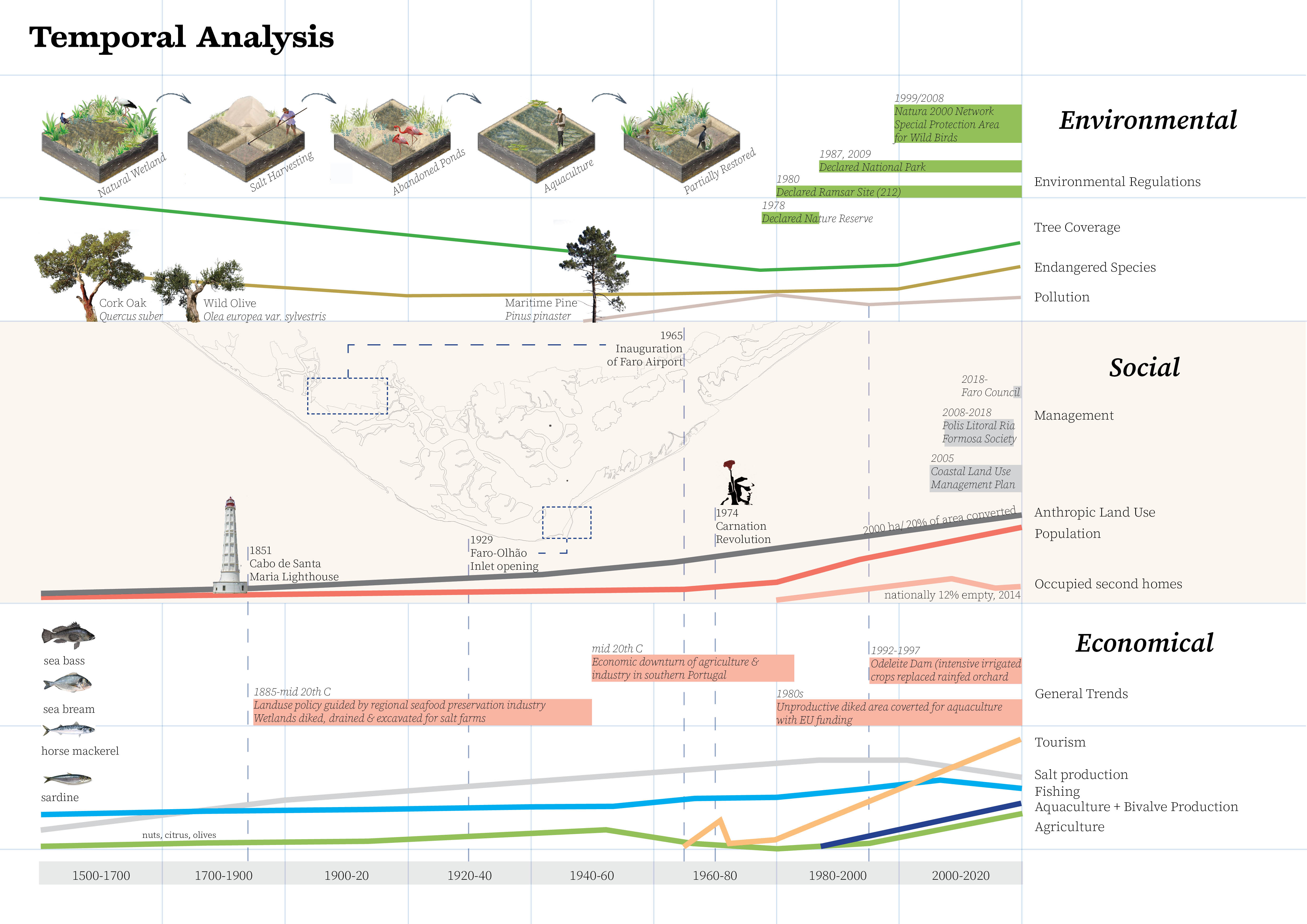
While resilience is needed everywhere, rural communities of coastal landscapes are particularly vulnerable. This project focuses on Farol, a little village sitting on a fragile sandy barrier island in southern Portugal as a case study. Experimenting how landscape architecture can be used to as a research tool to map the ecological, social and economic complexities on different scales and for communicating the future implications of ongoing trends. The built environment was used as a tangible mirror of societal changes that were investigated in five distinct scenarios.
Farol is located in a high risk area to coastal flooding and rising sea levels. The sand it is built on, is constantly shifting. The community resilience is additionally challenged by the surge in tourism, political decisions about the surrounding Ria Formosa Nature Park, it's aging infrastructure and many other socio-economic factors. The five global Shared Socioeconomic Pathways (SSPs, IPCC 2021) were translated into the local context, using historical data and personal impressions to explore these challenges. Under scenario 1 ‚Green Waves‘, it was assumed that nature would be given priority in all decision-making, alongside social equality and welfare. ‚Calm Waters‘ (2) continued the status quo and ‚Stormy Waters‘ (3) emphasised the importance of local self-reliance. In scenario 4 ‚Oceans Apart‘ the disparities in societies are amplified, whereas in ‚High Waves‘ (5) economic growth increases the standards of living for everyone, with no thought given to the surrounding ecosystems. All future narratives can be argued as realistic and all hold positive and negative implications. Through plans and sections, design responses that mitigate potential threats were explored. Rather than offering a ready-made solution, the project can be seen as an informative study that guides adaptation planning or a communication tool, that visualises opportunities for stakeholders.