-

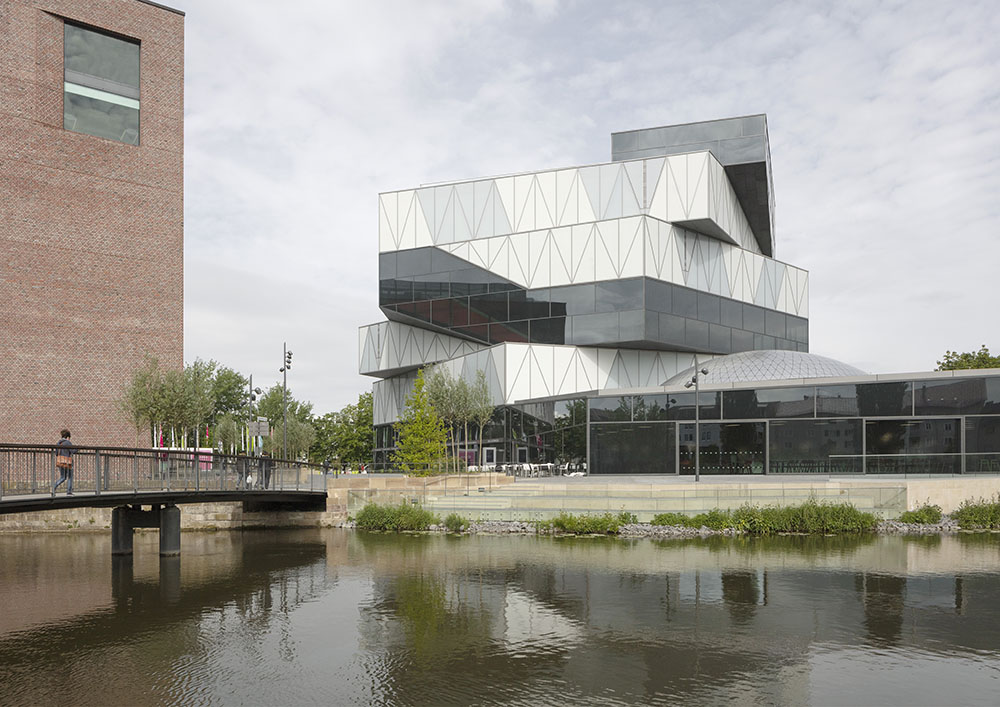
exterior view across the river Neckar with existing science centre to the left
-
evening view with illuminated helix
-
the helix offers panoramic views over the city and the surrounding landscape
-
the minimal construction offers an unobstructed view onto the surroundings
-
view into the atrium with the studios
-
site plan
-
ground floor
-
floor plan second floor
-
section aa
-
section bb
-
conceptual diagram
-
-
A2 panel
Experimenta Science Center
Sauerbruch Hutton. Heilbronn, Germany
-
Name of work in English
Experimenta Science Center
-
Name of work in original language
Experimenta Science Center
Prize year
EUmies Awards 2022
-
Work Location
Heilbronn, Germany
-
Studio
Sauerbruch Hutton
EUmies Awards 2022 Nominees


Extension of a science centre with spaces for exhibition and education, organized along a helical steel construction that makes the architecture part of the visitor's experience.
Collaborators
Construction manager: Beutelspacher Mirco (Drees & Sommer GmbH, Stuttgart), Mack Volker; Landscape architect: Hager Partner AG (Zürich/Berlin); Structural engineering: SBP Schlaich Bergermann Partner GmbH (Berlin); Building physics: Drees & Sommer Advanced Building Technologies GmbH (Stuttgart); Building technology: Drees & Sommer Advanced Building Technologies GmbH (Stuttgart); Façades: Drees & Sommer Advanced Building Technologies GmbH (Stuttgart); Environmental: Drees & Sommer Advanced Building Technologies GmbH (Stuttgart); Fire consulting: hhpberlin Ingenieure für Brandschutz GmbH (Frankfurt am Main); Others: Wenzel + Wenzel GmbH, Stuttgart (Site Supervision)
Program
Culture
-
Labels
Exhibition · Museum
Site area
10847 m²
-
Client
Schwarz Real Estate GmbH & Co. KG represented through Drees & Sommer, Stuttgart
Total gross floor
17580 m²
Completion
2019
This emblematic building stands at the centre of Heilbronn, on an island in the River Neckar. It is conceived as a helical sequence of spaces offering an experience that is finely choreographed between the interior of the building and the surrounding landscape. The new building forms an ensemble with a converted warehouse, framing a small piazza from where visitors enter the museum. Passing through the spacious foyer, they move upwards along the helix. This takes them through four levels containing themed exhibition spaces that focus on scientific and technological subjects. For young visitors there are interactive media installations, where they can apply what they have just learned to specific tasks.
The themed sections on each floor are offset in horseshoe form around the core of the building and a fullheight atrium, into which pods are inserted that contain interactive stations. Finally, the helix brings visitors out onto a landscaped roof terrace that offers a panorama of the entire Neckar Valley. Also located on the roof are an astronomical observatory and an auditorium for experimental theatre. An alternative route leads to the basement, where the 360° Science Dome cinema and spaces for temporary exhibitions are located. The Experimenta building is like a toolbox whose architecture reinforces the educational purpose of the science centre. It presents views out into the distance, while also leading the eye inwards, right down to a microscopic scale.
The extension of the Experimenta is a technical building made of steel and glass. Its reflective outer skin consists of large rectangular panes of transparent glass and triangular façade panels with opaque glass in white and light grey. Through the transparent panes, one looks in and recognises a continuous space that is diagonally connected across the floor levels. The interconnected areas form a large spiral of space: The geometry of this building is the result of the spiral movement. The visitor moves in a large steel construction and looks again and again at generous panoramas of the surrounding landscape. The construction itself is to a certain extent experimental. It consists of stacked, storey-high truss girders, from which the transparent storeys of the spiral-shaped access path are suspended on thin poles. In the core of the supporting structure hang glass cubes, which like crystalline cocoons form the protected centre of the spiral movement. Their materiality is robust and simple. Concrete, steel and glass are the predominant materials that form the framework for the views into the open air and the background for the experience of the exhibitions.