-

Adaptive housing typology
-
On-site research
-
Settlement morphology
-
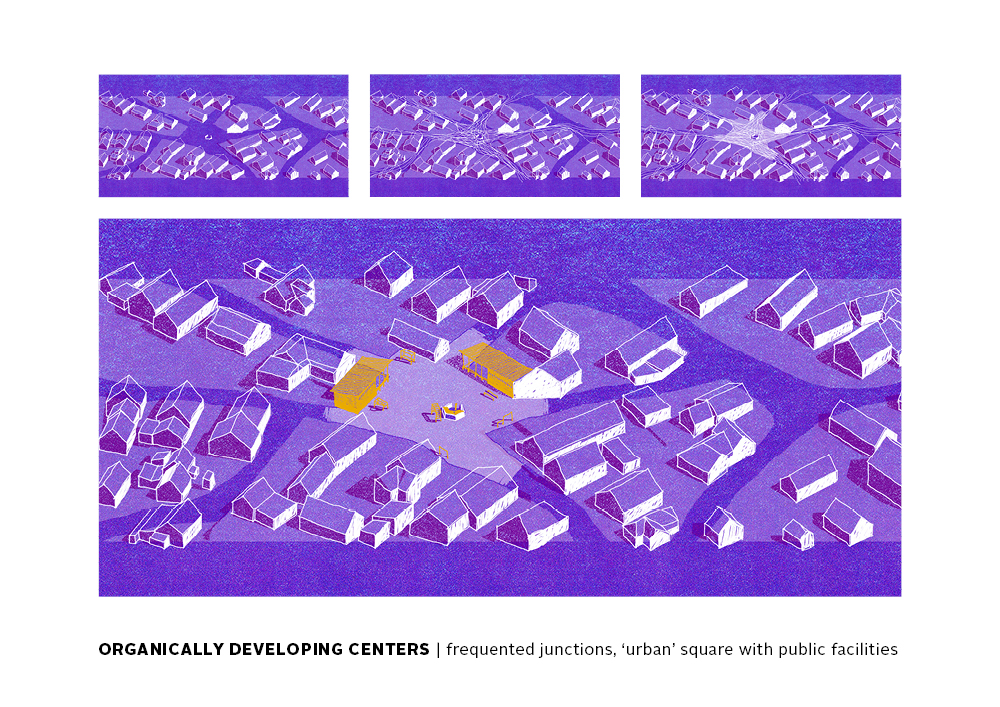
Organically developing centers
-
Community sanitation house
-
Adaptive housing typology
-
Integration
-
Entering the no-go zone
-
Entering the no-go zone
Hanna Kopacz. Sepsiszentgyörgy / Sfantu Gheorghe, Romania
-
Name of work in English
Entering the no-go zone
-
Name of work in original language
Social Housing and Settlement Upgrading in a Gypsy Community
Prize year
Young Talent 2023
-
Work Location
Sepsiszentgyörgy / Sfantu Gheorghe, Romania
-
Author/s
Hanna Kopacz
-
School
Institute of Architecture - Moholy-Nagy University of Art and Design.
Budapest, Hungary
Young Talent 2023 YT Shortlisted




Entering the no-go zone
Social Housing and Settlement Upgrading in a Gypsy Community
Program
Collective housing
-
Labels
Social
My graduation project investigates the possibilities of settlement upgrading in an informal Gypsy neighbourhood near my hometown in Romania. Based on a thorough personal research and local resources, my proposal aims to improve the present living conditions through small-scale urban interventions and an off-grid adaptable housing system.
My main objective was to improve the life conditions by offering an essential range of basic services unavailable before. I followed the development strategy of on-site upgrading, trying to preserve the identity of the settlement. My project seeks simple, practical and accessible forms of architecture, urbanism and landscape design that can contribute to improving the deficient circumstances. I looked for soft solutions that are easily adaptable by locals and feature a process-based design that builds on local values. My project proposes two interventions in different scales. Organically developing centers In case of densely populated areas, public spaces play a crucial role in the residents' life. By analysing the morphology of the settlement, I have identified six frequented junctions that are suitable for becoming small centers due to spacial attributes. In my proposal, these centers provide vital services like water supply, sanitation facilities, leisure and community activities. Each center has three components: paved square with well, community sanitation house and simple street furniture ideal for sitting, drying carpets or workout. The recovery of the once neglected spaces might inspire the residents to improve their close surroundings as well. Adaptive housing typology The main concept was to create a housing system that considers local habits. I designed a housing unit that is expandable in two directions in case of family growth, is independent from public utilities, and can be easily constructed and customized by its residents. The interior space is minimal, divided into community zone and small private zones. One third of each unit is a porch that is widely used in this climatic region. It can be a supplement for the interior space throughout the year, but means less area to heat during the cold months. Essential utilities are provided by underground rainwater collectors, solar panels, mixed-fuel stove and dry toilet. These interventions build up an organically developing system that could contribute to reach to a level where inhabitants can decide upon their own lifestyle.