-

Aerial view
-
Aerial view
-
Exterior view from the garden
-
Entrance courtyard
-
Entrance courtyard
-
Multifunctional space on the first floor
-
Site Plan
-
Ground floor plan
-
Upper floor plan
-
Section A-A
-
Section B-B
-
Detail of sliding shutters
Educational Building in the Marszewo Forest Botanical Garden
Gierbienis + Poklewski. Gdynia, Poland
-
Name of work in English
Educational Building in the Marszewo Forest Botanical Garden
-
Name of work in original language
Budynek edukacyjny w leśnym ogrodzie botanicznym Marszewo
Prize year
EUmies Awards 2026
-
Work Location
Gdynia, Poland
-
Studio
Gierbienis + Poklewski
EUmies Awards 2026 Nominees
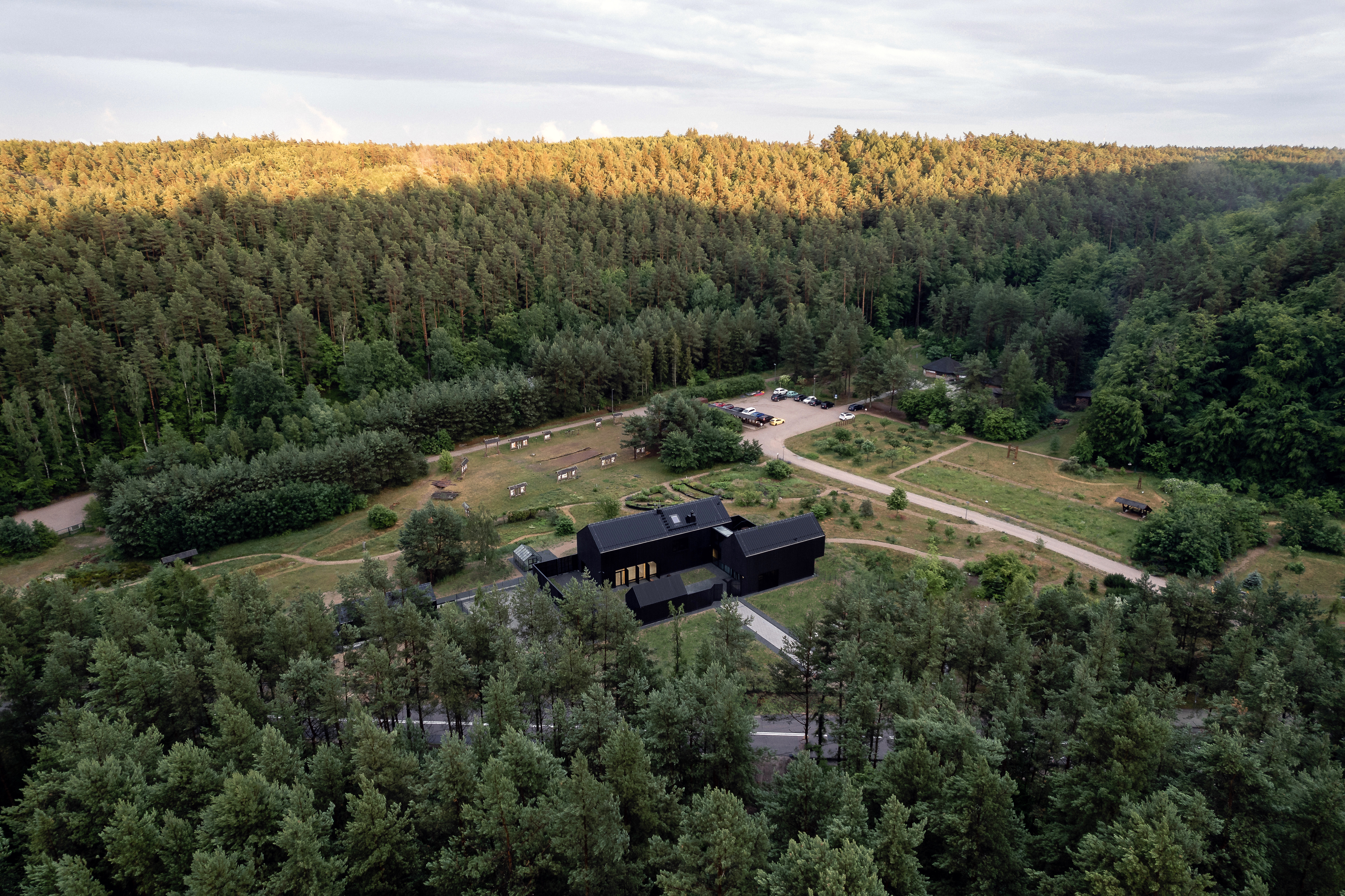


The Educational Building in the Marszewo Forest Botanical Garden creates a space of interaction between people and nature. These worlds merge and interweave, allowing for synergy and mutual exchange. As Poland’s first public CLT building, it stands as a manifesto for modern timber architecture.
Collaborators
Structure: Lech Mikuła - Mikuła Construction; Installations: Andrzej Formella - Uniprojekt; Installations: Łukasz Pilch - Pewa-Projekt s.c; Installations: Anna Pilch - Pewa-Projekt s.c; Installations: Katarzyna Pilch - Pewa-Projekt s.c; Installations: Mateusz Pilch - Pewa-Projekt s.c; Installations: Przemysław Górski - PRZEM-BUD INSTALL; Civil engineering: Jadwiga Zdroik - Neret s.c.; KLH sales representative: Krzysztof Zawartka - OMFO; Construction management: Tomasz Brzeziński - Tb.invest Construction Ltd.
Program
Education
-
Labels
Nature
Site area
5695 m²
-
Client
Skarb Państwa – Nadleśnictwo Gdańsk z siedzibą w Gdyni
Total gross floor
562 m²
Cost
2892 €/m²
The Marszewo Forest Botanical Garden is located in a forest clearing within the Tri-City Landscape Park, offering access to collections of native plant species and space for social activities. The Building extends its functionality, combining the work of foresters with educational activities. The project illustrates the process of introducing new architecture into an environmentally sensitive area, with respect for the environmental and cultural heritage of the Forest Settlement. Its primary goal is to highlight the educational and structural potential of wood in contemporary architecture.
The building was designed for the youngest visitors, who learn about the flora and fauna, and the principles of sustainable development. To avoid a large-scale structure, the complex consists of varied volumes dispersed according to function. Their forms recall the archetype of a barn, while a high wooden fence unites the composition and defines two courtyards: one serving as the garden entrance, the other with a amphitheatre as a space for meetings and workshops. Inspired by early wooden fortifications, the fence gives a sense of intimacy and security, with folding gates marking the entrances. Depending on interior use, façades feature glazed openings, often covered with shutters regulating daylight and echoing local traditions. Thus, the composition evokes a rural homestead rather than a typical public building. Rooted in the region’s wooden architecture, the project required extended procedures for finding a CLT contractor and fire certification of charred wood, delaying completion.
The building was constructed on the site of an unused masonry structure. It was It was built using CLT technology, with façades clad in larch boards charred using the Shou Sugi Ban technique, a traditional Japanese method of protecting wood from water, sunlight and insects. The project was based on the principle of minimal environmental impact: no tree felling, no sealed surfaces, and the preservation of permeable, biodiverse ground. Built primarily of wood, visible also in its interior details, furniture and finishes, the building represents an approach to sustainable architecture that is functional and free of superfluous elements. It is fully accessible to users with reduced mobility. The design draws inspiration from Polish wooden architecture in its dispersed layout, barn-like forms and use of shutters. The result is a contemporary habitat, rooted in local culture and landscape, that educates children about the forest – and about responsibility for the world in which they grow up.