-

Presentation Graphic
-
The neighborhood
-
Composition
-
Modulation
-
The way
-
Training
-
Integration
-
Blind Lanscape
-
Education Center for the Blind and the visually impaired as a social integrator to the Parque Morelos neighborhood
Brian Omar Martínez Munguía. Guadalajara, Mexico
-
Name of work in English
Education Center for the Blind and the visually impaired as a social integrator to the Parque Morelos neighborhood
-
Name of work in original language
Blind Landscape
Prize year
Young Talent 2020
-
Work Location
Guadalajara, Mexico
-
Author/s
Brian Omar Martínez Munguía
-
School
University Center for the Arts, Architecture and Design - University of Guadalajara.
Guadalajara, Mexico
Young Talent 2020 YT Open Nominees


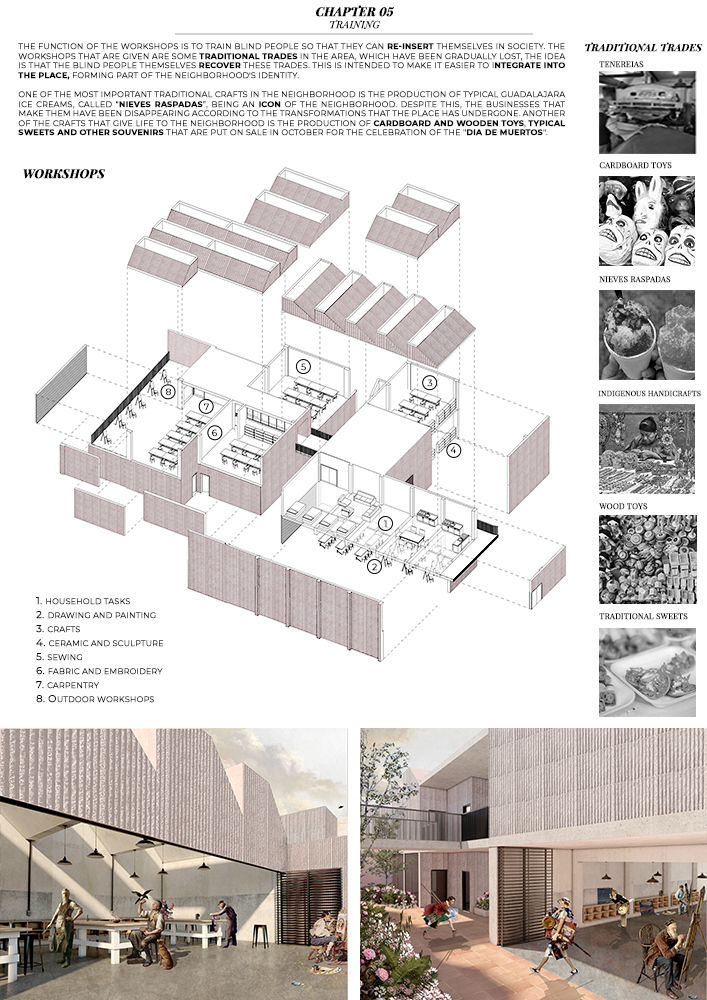


Education Center for the Blind and the visually impaired as a social integrator to the Parque Morelos neighborhood
Blind Landscape
Program
Social welfare
-
Labels
Community
The “blind landscape” is an educational center for the blind and visually impaired, whose objective is to rescue a residual urban space, located in a traditional neighborhood of Guadalajara, Mexico. The project aims to integrate blind people into society through context, improving their quality of life and strengthening the identities of the site.
The project has the premise of integrating blind people into society through context, it is here that the proposal to link the project to one of the most traditional neighborhoods of Guadalajara, Mexico is born. Currently, the Morelos neighborhood is undergoing a process of gentrification as a result of failed processes of redensification, resulting in urban voids caused by the eviction of families and the demolition of their homes. It has gone from being a traditional neighborhood to a place invaded by prostitution and vandalism. The center for the blind appears as a way to counteract this process, given the uprooting of the inhabitants of the area, on the other hand, the constant desire of blind people to participate in society appears. The main objectives of the project are to educate and train blind people so that they can integrate into their environment working as catalysts for the area, hoping to improve their quality of life and that of the inhabitants of the neighborhood. The building works as a response to the conditions of the context, beyond its natural environment, the exterior remains inside and this has its impact on the exterior, materializing within the project in the form of spaces, and that its activities include The inhabitants of the neighborhood, being this a social act that generates exchange, discussions and relationships, through the meeting between antagonistic sectors, it is that it seeks to reinforce social development, sensitively to the culture and history of the place, strengthening the identity and the social cohesion. This is achieved through a building in which classrooms, workshops, laboratories and general learning spaces are housed. These spaces are articulated through the senses, guiding blind people through different sensory experiences, taking refuge in their memory and allowing them to identify the different sensations and perceptions that are encountered along the way, creating a narrative of the senses and shaping an architecture of experiences. In the end the architecture becomes the main classroom.