-

Front Facade
-
Living Room
-
Living Room
-
Living Room
-
Living Room
-
Living Room
-
Situation Plan
-
Masterplan
-
Axonometry
-
Plan 0.00
-
Plan 3.40
-
Sketch
Detached House in Tskneti
Wunderwerk. Tskneti, Georgia
-
Name of work in English
Detached House in Tskneti
-
Name of work in original language
კერძო სახლი წყნეთში
Prize year
EUmies Awards 2026
-
Work Location
Tskneti, Georgia
-
Studio
Wunderwerk
EUmies Awards 2026 Nominees
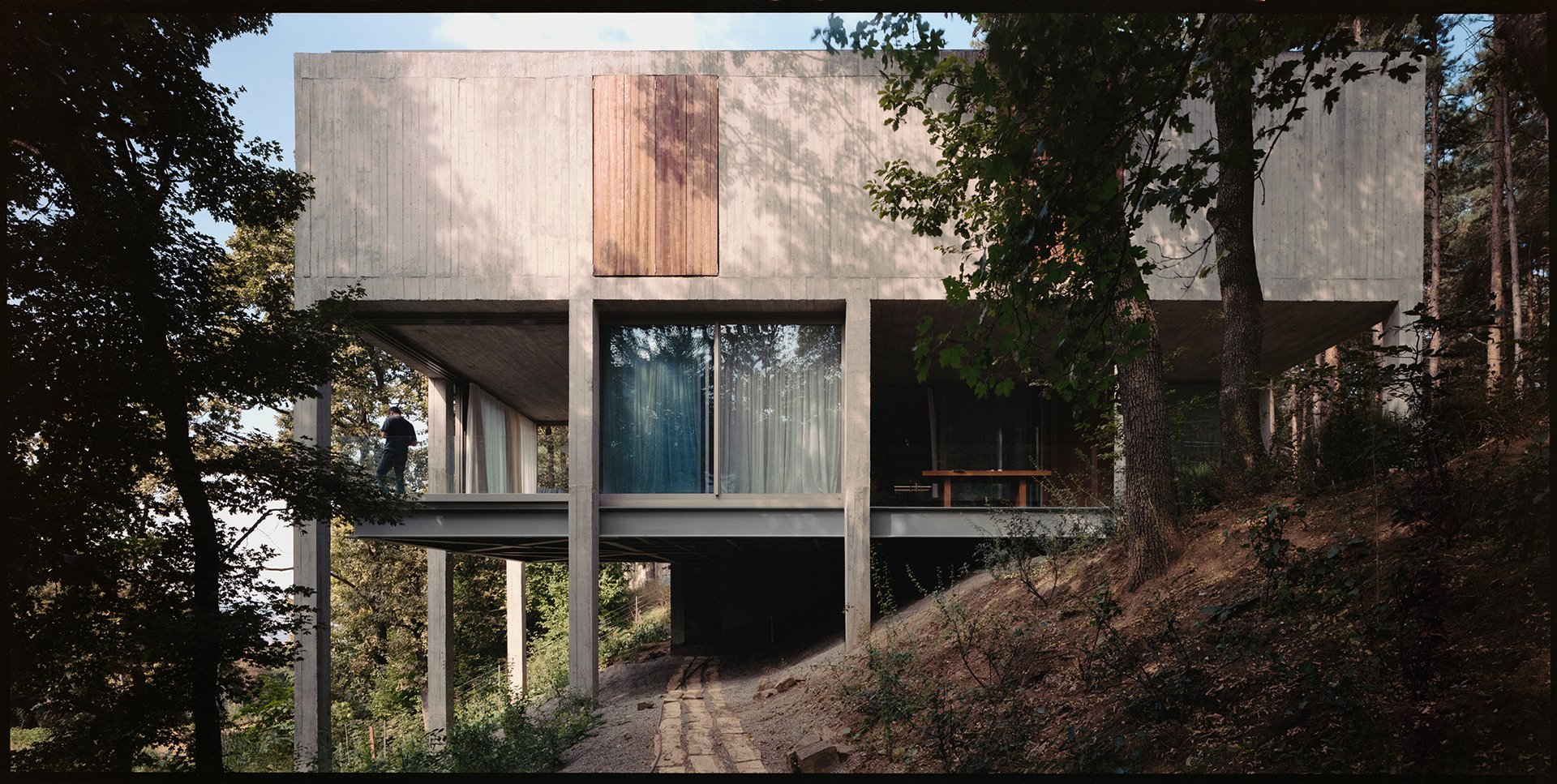


A light, elevated house in Tskneti redefines living without walls. Positioned on a steep forested slope, it hovers above the ground on concrete columns, merging architecture and landscape as a response to the post-Soviet culture of enclosure.
Collaborators
Structure: David Kevanishvili - Q Engineering; Engineering: Malkhaz Kurtanidze - Casa Calda
Program
Single house
-
Labels
Isolated · Holiday
Site area
800 m²
-
Client
Giorgi Darchiashvili / Anna Chanturia
Total gross floor
300 m²
Cost
600 €/m²
Located in the southeastern part of Tskneti, on the wooded slopes above Tbilisi, the project stands where dense development dissolves into a recreational forest zone. The house floats on slender concrete columns above the terrain, opening fully toward the surrounding oaks and pines. Its program combines open-plan living spaces with intimate upper rooms, designed to reconnect domestic life with nature through openness, modest materiality, and minimal contact with the ground.
The project emerged from the question of how to inhabit a steep, “non-buildable” site without disturbing its natural structure. Tskneti, once an open resort landscape, has gradually become defined by fences and isolation—a legacy of Soviet and post-Soviet spatial enclosure. The house responds by proposing minimal contact architecture: a light, raised volume that touches the ground only at points. Its hovering structure reinterprets the wall—not as a boundary but as a mediator between intimacy and exposure. The design restores the openness that characterized Tskneti’s earlier settlement patterns, replacing separation with coexistence. The landscape strategy by Ruderal Studio extends the forest into the site, dissolving the line between cultivated and natural terrain.
The main volume is a monolithic concrete body resting on tall structural columns anchored into rock. Beneath it, a light steel frame defines the ground floor platform, suspended in shadow to emphasize the floating mass. The rough timber formwork leaves its imprint on the concrete, visually merging with folding wooden shutters that age and grey over time, forming a continuous texture. The interior follows the same principle: exposed concrete, timber panels, and full glazing blur interior–exterior limits. The structure minimizes excavation and site impact, promoting passive ventilation through cross-orientation. Durable, low-maintenance materials ensure longevity and reduced cost, creating an architecture that respects both landscape and economy.