-

inside the prayer room
-
introduction to the area and the concept
-
diagrams of the concept and axonometric of the proposal
-
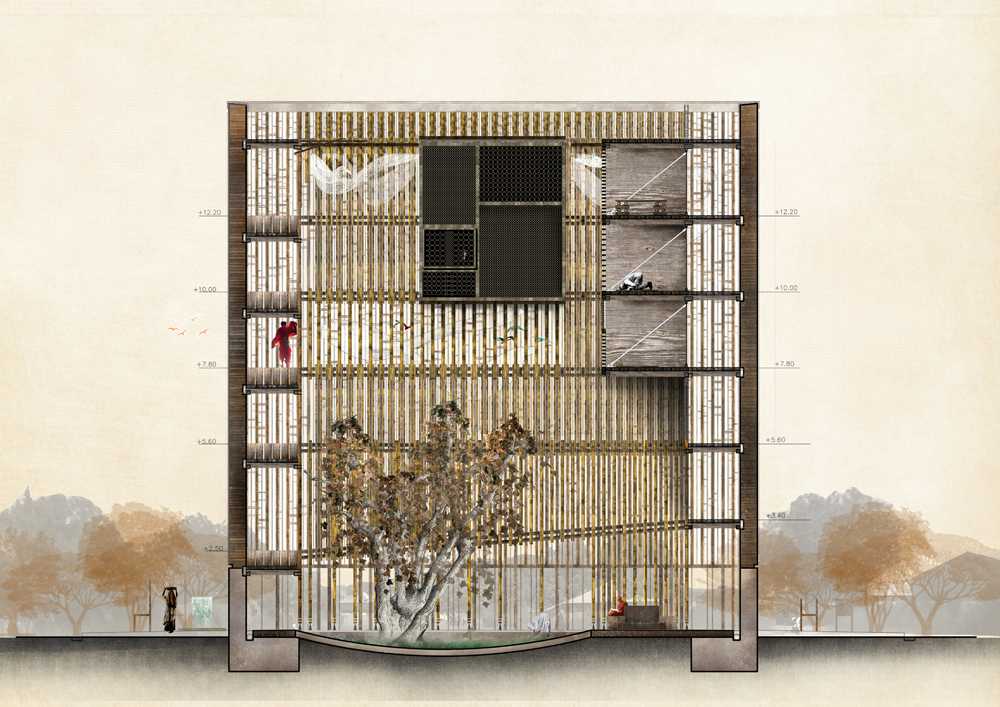
section looking at the main entrance
-
the two prayer structures with their functions
-
south-west facade
-
section and interior facade of one of two prayer spaces
-
vertical panel
-
Designing the absence
Virginia Lazarou. Tanaf, Senegal
-
Name of work in English
Designing the absence
-
Name of work in original language
A worship place in Tanaf
Prize year
Young Talent 2020
-
Work Location
Tanaf, Senegal
-
Author/s
Virginia Lazarou
-
School
School of Architecture, Faculty of Engineering - Aristotle University of Thessaloniki.
Thessaloniki, Greece
Young Talent 2020 YT Nominees




Designing the absence
A worship place in Tanaf
Program
Religion
-
Labels
Religious Centre · Chapel
The project aims to host three different religions into one building, letting people make their own choices and be free of judgement. The design was inspired by the area, the context, the climate, and the history of Senegal, along with the three religions: Christian, Muslim and Animist.
Two cylindrical huts triggered the interest of how the huts in Senegal were organized. The research resulted in the concept of the filter as a main design element for the new building. Specifically, this was materialized as a bamboo structure on the interior of the building, incorporated in the main facades. The introversion of the area, with the structures being mostly surrounded by fences, led to a more private feeling for the design of the new building. Furthermore, since the proposal aims to find a common area for three different religions, the prayer was taken into consideration. It was specifically put as a program into two suspended, box – like structures. They host different utilities, such as educational purposes, prayer and confession rooms. Specific elements of the building were designed in reference to the specific religions: The ramp comes from the ritualistic element of the Christian religion, in a Christian temple one enters from the west to the altar in the east. This time, though, the ramp leads to a balcony on top of the building, where people can view the surroundings. The entrance was important in both Christian and Muslim religions. It was designed as an open wooden structure to infiltrate the light and provide a certain atmosphere to the interior of the building. The interior boundary, created by bamboo sticks with different diameters create specific points of view on the interior. There worshippers have the chance to either view what is happening in the interior and common worship space, by the more open standing points. The main worship space was designed as a public square, to invite everyone to worship together in just one space. It also takes into account the climate and the heavy rainfall that lasts approximately half the year. The roof structure continues from the interior filter of bamboo. It is mainly open, carrying some light curtains suspended from it. This building was designed as an open one, where all people are equally invited to worship their own beliefs. Its character is where the title came from: a mostly vacant space, designed for the concept of the divine.