-

FOR A SIGHT REVERSAL ON THE TERRITORIAL ISSUE
-
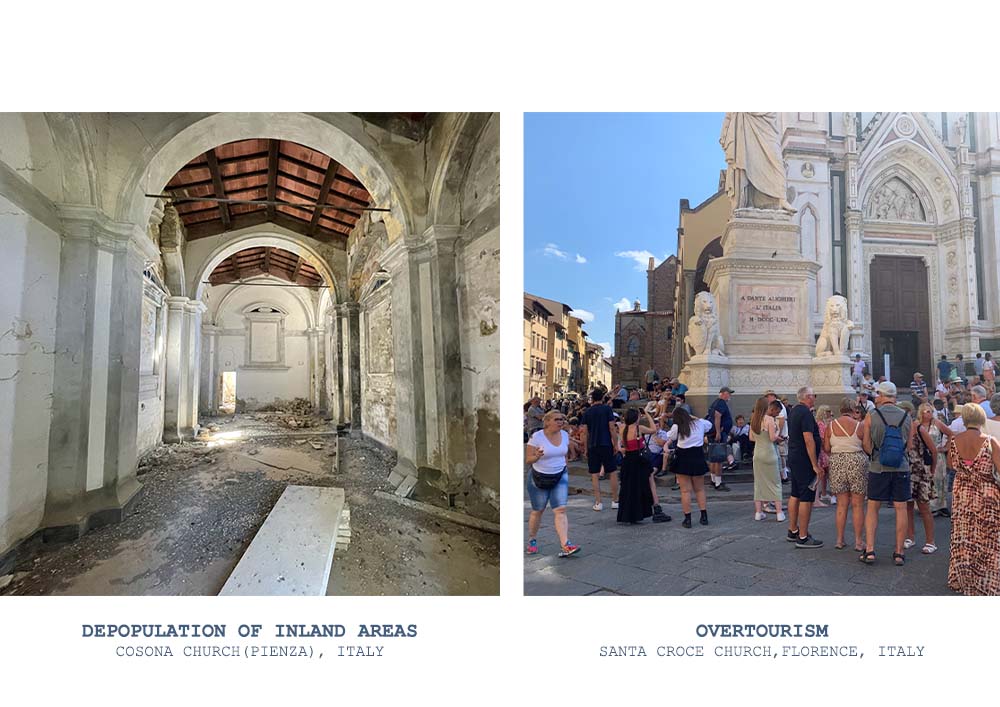
DEPOPULATION OF INLAND AREAS AND OVERTOURISM
-
SEASONALITY IN PIENZA
-
NEW TERRITORIAL STRATEGY
-
PIENZA AND ITS VALLEY
-
A SYNERGIC STRATEGY FOR PIENZA'S CITY CENTRE
-
PIENZA'S NEW CIVIC CENTRE
-
DEPOPULATION AND OVERTOURISM IN ITALIAN INLAND AREAS: PIENZA AS STUDY CASE AND THE PROJECT OF PIENZA'S NEW CIVIC CENTRE
-
Depopulation and overtourism in italian Inland Areas
Lorenzo Conoscenti. Pienza, Italy
-
Name of work in English
Depopulation and overtourism in italian Inland Areas
-
Name of work in original language
Pienza as study case and the project of Pienza's new civic centre
Prize year
Young Talent 2023
-
Work Location
Pienza, Italy
-
Author/s
Lorenzo Conoscenti
-
School
School of Architecture - University of Florence.
Firenze, Italy
Young Talent 2023 YT Nominees



Depopulation and overtourism in italian Inland Areas
Pienza as study case and the project of Pienza's new civic centre
Program
Culture
-
Labels
Culture Centre · Congress Centre
The project faces depopulation and overtourism of italian Inland Areas, by using a representative study case, which is the ideal city of Pienza, chosen for being itself idea of city come stone and paradigmatic by its foundative nature. Due to its recent history, Pienza resumes both, inland areas and tourist cities, aspiring to become an exportable model.
The proposal about Pienza takes up the challenge of the territorial issue, in the aim to address socioeconomical phenomenons of our time by using architectural tools and spatial design, in the awareness that complex problems requires complex responses and interdisciplinary skills. That why this work has been developed beside a parallel statistical graduation survey from the University of Siena. The attempt was to use the provided data as a base for historical study, spatial representation of the phenomenons and in the end a new architectural project. After a spot about italian current territorial and touristic framework, the study focuses on the representative study case of Pienza, in analogy to the two manifestos Se Venezia muore (Settis,2014) and Civita (Attili,2020): Pienza resumes both the depopulation trends that come from overtourism gentrification, as Venice do, and from inland inaccessibility, as Civita di Bagnoregio does. The historical, statistical and spatial studies about Pienza, its historical centre and its surrounding territory, lead to a project through the scales: from the territorial one to the technological detail, passing by a strategy for Pienza’s valley, Val d’Orcia, and by urban and architectural scales. All of them share the same strategy, which is tourism spillover and a new infrastructural accessibility based on tourism as economical sustainability source to gain inland areas re-use and synergy between residents and tourists. The ultimate end point of the proposal is the new civic centre, a levitant dynamic shaped massive brick gabled roof building, collocated in a previous urbanised lot with a baricentric position and next to the main tourists’ landing site. Here, resident’s facilities such as underground car park, library, coworking, municipal offices and public square, are held together with a tourist office, in order to mix tourists and residents and in the attempt to serve hit-and-run tourists a new knowledge tool to appreciate a slower visit: the splayed oculus plays with the postmodern idea of tourist marker and aims for recognizability by visitors.