-

Wall made of local limestone "Pouropetra"
-
Exterior view
-
Interior courtyard
-
Collection and processing of reclaimed local stone
-
Courtyard with palm tree
-
Atriums cut through the concrete slab
-
South-East Elevation
-
Exploded axo diagram
-
South-West Elevation
-
Section
-
Ground Floor Plan
DBH - Courtyard House
constantinos petrakos architects. Nicosia, Cyprus
-
Name of work in English
DBH - Courtyard House
-
Name of work in original language
DHB_Κατοικία με αυλή
Prize year
EUmies Awards 2026
-
Work Location
Nicosia, Cyprus
-
Studio
constantinos petrakos architects
EUmies Awards 2026 Nominees


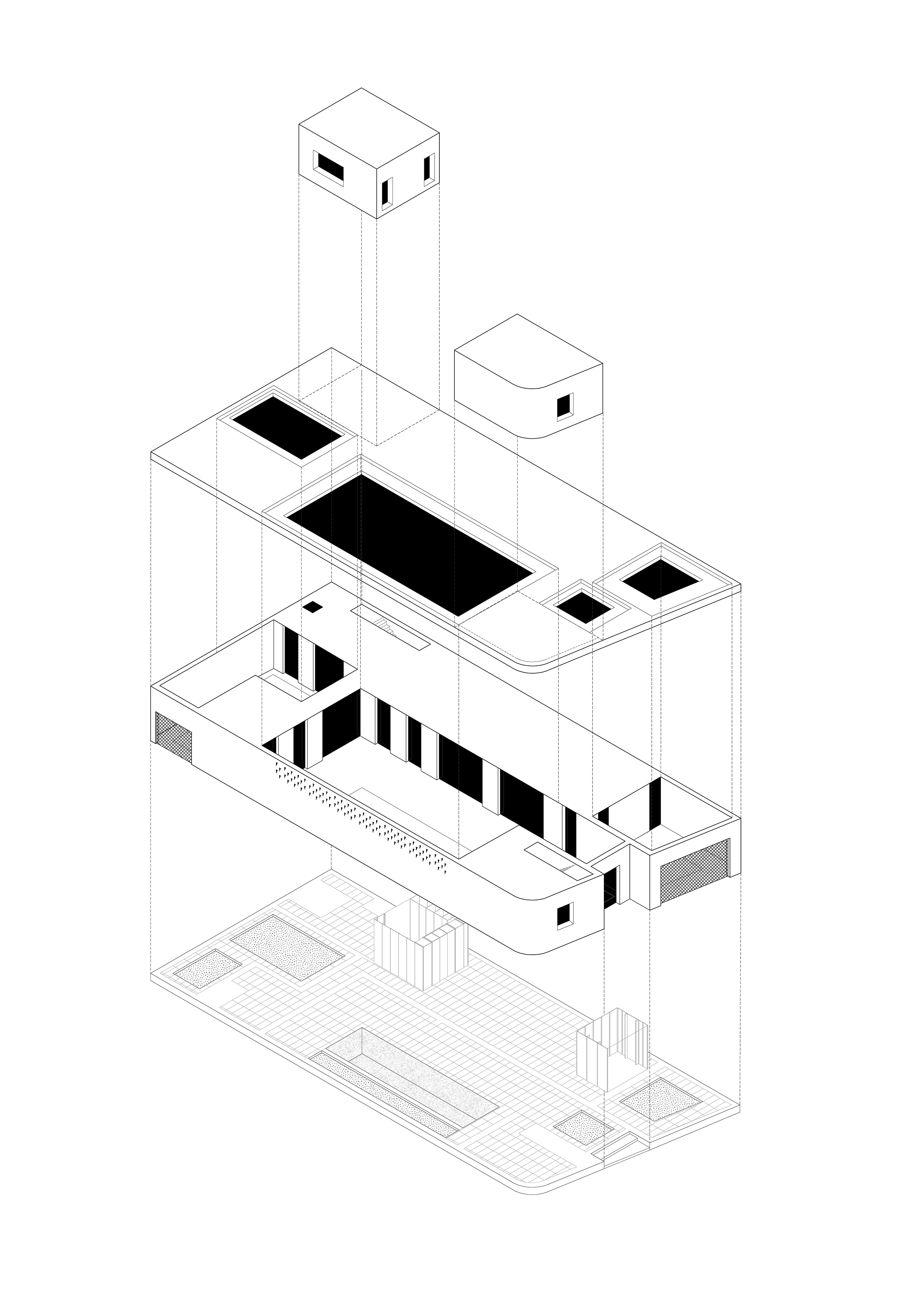


The Courtyard House is situated in the historical centre of Old Strovolos, Nicosia, within a dense urban fabric of walled plots and narrow streets that retain the character of the former village. The project reinterprets the typology of the Cypriot courtyard house as an open field of continuous inhabitation, dissolving the conventional boundary between interior and exterior space.
Organised around a series of enclosed courtyards and loggias, the dwelling is structured as a gradient of privacy. Programmatic functions are distributed both vertically and horizontally, according to their degree of seclusion and frequency of use. The courtyards act as climatic and spatial regulators, ensuring daylight, cross-ventilation, and microclimatic stability throughout the year, while fostering a sense of calm continuity between indoor and outdoor atmospheres.
The outer shell, clad in reclaimed local limestone (pouropetra), establishes a tactile continuity with the surrounding historic context. Above this stone base, two white cubic volumes accommodate the private quarters, introducing contrast and geometric precision.
Through the synthesis of typological memory, material reuse, and passive environmental performance, the Courtyard House proposes a contemporary interpretation of Mediterranean domesticity. It demonstrates how the logic of traditional Cypriot architecture—its inward orientation, its climate responsiveness, and its material honesty—can be re-articulated within a modern architectural language rooted in restraint and continuity.
Collaborators
Collaborator (office): Adamantia Soulioti - constantinos petrakos architects; Collaborator (office): Athina Xenouli - constantinos petrakos architects; Collaborator (office): Evangelia Stamatiou - constantinos petrakos architects; Collaborator (office): Vasileios Antonopoulos - constantinos petrakos architects; Collaborator (office): Savvas Kakalis - constantinos petrakos architects; Landscape: Michalis Pirokkas
Program
Single house
-
Labels
Family
Site area
460 m²
-
Client
Dimitrios Doukas
Total gross floor
270 m²
The Courtyard House lies in the historical centre of Old Strovolos, Nicosia—an urban tissue of narrow streets, walled plots, and stone façades that retain the scale of the former village. Within this compact environment, the project reinterprets the Cypriot courtyard typology as a continuous domestic field defined by proportion and light. The dwelling accommodates a family residence organised around a sequence of patios and loggias that regulate climate and structure everyday use. Communal areas—living, dining, and kitchen—are placed around the principal courtyard, while bedrooms and service rooms occupy the upper and rear zones, forming a clear hierarchy of privacy. Each courtyard introduces air and daylight, establishing environmental order through geometry rather than technology. Materially, the house belongs to its setting. The street façade is clad in reclaimed local limestone (pouropetra), recovered from dismantled structures within the neighbourhood. Above this base, two white cubic volumes contain the private rooms, forming a deliberate contrast between the textured stone and the smooth plaster. A reinforced-concrete structure supports the composition, its fair-faced slabs integrating services within their depth. Recessed aluminium frames maintain visual continuity between inside and courtyard. Through this synthesis of typology, material, and structure, the house establishes a precise model of Mediterranean dwelling—compact, introverted, and climatically responsive.
In the dense historic core of Old Strovolos, the site demanded privacy and daylight within minimal boundaries. The project’s defining decision was to occupy the full buildable area, transforming constraint into spatial strategy. By internalising air, light, and sky, the house becomes a self-contained micro-environment that mediates between density and openness. The plan develops as a sequence of voids and solids: enclosed courtyards and loggias organise circulation, ventilation, and social interaction. This internalised order redirects the dwelling’s orientation from the street to the interior, replacing façade display with spatial depth. The courtyards operate as environmental regulators, ensuring shade, cross-ventilation, and thermal stability throughout the year. The stone boundary wall towards the street restores the typology of continuous built edges that characterises Old Strovolos, preserving urban continuity while protecting the domestic world within. Behind this enclosure, spaces unfold according to degrees of collective and private use, their proportions calibrated by the movement of light. Locally reclaimed limestone was chosen for its structural mass, climatic performance, and contextual continuity; the concrete frame provides flexibility and permanence. The resulting architecture is compact yet porous, grounded in the material intelligence of the Mediterranean city.
The construction articulates the project’s conceptual precision through measured tectonics. A reinforced-concrete frame defines the load-bearing system, allowing open spans and continuity between interior and courtyard. The fair-faced slabs remain exposed, with electrical, mechanical, and lighting networks integrated within their depth. The timber formwork was designed so that the imprint of the boards remains visible, producing a consistent grain across the ceiling surface. At street level, the envelope is built from reclaimed local limestone—the traditional pouropetra—salvaged from nearby demolitions. Each block was cleaned, cut, and reassembled by local masons using lime-based mortar, preserving its natural tone and irregular texture. This process ensured material continuity, cost efficiency, and reduced environmental impact. The continuous flooring, executed in limestone from Limassol, extends seamlessly between interior and exterior. Joints were precisely aligned to read as controlled lines within a single ground plane. Fully recessed aluminium profiles eliminate visible frames, maintaining the integrity of openings and reinforcing the clarity of the structural order. Environmental performance is inherent to the construction: the mass of the stone provides thermal inertia; courtyards and loggias regulate temperature and shade. All materials are locally sourced and require minimal maintenance. Over time, the natural weathering of stone and concrete will consolidate the building’s integration within its urban context, affirming permanence through constructional logic.