-

Downstream position of the bridge
-
Areal view of the viaduct and footbridge
-
View beneath the arch of the viaduct
-
Incorporated viewpoints to the city centre framed by the arches of the railway viaduct
-
Waving geometry of the plan forming balconies above the Tarn - details of the lighting
-
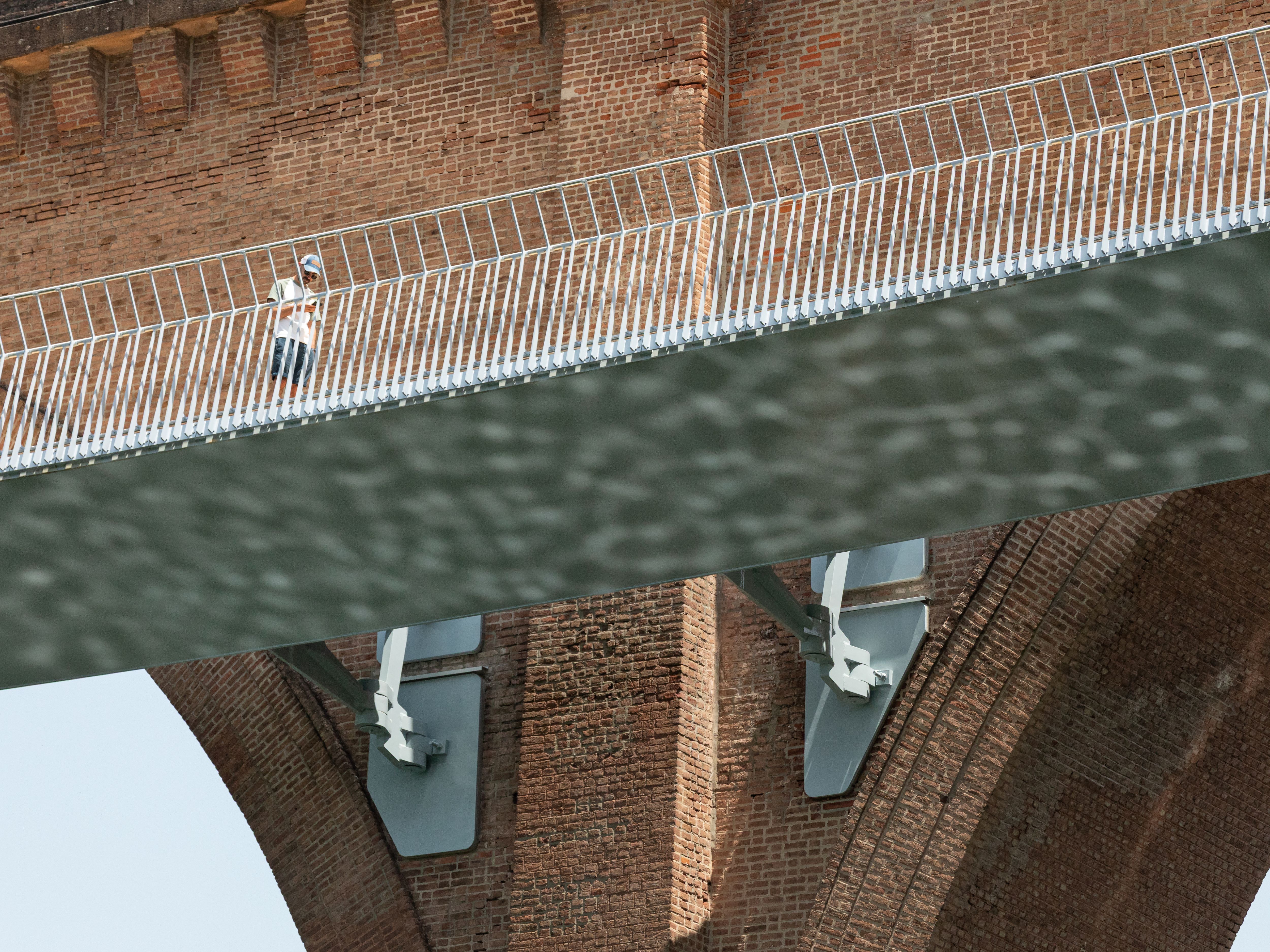
Views of the double-hinged connection
-
Vue en plan
-
Coupe B-B en travée
-
Elevation avale
-
Coupe transversale
Cycling and pedestrian bridge Albi
Ney & Partners, Urban Design: MS-A. Albi, France
-
Name of work in English
Cycling and pedestrian bridge Albi
-
Name of work in original language
Passerelle d'Albi
Prize year
EUmies Awards 2026
-
Work Location
Albi, France
-
Studio
Ney & Partners, Urban Design: MS-A
EUmies Awards 2026 Nominees
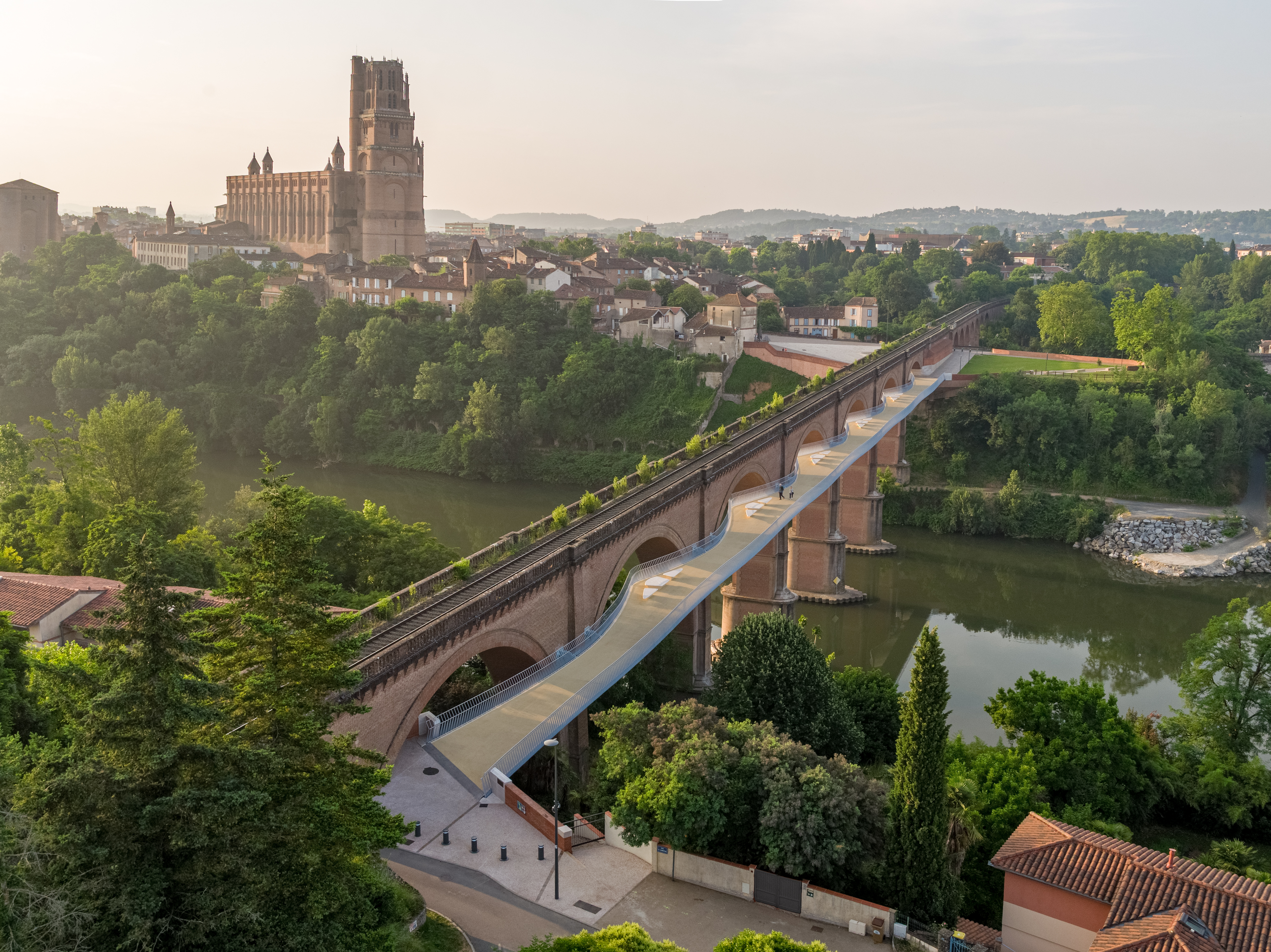




To improve the soft mobilities, the city of Albi desired a new footbridge cantilevered from an existing railway viaduct. Together with MS-A (urban design), Ney and Partners won the design competition. The footbridge subtly interacts with the viaduct while give new insights on the UNESCO city centre.
Collaborators
Collaborator (office): Matthieu Mallié - Ney & Partners; Collaborator (office): Benoît Mallet - Ney & Partners
Program
Mixed use - Infrastructure & Urban
-
Labels
Bridge · Public Space
Site area
1000 m²
-
Client
Communauté d'agglomération de l'Albigeois
Total gross floor
1000 m²
Cost
7000 €/m²
The new lightweight steel footbridge subtly interacts with its supporting structure, a 19th century railway viaduct fully made of baked masonry. The lightness and materiality of the new footbridge answer to the compactness and uniformity of the existing brick viaduct. Together, they form a new architectural composition. It is not only a new link for soft mobility within the Albi urban area, but also a genuine place to stay. The bridge features five viewpoints equipped with generous benches, inviting people passing by to admire the landscape of the Tarn Valley and the UNESCO-listed city centre.
The main challenge was the location of the new footbridge: upstream or downstream of the existing railway viaduct ? Upstream seemed the natural entry point from the city centre, yet it posed three problems: 1/ Cavalry square, cut from the city centre by the 19th-c. viaduct, would remain a left-over space; 2/ A contemporary structure would visually clash with Albi’s natural and heritage landscape; 3/ The narrow space on the left bank offered poor visibility and unsafe conditions for cyclists. The decision was therefore made to position the bridge downstream; extending the public space beneath the first arch of the viaduct to ensure a direct link from the city centre. This design strategy also healed the “urban wound” caused by the 19th c. railway viaduct. Beyond solving a mobility problem, the footbridge is designed as a “place to stay”. Its deck widens beneath each arch of the viaduct, creating framed viewpoints to the Tarn valley and the UNESCO-listed historic centre of Albi.
Structurally, the footbridge is a continuous beam with seven spans. However, to minimize internal forces in the new structure and preserve the order of the masonry piers of the viaduct, a double support was introduced on each of the six piers. This reduces the main span of the bridge from 29 m to 24.5 m. For obvious reasons of weight, structural performance and construction methodology, the bridge is entirely made of painted steel. To prevent unwanted corrosion, the bridge is to be repainted every 25 years. Being cantilevered from the railway viaduct, the cross-section is a closed box girder, providing sufficient torsional resistance and stiffness. The fixed point is centrally located, on pier P3, to minimize thermal expansion at both supports. The other cantilevered supports allow longitudinal movement while transmitting vertical reactions and torsional moments. They are thus double-hinged, both on the bridge side and on the viaduct side.