-

frontal view from across the canal - stratas and patina
-
the project in dialog with its industrial context
-
layered view towards the entrance hall - rawness, reflections and transparency
-
a fragment of daily life seen from one of the central bridges
-
panoramic promenade - the visitor in the city
-
site plan
-
ground floor plan
-
typical plan from level +2 to +4
-
transversal section
-
longitudinal section
-
before and after: lightweight reactivation of a formerly suffocated site
-
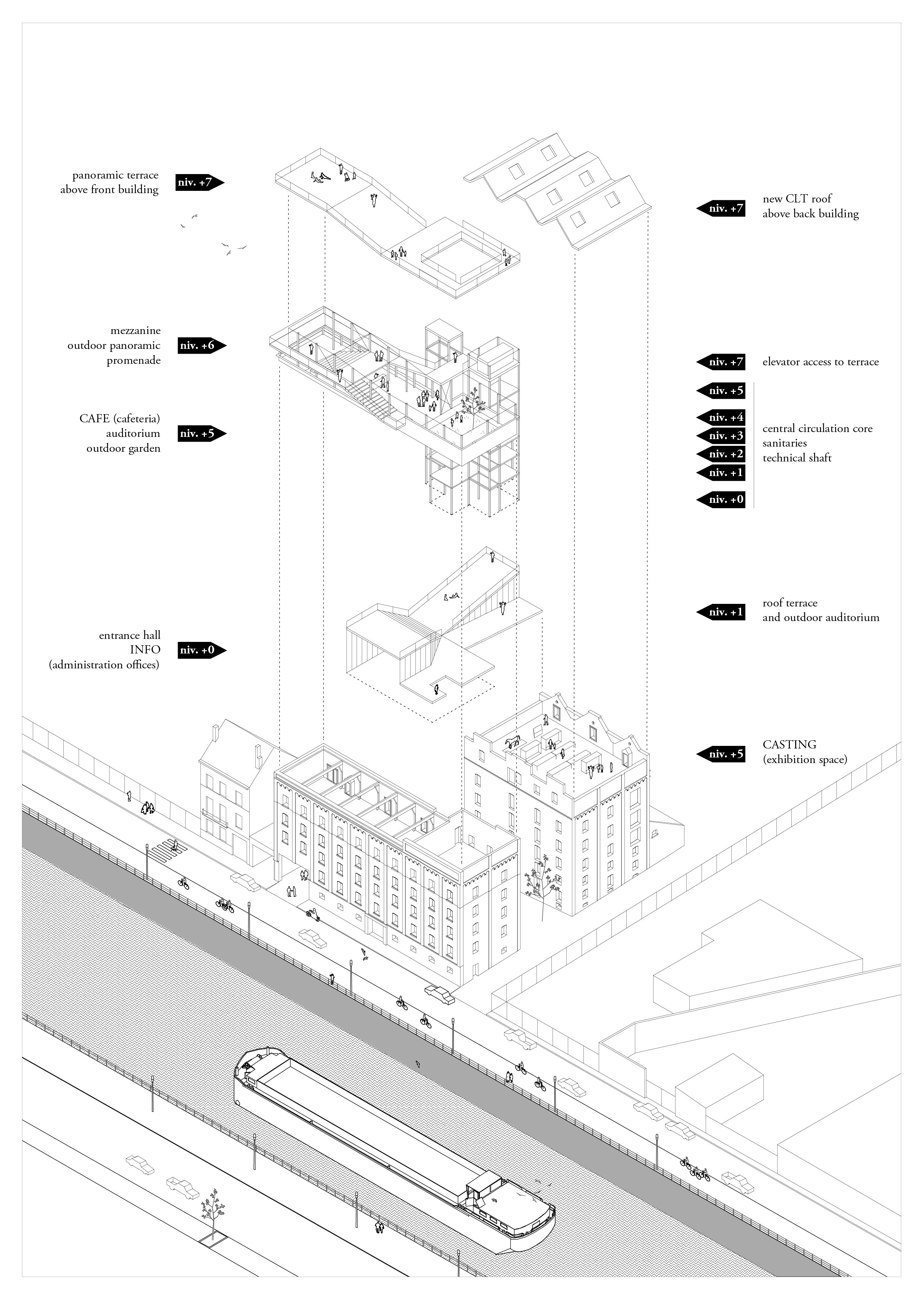
exploded isometry
-
Modularity and flexibility: layout potential for new inner lightweight partitions and technical installations in relation to the existing structural grid and windows.
-
-
BE04-BOGDAN&VANBROECK-A2sheet
-
Name of work in English
COOP
-
Name of work in original language
COOP
Prize year
EUmies Awards 2019
-
Work Location
Brussels, Belgium
-
Studio
BOGDAN & VAN BROECK
EUmies Awards 2019 Nominees



Reconversion of an old mill into an interpretation centre and an incubator for small and medium enterprises.
Collaborators
Structural engineering: NEY & Partners; Engineering: CES (Technical Engineering); Others: Hendrik Vanmolkot (Cultural Expert); Design: Håkan Harrysson – Svensk Idé (Scenography)
Program
Mixed use - Cultural & Social
-
Labels
Compact · Children & Youth · Culture Centre · Exhibition · Heritage
Site area
1507 m²
-
Client
Anderlecht Moulart
Total gross floor
5099 m²
Completion
2018
Cost
1182 €/m²
The program for the conversion of an old mill along the canal in Anderlecht combines a centre for Small and Medium Enterprises and an “interpretation centre”. An innovative restoration approach has been used as a form of ecological recycling and cultural sustainability for the re-valuation of the industrial heritage.
– The elements of the program are not considered as fixed “spaces” or “buildings”, but rather as evolving “projects” in constant interaction with each other. – Time (and therefore change) rather than space is taken as the main context of architecture. Flexibility and permanent adjustability therefore become key qualities. – The project interacts on both local and supralocal levels and presents a low threshold towards the neighbourhood and the city. The two existing listed buildings are stripped and used as large flexible containers. In between these two – within a “light architecture” shell – all the ancillary functions are inserted: stairs, elevators, techniques, service space, etc. On the ground floor, the open plan reception and administration spaces link the project to the neighbourhood. A panoramic roofscape including a restaurant, a roof garden and terraces, functions as a lighthouse along the canal and a landmark that links the site with the city.
Old and new industrial constructions enter into dialogue: The existing brick, concrete, and plaster bare traces of the building's rich history, while the new volumes combine a transparent skin with lightweight steel skeletons and composite steel-concrete floorplates. Rawness and robustness, complemented with the warmth and lightness of wooden and polycarbonate inner partitions, create a low-maintenance, non-intimidating environment that lets itself acquire patina and be appropriated by its users. The sustainability of the project lies in first line in its program: together, the incubator and interpretation centre work as social, cultural and economical catalysts in the neighbourhood. Beyond the new energy-efficient technical installations, envelope elements, or rainwater recuperation, the act of transforming an existing structure into a flexible and adaptable place to work, discover and exchange, constitutes the biggest ecological gesture of the project.