-

EUmies posters.jpg
-
EUmies posters2.jpg
-
EUmies posters3.jpg
-
EUmies posters4.jpg
-
EUmies posters5.jpg
-
EUmies posters6.jpg
-
EUmies posters7.jpg
-
yt25_ce_panel_template.jpg
Connecting Architecture: Revitalization of Odesa’s Cruise Port
Anna Khomchenkova. Odesa, Ukraine
-
Name of work in English
Connecting Architecture: Revitalization of Odesa’s Cruise Port
-
Name of work in original language
Revitalizing Odesa’s maritime identity
Prize year
Young Talent 2025
-
Work Location
Odesa, Ukraine
-
Author/s
Anna Khomchenkova
-
School
Faculty of Architecture - Vilnius Gediminas Technical University.
Vilnius, Lithuania
Young Talent 2025 YT Nominees


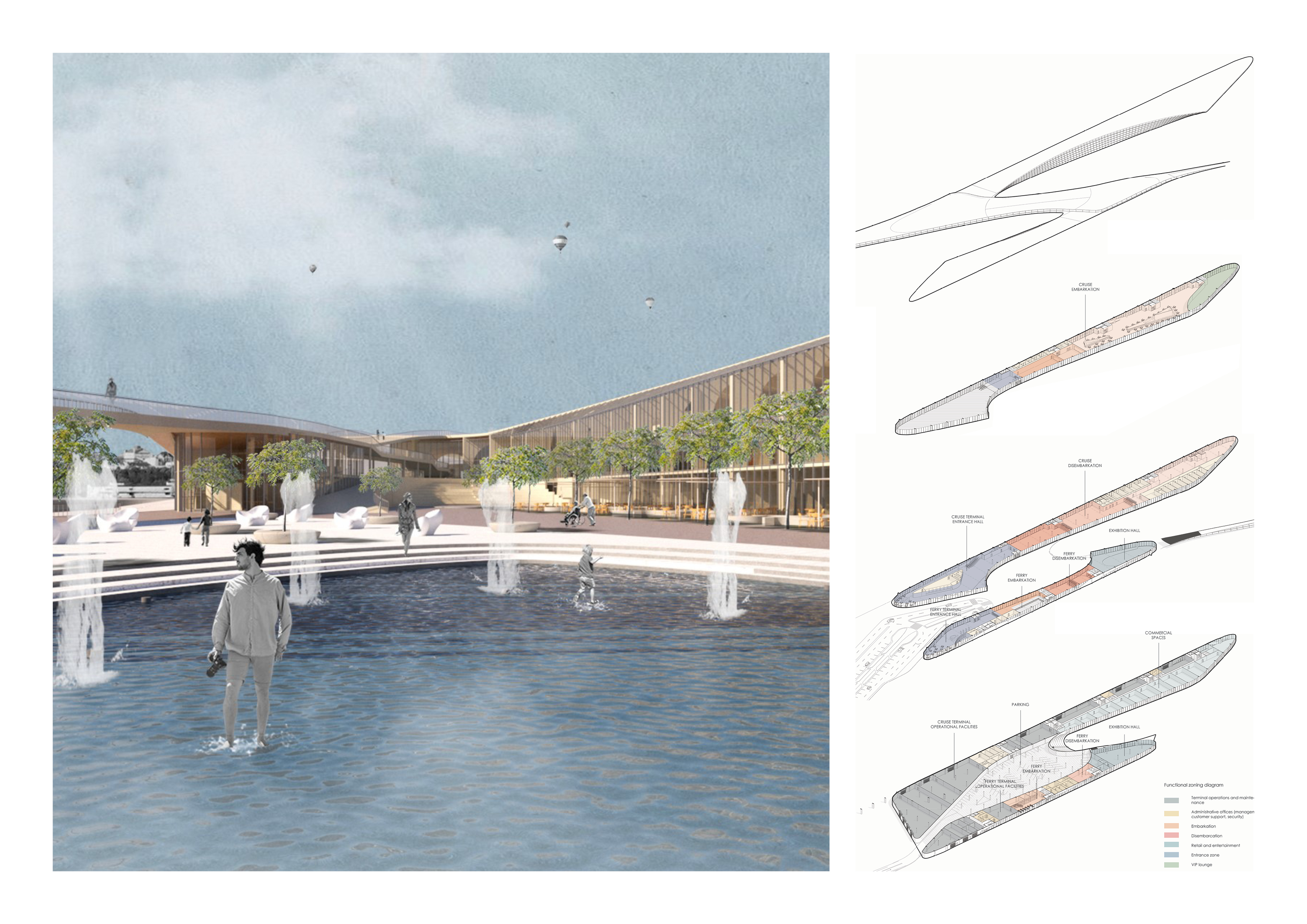


Connecting Architecture: Revitalization of Odesa’s Cruise Port
Revitalizing Odesa’s maritime identity
Program
Infrastructure
-
Labels
Port · Bridge
In Ukraine, public part of port infrastructure is quite overlooked from both architectural and urban development perspectives. This has led to a lack of spatial, structural, aesthetic, and social connectivity within the maritime transportation facilities. The assessment of Odesa's cruise terminal highlighted several problems: lack of connection between the terminal and the city, insufficient public recreational spaces, inadequate accessibility to the waterfront, and harsh vertical dominants that disrupt visual and compositional link between the city and water.
This revitalization strategy proposal responds to the disconnection caused by industrial infrastructure, the lack of public spaces, and the destruction of Odesa's Cruise Terminal in 2023. The goal is to reconnect the city to the waterfront while ensuring functionality, accessibility, and aesthetic cohesion. The design introduces a loop, starting as a bridge from the city center, transitioning into the terminal and descending into the main public space. It serves both as a physical structure and a symbolic concept, emphasizing connectivity between the city and the port. The building form is inspired by water patterns and the surrounding neoclassical architecture, creating a harmonious dialogue with the context. The complex is divided into 2 volumes for cruise and ferry terminals, addressing the specific needs of home-port and transit activities. It includes necessary facilities like parking, commercial spaces, and an amphitheater for public engagement. A key design challenge was to separate embarkation and disembarkation processes efficiently, while also handling large numbers of passengers, especially for transit cruises. The materials are chosen to reflect simplicity and neutrality, including wood, concrete, and metal, while focusing on water elements within the public space to enhance interaction with the sea. Overall, the project emphasizes the natural relationship between the city and the waterfront, aiming to create a revitalized and connected port that strengthens Odesa’s identity as a maritime city. The design bridges architecture and urbanism, demonstrating their interdependence and the potential for integrated, functional solutions.