-

Outside picture showing the volumetry and façade of the building
-
Interior of the courtyard
-
Entrance to the house and its connection with the communal walkpath
-
Interior of one of the units, showing the kitchen and its connection with the rest of the house
-
Interior of one of the housing units, showing the connection with the gallery
-
Connection to the communal green rooftop
-
Urban axonometry
-
Floor plan
-
Section from the green courtyard, showing the interior façade and the bi-oriented housing units
-
Type plan showing the aggregation of the units and the communal walkpaths
-
housing unit typologies
-
Construction detail of the façade, showing entrances and walkways
Community of Rooms - Glòries Block Building A
cierto estudio. Barcelona, Spain
-
Name of work in English
Community of Rooms - Glòries Block Building A
-
Name of work in original language
La Comunitat Habitacional - Illa Glòries Bloc A
Prize year
EUmies Awards 2026
-
Work Location
Barcelona, Spain
-
Studio
cierto estudio
EUmies Awards 2026 Nominees
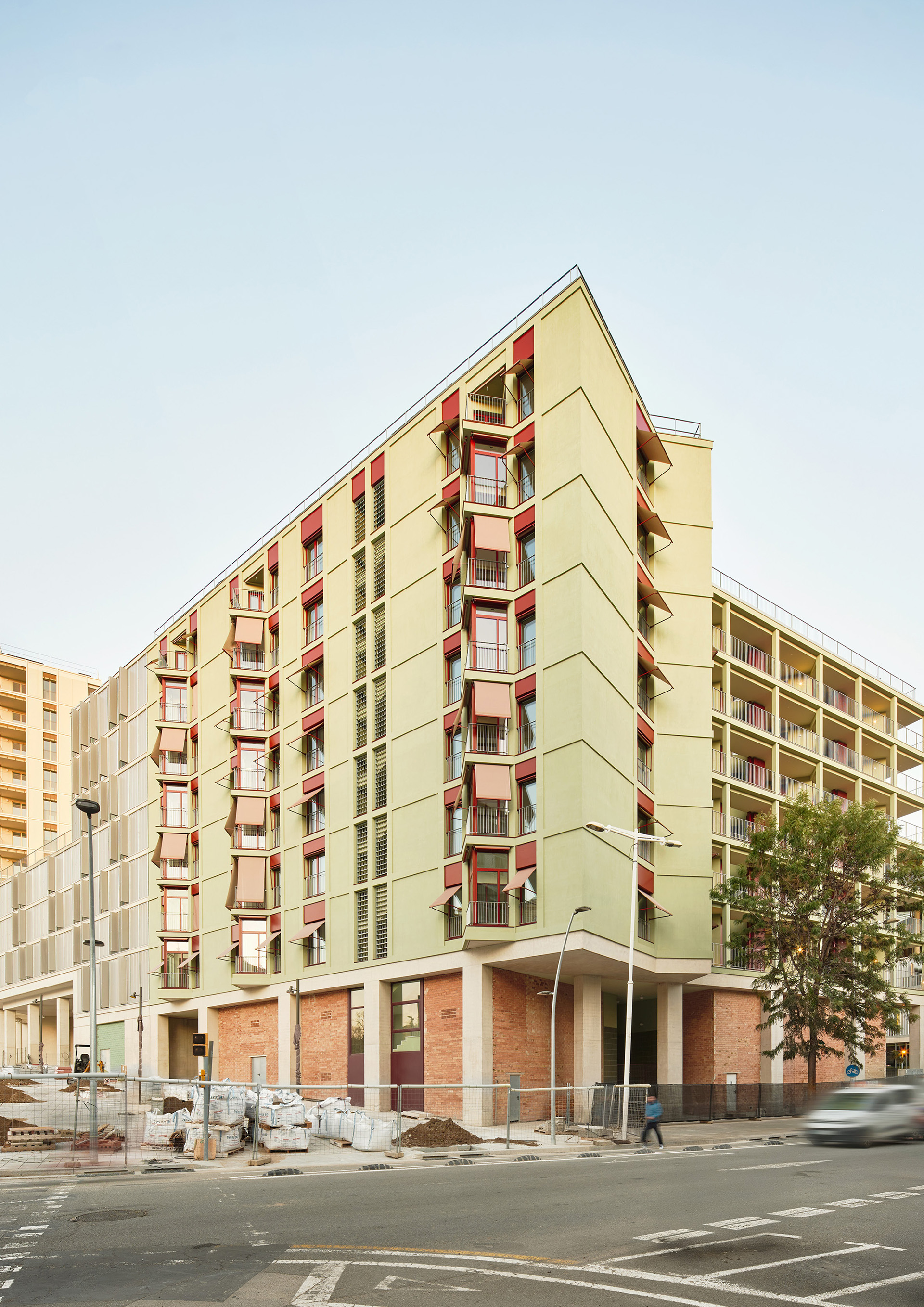


“Community of Rooms” is a collective housing project in Barcelona’s Eixample, combining flexibility, sustainability, and shared spaces. With 51 units, it promotes community life through courtyards, rooftop use, and adaptable layouts focused on inclusivity and a comunal life style.
Collaborators
Landscape: Beatriz Borque - Borque-Mariné; Landscape: Miquel Mariné - Borque-Mariné; Structure: Bernuz Fernández Arquitectes S.L.P; Installations: Eletresjota Tècnics Associats S.L.P; Construction management: Ángel Gil; Environmental: Societat Orgànica; Acoustics: Áurea Acústica; Collaborator (office): Franc Llonch Vilalta - Franc Llonch arquitectes
Program
Collective housing
-
Labels
Courtyard · Social
Site area
1398 m²
-
Client
Institut Municipal de l’Habitatge i Rehabilitació de Barcelona
Total gross floor
8371 m²
Cost
1135 €/m²
Illa Glòries extends Barcelona's Eixample grid through two volumes that frame a pedestrian passage connecting key city routes. The massing shapes two sheltered courtyards where residents gather. Building A provides 51 social housing units with exterior walkways linking flats to shared patios and roof terraces. The cross-laminated timber structure, one of Barcelona's first at this scale, reduces embodied carbon whilst enabling flexible, interconnected homes, demonstrating how sustainable construction can deliver adaptable, liveable urban housing.
Challenges included: integrating social housing into the dense Eixample grid, fostering community, ensuring long-term adaptability and meeting sustainability targets but remaining cost-effective. Our urban strategy prioritised cohesion across 4 volumes developed by different teams, maintaining continuity whilst creating permeability. This delivered a replicable model of affordable, sustainable housing addressing Barcelona's pressing needs. Internally, each flat is organised around equally sized rooms with a central, rotated space that multiplies connections and allows functions to evolve and adapt to changing family structures. We repositioned the kitchen from a hidden service space to a prominent location on the southern façade with optimal light and views. This placement recognises domestic work as central to home life, promoting a gender-sensitive approach whilst fostering interaction. The CLT structure enabled this flexibility whilst reducing embodied carbon.
The building uses a hybrid structure. It combines cross-laminated timber (CLT), floors, walls and façades; with metallic structure for the pathways, and reinforced concrete core for vertical circulation and stability. This approach reduces the building’s carbon footprint and shortens construction time. CLT is renewable, low in embodied energy, and contributes to thermal efficiency. Façade finishes and materials are selected for durability and low maintenance, using ventilated systems and treated wood. The building meets NZEB standards, integrating passive design, solar energy, and natural ventilation. Maintenance should focus on preserving timber elements through regular inspection and treatment, ensuring façade systems remain ventilated and intact, and maintaining energy systems (solar panels, HVAC) for long-term performance and efficiency.