COMMUNITY ARCHITECTS. Office of Citizen Assistance at the Raval in Barcelona.
ETSAB-UPC (Escola Tècnica Superior d'Arquitectura de Barcelona - Universitat Politècnica de Catalunya). Barcelona, Spain
-
Name of work in English
COMMUNITY ARCHITECTS. Office of Citizen Assistance at the Raval in Barcelona.
-
Name of work in original language
ARQUITECTOS DE CABECERA. Oficina de Atención al Ciudadano en el Raval de Barcelona.
Prize year
EUmies Awards 2017
-
Work Location
Barcelona, Spain
-
Studio
ETSAB-UPC (Escola Tècnica Superior d'Arquitectura de Barcelona - Universitat Politècnica de Catalunya)
EUmies Awards 2017 Nominees


Arquitectos de Cabecera (AC) is a methodology born out of an academic project at ETSAB. Working on the city, focusing on collective housing, the methodology aims to bring closer the figure of the architect to the citizen. It does so by addressing their needs and demonstrating the architect's utility in society, in the midst of an economic and social crisis.
Program
Social welfare
-
Labels
Community
Completion
2015
AC is the result of architecture students questioning the university teaching model, whilst also addressing the following shortcomings: In academia, there is a lack of contact with reality and its challenges. In the social context, there is a general housing emergency. In the profession, there is a crisis within the practice of architecture. In response, we aim to empower students and to act on the existing city as a field of work. Through multidisciplinary teams, and in direct collaboration with other entities of the neighborhoods, the approach to the collective housing focuses on the subject instead of the object. It acts on the housing in order to transform the city from the inside out. The AC methodology aims to be exportable to other universities and administrations as an open source tool.
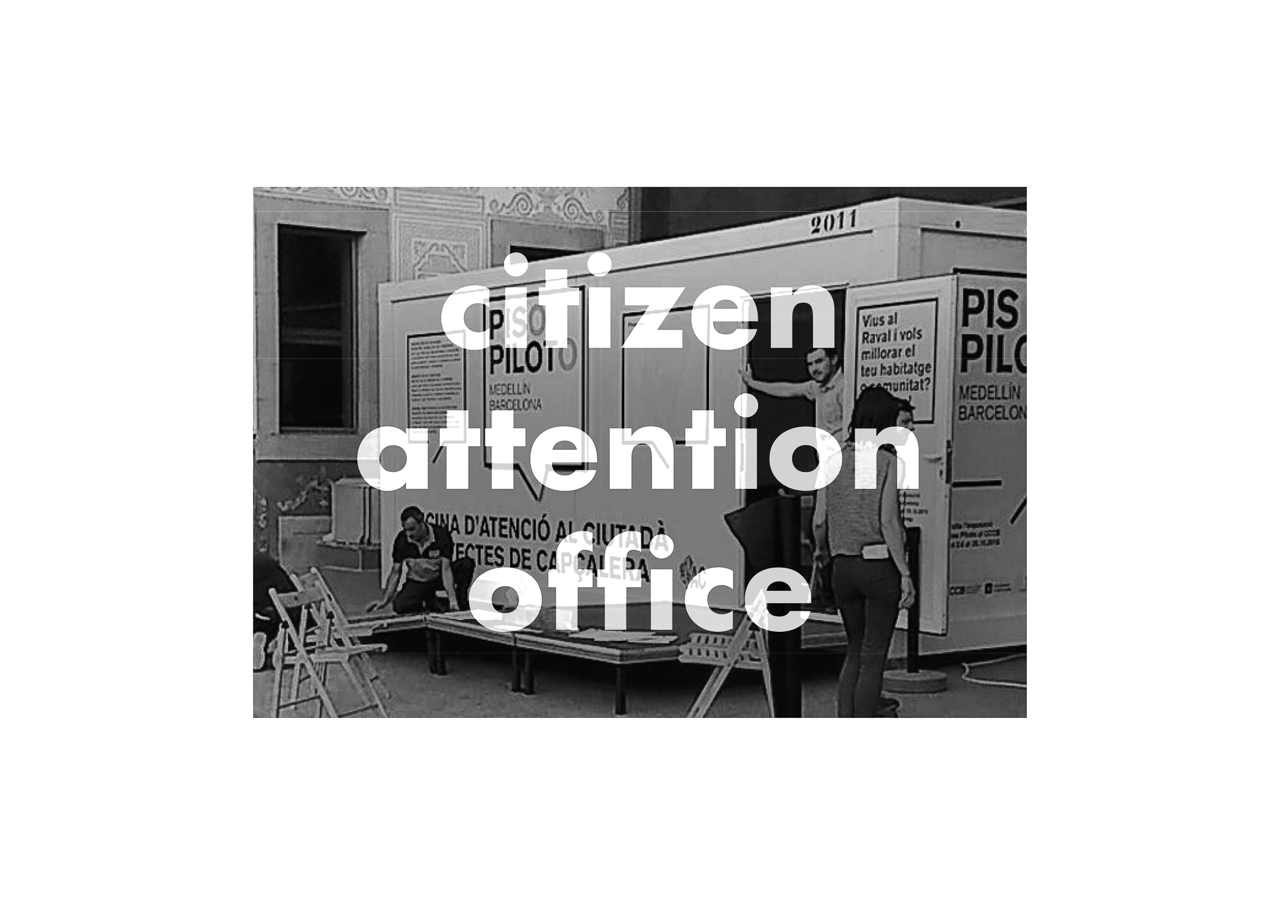
Two actions take place in order to put the AC methodology into practice: the setting up of the Citizen Attention Office, on the street level. And getting into contact with the entities and associations that already work within the neighborhood. These two actions allow us to be visible and engage the case studies. At the 2015 exhibition of 'Piso Piloto', the Citizen Attention Office was first set up. It bore out of the debate tackling the 'right to the housing' and 'right to the city'. It took the Raval of Barcelona as a field of work. At the office, five case studies of different scales and conditions were engaged: from the dwelling, to the factoryhouse, and from the rental to the occupation. The neighbours opened their doors to the students. The protocol then started with taking the cartography of a person and their habitation: everything that happens inside the house, activities and objects; and the relation of the user with their neighbourhood, through their routes and habits. It then continues with a diagnosis based on the gathered data, identifying the inhabitant's needs and its ability to implement the proposal.
Can 60. An achievement of the AC methodology . One of the cases at the Citizen Attention Office was Can 60; a factory-house. In the past 30 years, there coexisted different socio-cultural and artistic entities, that were very attached to the social fabric of the neighborhood and the city. In 2015, an investment fund bought the estate and started a process of contract termination. It was tasked to develop the building into luxury apartments. The Foundation Tot Raval contacted AC to prevent the eviction. The raised proposal followed two guidelines: the protection of the object and the protection of the subject and its activities. Both issues were included in the Project Report that the collective 'Can 60' and the Council used at the negotiations with the property. Resulting from this process, there was a re-evaluation of the heritage value of the factory-houses of Raval, freezing all their construction licenses. This was on the city scale. On the other hand, there was on the neighborhood-scale, the purchase of the building by the council. The factory-house Can 60 is the proof of the utility of the AC methodology. Can 60 still continues to enrich the neighborhood and the city.