-

Main entrance to the columbaria complex, aligned with the cemetery’s main compositional axis
-
Bird’s-eye view of the columbarium chambers ensemble (view from the north side)
-
Central square, designed as intimate space for funeral rites
-
View into the columbarium chamber
-
Aerial top view of the columbaria
-
Close-up view of the chamber’s wall clad in local sandstone
-
Concept/urban diagram
-
Site plan
-
Roof plan
-
Floor plan
-
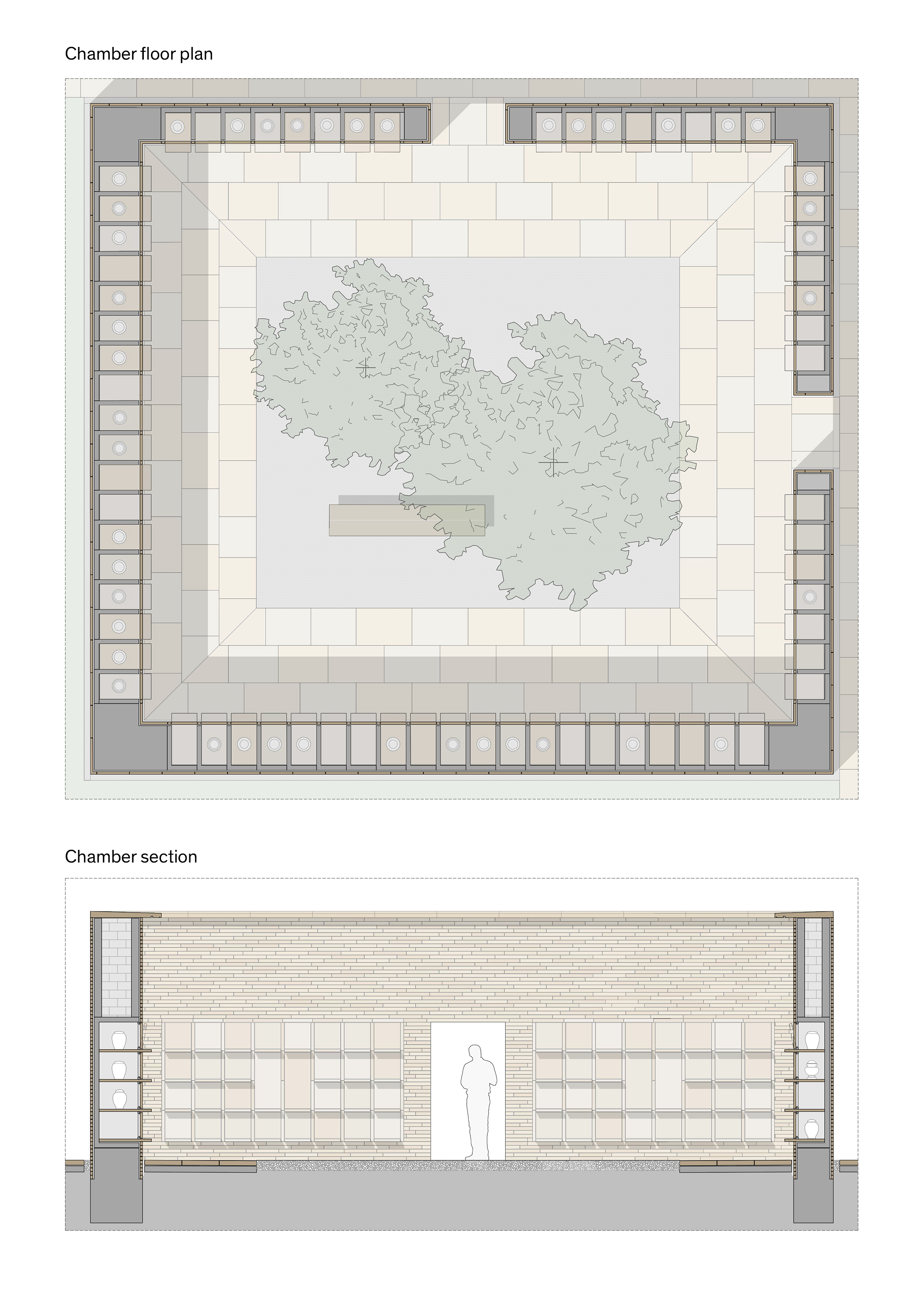
Chamber floor plan and section
-
Chamber wall components - axonometric view
Columbaria at the Municipal Cemetery
BDR ARCHITEKCI. Radom, Poland
-
Name of work in English
Columbaria at the Municipal Cemetery
-
Name of work in original language
Zespół kolumbariów na Cmentarzu Komunalnym w Radomiu
Prize year
EUmies Awards 2026
-
Work Location
Radom, Poland
-
Studio
BDR ARCHITEKCI
EUmies Awards 2026 Nominees



A new columbarium complex in Radom redefines traditional burial space with 2,000 niches, intimate courtyards, and local materials. Rooted in respect and sustainability, it reclaims neglected land at the cemetery’s center, creating a meaningful space for remembrance and future funeral rites.
Collaborators
Structure: TMJ Projekt; Installations: Joanna Szczudlik; Installations: Jarosław Maleńczuk; Landscape: Łukasz Kowalski - La.Wa Architektura Krajobrazu
Program
Funerary
-
Labels
Cemetery
Site area
7400 m²
-
Client
Cmentarz Komunalny w Radomiu
Total gross floor
516 m²
Cost
2900 €/m²
Located in Radom’s municipal cemetery, the project replaces the existing sprawl with a centralized, 2,000-niche columbarium complex. The design preserves the necropolis original axial layout, using it to organize the new columbarium and central square. Timeless materials and greenery define the structure’s contextual, respectful presence. Local character is evident in almost every element of the completed building: the sandstone, the floor slabs and, above all, the work and effort of local stonemasons and craftsmen, whose contribution was of great importance to the overall project.
Project addressed two challenges: halting cemetery expansion into nearby forests and revitalizing its neglected center. The burial plan (2,000 niches) has been divided into smaller chambers that create intimate spaces, supporting focus and finding your loved one's resting place. The chambers were designed as blocks of varying heights arranged around a central focal point - the ecumenical square. The tallest on them is formed by the existing pre-burial house, with a wall-enclosed courtyard. The central square is located on the site of the unrealized chapel - on the main axis of the cemetery. This intimate space, closed off by columbarium blocks, may become a place for future funeral rites and an ecumenical gathering space for the entire cemetery. Greenery plays an important role here, designed in the form of edged fields planted with creeping shrubs. Fifty Scots pines, a tree that grows in the neighboring woods, have also been planted.
Both the niches for the columbarium urns and its basic structure were made of precast concrete elements, supported by reinforced concrete footing strip. Attics of varying heights were built on top, so that the columbaria chambers differ not only in the proportion of the courtyards but also in height. From the outside, the chambers and the pre-burial house with a rebuilt facade were clad with oblong sandstone blocks from local quarries. Sandstone was also used to make shelves and plaques with concealed fixtures that allow niches to be opened and closed. The floor slabs were designed and constructed with an individualized finish at a Radom-based concrete plant. The design is complemented by solid wood benches, a water intake point and a decorations made of raw brass, which will patina over time. A unified typeface for the signs and burial boards was introduced. Lighting was an important design element. Lines of light in the floor illuminate the passages between the columbarium blocks.